
Hello and welcome back to your course on advanced performance marketing.
In our last lesson, we developed a framework for segmenting products based on their profit margins, creating distinct campaigns for different profitability "buckets." This was a crucial step in aligning ad spend with bottom-line impact.
Today, we take the next logical step. Now that you have multiple, strategically segmented campaigns, how do you manage their bidding and budgeting as a unified whole? This lesson will equip you to critique a portfolio bidding strategy designed to optimize across multiple campaigns or business units.
For you, moving into a strategic leadership role, this is a vital skill. It’s about moving beyond optimizing individual campaigns (a local optimum) to orchestrating your entire marketing investment for the best possible overall result (a global optimum). You'll learn the questions to ask and the criteria to use when your team proposes or manages such a strategy.
1. The Strategic Imperative: Beyond Campaign Silos
Managing campaigns in isolation is a common practice, but at an enterprise scale, it becomes a losing game. The complexity of modern customer journeys and the sheer volume of data make manual, campaign-by-campaign optimization inefficient and often counterproductive.
To understand why, let's explore the core challenges that portfolio bidding aims to solve.
Beyond Bids: Building Enterprise Search Performance with ...
The article 'Beyond Bids' from Brainlabs provides an excellent high-level overview of the shift from outdated manual bidding to modern enterprise-level strategies. It perfectly frames the 'why' behind portfolio bidding.
Please read the first section, 'The Old Playbook: The Enterprise Bidding Dilemma'. Pay close attention to the three core problems it identifies: The Scale Problem, Data Disconnect, and The Myth of Control.
As the article highlights, the traditional approach creates three major issues:
- Scale Problem: Manual management is simply too slow and resource-intensive.
- Data Disconnect: Siloed campaigns prevent the algorithm from seeing the full picture, leading to suboptimal decisions.
- The Myth of Control: A focus on granular, keyword-level bids creates a "local" optimum, preventing the entire portfolio from reaching its full potential.
Portfolio bidding is the solution to this dilemma. It bundles multiple campaigns or ad groups together, allowing an automated bidding algorithm to manage them collectively toward a single, shared performance goal.
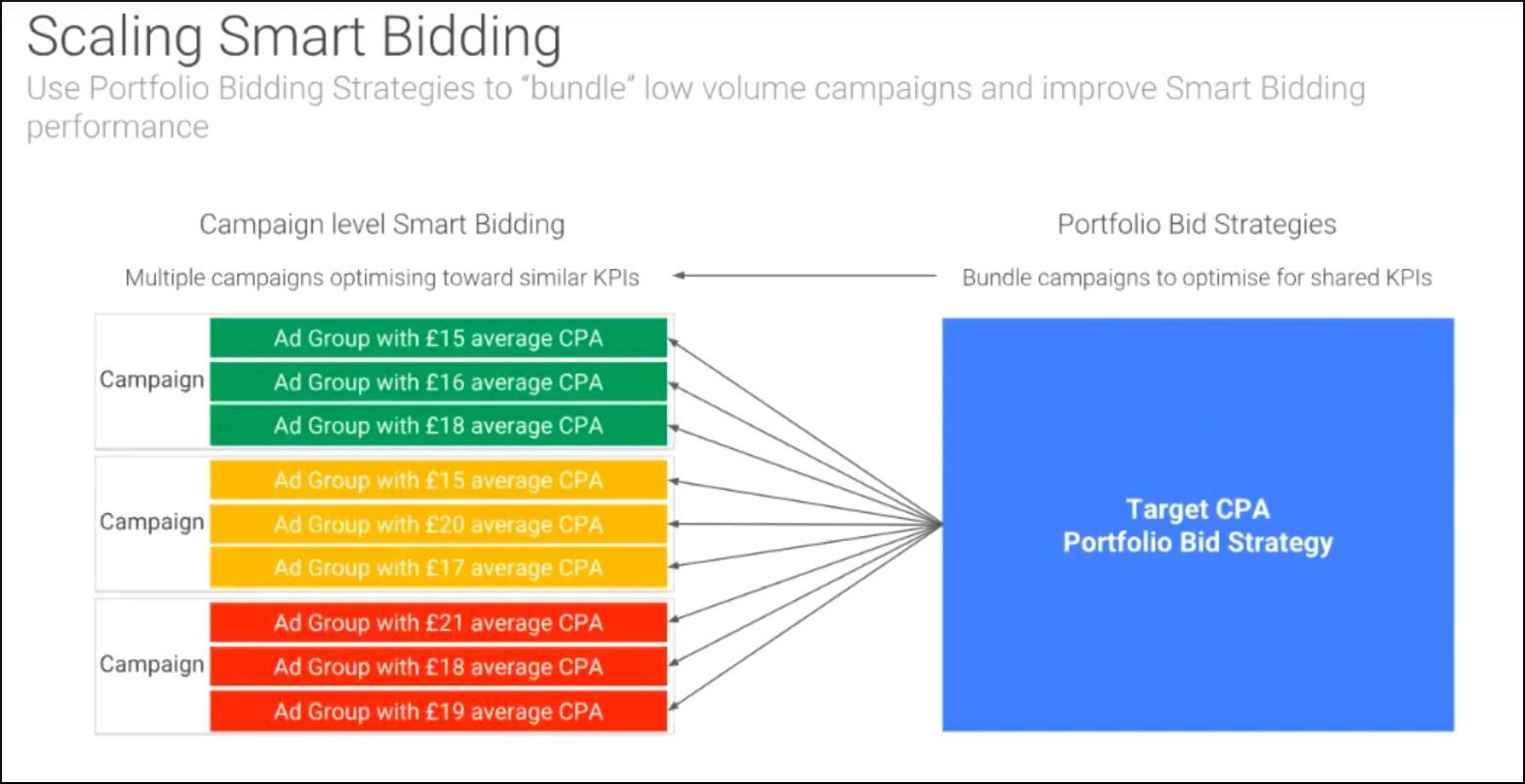
This approach allows the algorithm to make trade-offs. For example, it might accept a slightly higher CPA in one campaign if it knows it can achieve a much lower CPA in another, as long as the average CPA across the entire portfolio meets your target.
2. Core Components: Portfolio Strategies and Shared Budgets
Now that we understand the "why," let's look at the core components. You are already familiar with bidding strategies like Target CPA and Target ROAS at the campaign level. Portfolio strategies use the same logic but apply it across a group of campaigns.
Save Time And Improve Your Data Analysis Using Portfolio Bid Strategies in Google Ads
This video from Solutions 8 provides a quick, practical walkthrough of the different portfolio bid strategies available in Google Ads and how to create one. This will give you a concrete sense of what your team would be implementing.
Watch the first three minutes (00:00 - 02:51) for a quick overview of the main portfolio bid strategy types. Then, skip to the section from 05:02 to 06:45, where the presenter discusses the key strategic benefit: consolidating data for better analysis and algorithmic performance.
A portfolio bid strategy on its own is powerful, but it becomes even more effective when combined with a shared budget.
- Portfolio Bid Strategy: Manages bids within an auction to hit a performance target (e.g., Target ROAS).
- Shared Budget: Manages budget allocation between campaigns to maximize performance.
Combining these two tells the platform: "Here is a group of campaigns with a single goal and a single pool of money. Spend this money as intelligently as possible across these campaigns to get the best overall result."
Google Ads Shared Budgets and Portfolio Bid Strategies
The video 'Google Ads Shared Budgets and Portfolio Bid Strategies' by Surfside PPC clearly explains this powerful combination. It demonstrates the best practice of using both tools together for maximum effect.
Please watch the section from 02:36 to 04:39. Focus on how a portfolio bid strategy is created and simultaneously linked to a new shared budget, and the explanation of why this allows Google to optimally allocate spend to the highest-performing campaigns.
3. A Framework for Critiquing a Portfolio Strategy
As a leader, your role isn't to set up these strategies yourself, but to evaluate them. When your team presents a portfolio strategy, you need a mental checklist to assess its soundness. Here is a five-point framework for your critique, drawing on common industry best practices and pitfalls.
How to Use Portfolio Bidding and Campaign Groups ...
The article 'How to Use Portfolio Bidding and Campaign Groups' from Optmyzr provides a very clear, actionable guide on when to use portfolios and, crucially, what mistakes to avoid. We will use its insights to build our critique framework.
Please read the sections 'When to use Portfolio Bidding?', 'When not to use Portfolio Bidding?', and 'Here are some common mistakes to avoid'. These sections form the basis of our evaluation framework.
Based on these best practices, here are the five key questions you should ask when critiquing a portfolio bidding strategy:
1. Is there strong strategic alignment?
- The Question: Do all campaigns within the portfolio share the exact same business objective and performance target (e.g., Target CPA, Target ROAS)?
- Why it Matters: As the Optmyzr article points out, mixing campaigns with different goals (e.g., a brand awareness campaign with a lead generation campaign) confuses the algorithm. The portfolio should be a collection of campaigns that are truly comparable and work towards a single definition of success.
- Red Flag: A portfolio containing a
Maximize Clickscampaign alongside aTarget ROAScampaign.
2. Is there sufficient data volume?
- The Question: When pooled together, do the campaigns in the portfolio generate enough conversion data (e.g., >30-50 conversions per month) for the algorithm to learn effectively?
- Why it Matters: The primary benefit of a portfolio is data aggregation. If the combined volume is still too low, the algorithm won't have enough signal to make smart decisions.
- Red Flag: A portfolio of five brand-new, low-traffic campaigns with zero historical conversions.
3. Are the constraints appropriate?
- The Question: If "guardrails" like max/min bid limits are being used, what is the justification for them? Are they too restrictive?
- Why it Matters: Setting a max CPC cap that is too low can completely hamstring a smart bidding algorithm, preventing it from bidding what's necessary to win high-value auctions. As the Solutions 8 video noted, this is a "wrench in the gears." While they can prevent outlier spending, they must be set with care.
- Red Flag: A
Target CPAportfolio with a max CPC limit set just 10% above the average CPC. This offers no room for the algorithm to maneuver.
4. Is performance evaluated holistically?
- The Question: Is the team measuring success at the overall portfolio level, or are they still getting distracted by the performance of individual campaigns within it?
- Why it Matters: The very purpose of a portfolio is to accept that some campaigns may perform slightly below target to allow others to perform significantly above it. Pausing a campaign because its individual ROAS dipped might harm the portfolio's overall performance.
- Red Flag: A team member recommending pausing a campaign within a successful portfolio solely because its CPA is 5% higher than the portfolio's average.
5. Is the budgeting logic optimized?
- The Question: Is the portfolio strategy paired with a shared budget to allow for dynamic spend allocation?
- Why it Matters: A portfolio strategy without a shared budget is a major missed opportunity. The algorithm can adjust bids, but it can't move money from an underperforming campaign to a high-potential one.
- Red Flag: A portfolio of ten campaigns, each with its own separate daily budget, where some are consistently underspending while others are budget-capped.
Test your understanding!
Your Head of Paid Search presents a new portfolio strategy for your e-commerce business. The details are:
- Name: "Q3 Growth Portfolio"
- Goal:
Target ROASof 400%. - Campaigns Included:
Brand Search(Historical ROAS: 800%)Non-Brand General Search(Historical ROAS: 350%)Shopping - Top Sellers(Historical ROAS: 450%)
- Constraints: A maximum CPC limit has been set across the portfolio to "control costs."
- Budgeting: Each campaign retains its individual daily budget.
Using the five-point critique framework, identify at least two potential flaws in this strategy and explain why they are problematic.
Show answer
Here are two significant flaws based on our framework:
-
Flaw: Lack of a Shared Budget.
- Critique Point: #5 - Is the budgeting logic optimized?
- Explanation: By keeping individual daily budgets, the strategy prevents the algorithm from making the most important optimization: shifting spend dynamically. For example, if the
Shopping - Top Sellerscampaign finds a surge of profitable traffic, it might hit its budget cap and stop serving ads. Meanwhile, theNon-Brand General Searchcampaign might be struggling to spend its budget on a slow day. A shared budget would automatically reallocate funds from the non-brand campaign to the shopping campaign, maximizing the portfolio's total return.
-
Flaw: Unjustified Constraints (Max CPC Limit).
- Critique Point: #3 - Are the constraints appropriate?
- Explanation: While "controlling costs" sounds reasonable, adding a max CPC limit to a
Target ROASstrategy is often counterproductive. TheTarget ROASalgorithm already factors in cost vs. potential return value. The max CPC limit acts as an artificial ceiling that can prevent the algorithm from bidding high enough to win extremely valuable, high-ROAS conversions, thus lowering the portfolio's overall potential. The question to ask your team is, "What data suggests this CPC cap is necessary and won't hurt our overall ROAS?"
An additional point for discussion could be including the Brand Search campaign. While not strictly wrong, its performance (800% ROAS) is so different from the others that it might skew the portfolio's average and mask issues in the non-brand campaign. Some strategists prefer to keep brand campaigns separate to get a cleaner read on non-brand performance.
Conclusion
Mastering the art of critiquing a portfolio bidding strategy is a hallmark of a modern marketing leader. It signifies a shift from tactical execution to strategic oversight. By focusing on the "global optimum," you guide your team and the platform's algorithms toward what truly drives the business forward.
Key Takeaways:
- Think Holistically: The goal is to optimize the entire portfolio, not individual campaigns. Accept trade-offs between campaigns to achieve a better overall result.
- Use the Critique Framework: When evaluating a portfolio strategy, systematically check for 1) Strategic Alignment, 2) Data Sufficiency, 3) Appropriate Constraints, 4) Holistic Evaluation, and 5) Optimized Budgeting.
- Combine Portfolios with Shared Budgets: This is a key best practice that unlocks the full potential of automated optimization by allowing for dynamic budget allocation.
- Your Role is Strategic Communication: As the Brainlabs article concludes, your job is to define the business objectives and translate them into clear signals for the algorithm. You are the "strategic communicator," not the manual operator.
Preview of the Next Lesson:
We've now established how to group campaigns into portfolios for optimal performance. The natural next question is, "What happens when we want to grow?" In our next lesson, we will evaluate the trade-offs of budget scaling strategies on platform algorithm performance and efficiency. We'll explore how to increase your investment without breaking the delicate balance the algorithms have learned, a critical challenge in any growing business.