
Hello and welcome back to your course on advanced performance marketing.
In our last lesson, we focused on optimizing performance across campaigns by critiquing portfolio bidding strategies. We learned how to group campaigns to achieve a "global optimum" for your marketing efforts. Now, we'll address the next critical question a marketing leader faces: "How do we grow?"
This lesson will equip you to evaluate the trade-offs of budget scaling strategies on platform algorithm performance and efficiency. Scaling ad spend is a key lever for business growth, but it's fraught with risk. Simply increasing the budget often leads to diminishing returns—higher costs and lower profitability. Your role as a strategic leader is to guide your team in scaling spend intelligently, balancing the desire for growth with the need for efficiency. This involves understanding how platform algorithms react to budget changes and setting realistic expectations with stakeholders.
1. The Fundamental Trade-Off: The Law of Diminishing Returns
Before we dive into specific scaling tactics, we must understand the core principle that governs them: the law of diminishing returns. In marketing, this law states that as you increase investment in a channel, the incremental return on that investment will eventually decrease. A dollar spent to acquire your 100th customer is almost always more efficient than a dollar spent to acquire your 10,000th.
To understand why this happens in digital advertising, let's explore how platform algorithms work.
Understanding the Law of Diminishing Returns in Digital Marketing
The article 'Understanding the Law of Diminishing Returns in Digital Marketing' by Talking Stick Digital provides an excellent explanation of this core concept. It clarifies why simply spending more money forces algorithms into less efficient territory.
Please read the introduction and the section that begins 'At the heart of the matter lies the nature of audience targeting.' Focus on how algorithms expand from high-intent 'low-hanging fruit' to broader, more expensive audiences as the budget increases.
As the article explains, when you scale your budget, you force the platform's algorithm to find more people to show your ads to. It starts with the most likely converters but must eventually expand to:
- Broader, less relevant keywords or audiences.
- More competitive auctions, driving up costs.
- Users who are further away from making a purchase decision.
This trade-off between spend and efficiency is visualized perfectly by a diminishing returns curve.
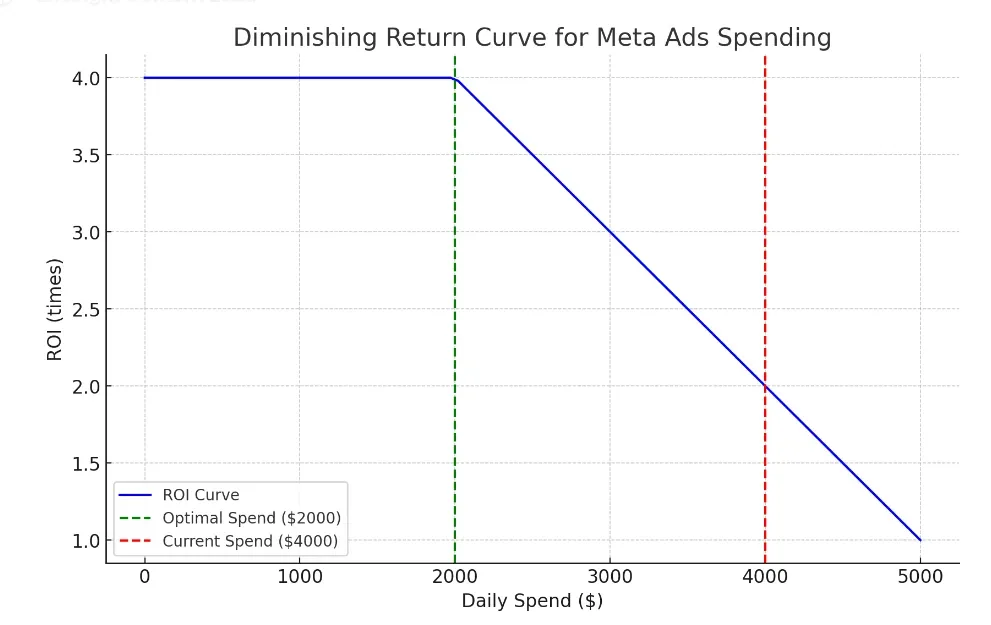
Your goal as a strategist isn't to eliminate diminishing returns—that's impossible. It's to manage them effectively, pushing the point of diminishing returns out as far as possible and scaling in a way that respects the algorithm's learning process.
2. Common Scaling Strategies and Their Trade-Offs
There are several ways to increase budgets, each with a different impact on platform algorithms and performance stability. Let's examine the most common strategies.
A. Vertical Scaling: The Gradual "Stairstep" Approach
Vertical scaling means increasing the budget on your existing, high-performing campaigns. The most recommended method for this is a gradual, controlled approach.
How to Scale Google Ads Campaigns in 2025
This video from Grow My Ads, 'How to Scale Google Ads Campaigns in 2025', introduces a powerful mental model for this strategy: the 'stairstep effect'. It explains how to work with Google's algorithm, not against it.
Please watch from the beginning to 04:13. Pay close attention to the 20% budget increase rule, the subsequent 'learning phase', and the re-optimization cycle. This is the core of stable scaling.
The "stairstep" method involves:
- Increasing budget by a small increment, typically 15-20%.
- Waiting for 1-2 weeks for the algorithm to exit its "learning phase" and stabilize at the new spend level.
- Evaluating performance to ensure efficiency (CPA/ROAS) has returned to an acceptable level.
- Repeating the process.
This gradual approach respects the fact that any significant budget change forces the algorithm to re-learn. A small change allows it to adapt without causing wild performance swings.
- Trade-Off: This is the safest but slowest method. You trade speed for stability and predictability. It's ideal for sustainable, long-term growth.
B. Horizontal Scaling: The Aggressive Duplication Approach
Horizontal scaling involves duplicating successful campaigns or ad sets to target new audiences, use new creatives, or simply "reset" the algorithm's learning on a larger budget.
3 Ways to Scale Facebook Ads in 2025
The video '3 Ways to Scale Facebook Ads in 2025' by Nick Theriot clearly outlines three distinct scaling methods for Meta Ads, including duplication. It offers a candid look at the pros and cons.
Watch the section on the 'duplication method' (00:11 - 01:10) and the section on '20% budget increases' (02:41 - 04:20). Notice how the presenter contrasts the high-risk/high-speed nature of duplication with the stability of gradual increases.
As the video highlights, duplication can be a way to scale spend quickly. However, it comes with significant risks:
-
Auction Overlap: Your own duplicated campaigns can start competing against each other, driving up costs for everyone.
-
Inconsistent Performance: A campaign that was profitable at $100/day is not guaranteed to be profitable when duplicated at $1,000/day.
-
Increased Management: More campaigns mean more complexity and overhead.
-
Trade-Off: You trade stability for speed. This method can be useful when you need to increase spend very quickly (e.g., for a short promotional period), but it's a high-risk strategy that can lead to wasted budget.
3. A Strategic Framework for Evaluating Scaling Decisions
As a leader, you won't be in the weeds adjusting budgets daily. Your role is to set the strategy and ask the right questions to ensure your team is scaling responsibly. Here is a framework to guide your evaluation.
How to Scale Meta Ads Without Losing ROAS – Proven Tips
The article 'How to Scale Meta Ads Without Losing ROAS' from DWAO provides a fantastic checklist of prerequisites and strategies for scaling effectively. We'll use its insights to build our evaluation framework.
Please read the sections 'Set the Right Foundation Before Scaling', 'Smart Budget Scaling Strategies', 'Creative Scaling Is Non Negotiable', and 'Common Scaling Mistakes to Avoid'. These sections cover the key strategic considerations beyond just changing the budget number.
Based on these principles, here are the key questions to ask your team when they propose a scaling plan:
1. Are the Foundations Ready for Scale?
- The Question: "Before we increase the budget, can you confirm our conversion tracking is solid and that these campaigns have demonstrated stable, profitable performance at their current spend?"
- Why it Matters: As the DWAO article emphasizes, scaling amplifies existing problems. If your tracking is faulty or the campaign is already unprofitable, spending more will only accelerate your losses.
2. What's Our Scaling Velocity and Why?
- The Question: "Are we planning a gradual 'stairstep' increase or a more aggressive horizontal scaling approach? What is the business justification for this speed, and have we acknowledged the associated risks?"
- Why it Matters: This question forces an explicit discussion about the trade-off between speed and stability. An aggressive plan might be justified by a major product launch, but the risk of inefficiency must be a known part of the plan.
3. How Are We Managing the Learning Phase?
- The Question: "What is our plan for the temporary drop in efficiency during the algorithm's learning phase after we increase the budget? How long will we wait before making further changes, and how will we communicate this expected volatility to stakeholders?"
- Why it Matters: This shows you understand how the platforms work. It prevents panicked reactions and premature changes when the inevitable short-term CPA increase occurs.
4. Is Our Creative and Audience Strategy Scaling with Our Budget?
- The Question: "A higher budget means higher ad frequency and audience saturation. What is our plan for introducing new creatives and expanding to new audiences to maintain performance?"
- Why it Matters: Creative fatigue is a primary cause of declining ROAS when scaling. A budget scaling plan without a corresponding creative refresh plan is incomplete and destined to fail.
Test your understanding!
Your e-commerce team runs a Meta campaign that is performing very well, generating a 5x ROAS on a $500/day budget. The Head of Sales wants to capture more demand and has requested you increase the budget to $2,000/day immediately to hit a monthly target.
Based on what you've learned, identify two major risks of this immediate jump. Then, propose an alternative, more controlled scaling strategy to your Head of Sales, explaining the rationale.
Show answer
Two Major Risks:
- Disrupting the Learning Phase: Jumping from $500 to $2,000 a day (a 300% increase) will shock the algorithm. This will almost certainly trigger a prolonged and volatile learning phase, causing the ROAS to drop significantly in the short term, potentially below a profitable level. The system won't have time to adapt gracefully.
- Rapid Audience Saturation and Creative Fatigue: At 4x the budget, the same audience will see the same ads much more frequently. This will quickly lead to ad blindness and diminished engagement, causing efficiency to plummet. The existing creative and audience strategy is not built for that level of spend.
Alternative Strategy Proposal:
"I agree we should scale this successful campaign to capture more sales. However, increasing the budget by 300% overnight is very risky and will likely make the campaign unprofitable in the short term, defeating our goal.
Instead, I propose a 'stairstep' scaling approach. We will increase the budget by 20% (to $600/day) today. We'll let the campaign stabilize for a few days to a week. If ROAS remains strong, we will repeat this 20% increase. While this is slower, it's a much more predictable and sustainable way to grow spend without sacrificing the profitability we've worked hard to achieve. In parallel, my team will begin developing new creatives and testing new audiences to support these higher spend levels and prevent fatigue."
This response shows strategic thinking, manages expectations, justifies the decision with algorithmic principles, and provides a clear, actionable alternative.
Conclusion
Evaluating budget scaling strategies is a core competency for any modern marketing leader. It requires moving beyond the simple desire for "more" and embracing a nuanced understanding of the trade-offs between volume and efficiency. By working with the platform algorithms instead of against them, you can guide your organization toward growth that is both significant and sustainable.
Key Takeaways:
- Diminishing Returns are Unavoidable: Scaling always involves a trade-off between volume and efficiency. Your job is to manage this, not ignore it.
- Gradual Scaling is Safe Scaling: The "stairstep" method of small, incremental budget increases (15-20%) followed by a stabilization period is the most reliable way to grow spend while maintaining profitability.
- Aggressive Scaling is High-Risk: Strategies like campaign duplication can increase spend quickly but come with major risks of inefficiency and instability. Use them cautiously and with clear justification.
- Ask Strategic Questions: Use the evaluation framework to probe your team's scaling plans, focusing on foundations, velocity, management of the learning phase, and creative strategy.
Preview of the Next Lesson:
Now that you understand how to scale your own budgets and manage internal performance, the next logical step is to understand how your efforts stack up against the competition. In our next lesson, we will learn how to use auction insights reports to formulate competitive positioning strategies. This will help you understand how your increased spend is affecting your visibility and share of voice in the marketplace.