
Hello! Welcome back to your course on advanced performance marketing.
In our last lesson, we established the crucial link between high-level business goals and the bidding targets you set for your teams. We explored how to translate objectives like profit margin and market share into concrete metrics like Target CPA and Target ROAS, and we introduced Value-Based Bidding (VBB) as the strategic framework to manage this.
Today, we will build directly on that foundation. This lesson will equip you to develop a framework for segmenting products or services by margin to inform differentiated bidding targets. This is where the strategic theory of VBB meets tactical execution. As a marketing leader, mastering this skill allows you to steer your advertising budget with surgical precision, ensuring you invest most heavily in what truly drives profit, not just revenue.
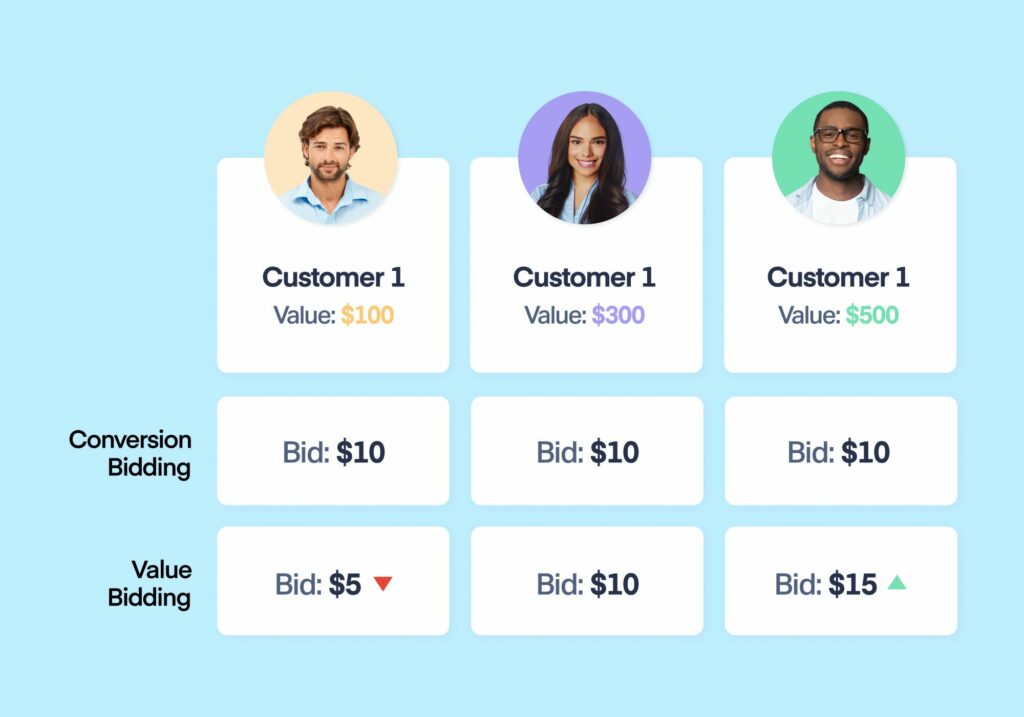
Let's begin by quickly revisiting the core idea from last lesson with this visual:
1. The Foundation: Calculating Profit Margin
You can't segment by profit if you don't know your profit. While your finance team will have the official numbers, you need a practical understanding of the components to guide your marketing strategy. The goal is to move beyond revenue-focused ROAS (Return on Ad Spend) to profit-focused POAS (Profit on Ad Spend).
Let's watch a video that breaks down the calculation of profit margin in an e-commerce context.
How to Calculate Your Ecommerce Profit Margin (Free Template)
The video 'How to Calculate Your Ecommerce Profit Margin' provides a clear, practical guide to the essential calculations. Pay close attention to the distinction between gross profit and net profit, and how variable costs are handled.
Please watch the following sections: Gross Profit Calculation (04:22 - 07:17): Focus on how Gross Profit is calculated by subtracting the Cost of Goods Sold (COGS) from sales. Fixed vs. Variable Expenses (07:17 - 12:02): Understand the difference and why variable costs (like shipping and payment fees) are critical for our marketing calculations. From Profit to Bidding Targets (14:13 - 18:24): See how the profit calculations are used to determine breakeven ROAS and target ROAS.
The video underscores a key formula for POAS mentioned in the resource "Mastering POAS® in Google Ads":
Where Gross Profit accounts for COGS and other variable order costs (shipping, payment fees, etc.). A POAS target of 1.0 is your breakeven point. Anything above 1.0 is profit. This is much clearer than a ROAS target, which could be 3x for one product and 8x for another to hit the same profit margin.

A Practical Approach to COGS
Getting perfect COGS data for every single product can be a hurdle. As a leader, your role is to drive progress, not wait for perfection.
How To Bid To Profit In Google Ads - Concept
The article 'How To Bid To Profit In Google Ads' offers a pragmatic solution for when precise COGS data is unavailable. This is a valuable technique for getting a profit-bidding project off the ground quickly.
Read the section titled 'A Simpler Method: Rough Estimations'. It provides a straightforward formula to estimate COGS based on an average gross profit margin.
As the article explains, you can use an estimated formula:
COGS = Revenue - (Revenue * Gross Profit Margin).
This "good enough" data is often far more effective for steering algorithms than using no profit data at all.
2. The Framework: A Four-Bucket Segmentation Strategy
Now that we have our profit data, how do we use it? Simply uploading it to Google Ads is a start, but the real strategic value comes from segmentation. A single POAS or ROAS target for all products is a blunt instrument. We need to create distinct "buckets" for our products based on their profitability and performance.
The article "Mastering POAS® in Google Ads" outlines an excellent four-bucket framework.
This article provides a best-in-class framework for product segmentation based on profit. It moves beyond simple 'high/low margin' to a more nuanced model that accounts for data volume.
Please read the section 'How to use POAS® with labelizing segmentation strategies'. It details a four-bucket strategy that you can adopt directly.
Here is a summary of that strategic framework, which you can use to guide your team:
| Bucket | Definition | Strategic Goal | Bidding Action |
|---|---|---|---|
| 1. Highly Profitable | High POAS (>1.5) & sufficient conversions (>5) | Scale Aggressively: Maximize impression share and volume for your proven winners. | Set a moderate POAS target (e.g., 1.5) to give the algorithm room to bid aggressively. Ensure budget is never a limiting factor. |
| 2. Profitable | High POAS (>1.5) but few conversions (<5) | Validate & Grow: Carefully test if these products can become winners. | Set a slightly more conservative POAS target than Bucket 1. Give it enough budget to gather more data. |
| 3. Unprofitable | Low POAS (<1.5) | Fix or Kill: Force the algorithm to find a path to profitability or stop wasting spend. | Set a high POAS target. This forces the algorithm to lower bids (CPC). If it still can't become profitable, consider removing it from paid campaigns. |
| 4. Sleeping/Low Traffic | New or low-impression products | Discover Potential: Force the algorithm to gather data on products it would normally ignore. | Isolate these in a separate campaign with a dedicated budget and a breakeven POAS target to encourage experimentation. |
Your role is to define these buckets and their corresponding strategic goals, then direct your team to implement them.
3. The Execution: Bringing the Framework to Life
Having a framework is great, but how do you actually implement it in a platform like Google Ads? This is typically done by passing your profit data into the platform and using custom labels in your product feed to assign each product to one of your four buckets.
This next video shows the mechanics of how product groups are subdivided in Google Shopping. While you won't be doing this yourself, understanding the process is vital for giving clear instructions to your team.
How To Segment Your Products in Google Shopping (Step by Step)
This video, 'How To Segment Your Products in Google Shopping,' demonstrates the tactical steps needed to implement our strategic framework. It shows how custom labels are used to create the very product segments we've been discussing.
Please watch from 01:15 to 04:26. Pay attention to: The explanation of custom labels (starting at 02:20). The specific example given: you've labeled in your feed which products are high margin and which products are low margin. You may want to segment out the low margin products so that you can bid lower on them (at 02:55). This is exactly what our framework does. The process of subdividing product groups and setting different bids for them.
With this knowledge, you can now formulate a clear, strategic directive for your team:
"Team, we are moving to a profit-based bidding strategy. I need you to work with Analytics to pass POAS data into Google Ads. Then, using the 'four-bucket' framework, create a custom label in our product feed to tag every product as 'Highly Profitable', 'Profitable', 'Unprofitable', or 'Sleeping'. Once tagged, create four separate Performance Max or Shopping campaigns, one for each bucket, and set the initial POAS targets we've defined. Let's monitor performance and adjust."
This is the language of a strategic marketing leader.
Test your understanding!
You manage advertising for an online store that sells three types of coffee makers. You have the following data from the last 90 days:
| Product | Retail Price | COGS & Var. Costs | Ad Spend | Conversions |
|---|---|---|---|---|
| A: Basic Brewer | $50 | $35 | $1,000 | 80 |
| B: Pro Espresso | $400 | $200 | $5,000 | 30 |
| C: Smart Grinder | $150 | $90 | $200 | 2 |
Based on the four-bucket framework, how would you categorize each product and what initial strategic action would you propose for each?
Show answer
First, let's calculate the Gross Profit per unit and the POAS for each product.
-
A: Basic Brewer
- Gross Profit/unit: $50 - $35 = $15
- Total Gross Profit: 80 conversions * $15 = $1,200
- POAS: $1,200 / $1,000 = 1.2
-
B: Pro Espresso
- Gross Profit/unit: $400 - $200 = $200
- Total Gross Profit: 30 conversions * $200 = $6,000
- POAS: $6,000 / $5,000 = 1.2
-
C: Smart Grinder
- Gross Profit/unit: $150 - $90 = $60
- Total Gross Profit: 2 conversions * $60 = $120
- POAS: $120 / $200 = 0.6
Now, let's categorize them using a POAS threshold of 1.0 (breakeven) for simplicity:
-
Product A (Basic Brewer): POAS is 1.2 (>1.0) and it has many conversions (80). This falls into the Highly Profitable bucket (even though the POAS is modest, it's a proven, profitable volume driver).
- Action: Ensure it has sufficient budget. You could test a slightly lower POAS target to see if you can drive even more volume profitably.
-
Product B (Pro Espresso): POAS is 1.2 (>1.0) and has a good number of conversions (30). This also fits the Highly Profitable bucket.
- Action: This is a key profit driver. Ensure it gets maximum visibility and budget. Maintain or slightly lower the POAS target to encourage more sales.
-
Product C (Smart Grinder): POAS is 0.6 (<1.0) and it has very few conversions (2). This is clearly in the Unprofitable bucket.
- Action: Move this to the 'Unprofitable' campaign and set a high POAS target (e.g., 1.5 or 2.0). This will drastically reduce its bids. The goal is to see if it can convert profitably at a much lower CPC, or to stop spending money on it if it can't.
Conclusion
You have now learned a practical and powerful framework for optimizing your advertising based on what truly matters: profit. By moving beyond a single, blended ROAS target and segmenting your products by margin, you can make more intelligent, data-driven decisions that directly impact the bottom line.
Key Takeaways:
- Profit is the True North: Your primary goal should be to maximize Profit on Ad Spend (POAS), not just Revenue on Ad Spend (ROAS).
- Segmentation is Key: A one-size-fits-all bidding strategy is inefficient. Segmenting products by profitability allows you to apply the right strategy to the right product.
- Use a Strategic Framework: The four-bucket model (Highly Profitable, Profitable, Unprofitable, Sleeping) provides a clear, actionable way to structure your campaigns and bidding targets.
- Lead the Implementation: Your role is to understand the framework, define the goals for each segment, and direct your team to use platform tools like custom labels to execute the strategy.
Preview of the Next Lesson:
We've focused on segmenting products into different campaigns. The next logical question is how to manage bidding across these campaigns and other marketing initiatives. In our next lesson, we will explore how to critique a portfolio bidding strategy designed to optimize across multiple campaigns or business units, taking our strategic oversight to an even higher level.