
Hello! Welcome to the next lesson in our journey toward strategic marketing leadership.
In our previous session, we focused on evaluating the performance of automated bidding systems and learning when to intervene. We established that your role is not to micromanage bids but to act as a strategic overseer of a complex learning system.
Now, we will address an even more critical leadership function: setting the right goals for that system in the first place. This lesson is designed to help you translate high-level business objectives (e.g., profit margin, market share) into primary bidding goals for your campaign teams. This is the crucial link between the C-suite's financial targets and your team's day-to-day execution on platforms like Google and Meta. Mastering this translation is what separates a good campaign manager from a great marketing leader.
1. From Business Goals to Bidding Strategies: A High-Level Map
At a basic level, different business goals align with different automated bidding strategies. As a leader, you should be familiar with this general map to guide initial campaign setups.

This map is a useful starting point, but it leaves out the most important question: If your goal is to "Obtain more conversion value," what Target ROAS should you actually set? If your goal is "Increase conversion," what is a profitable Target CPA? The answer isn't found in Google Ads; it's found in your business's financial statements.
2. The Profitability Mandate: Translating Margin into Bidding Targets
The most common and critical business objective is profitability. Your executive team thinks in terms of profit margins, not just revenue. Your job is to translate their profit goals into bidding targets that your team can execute. This means moving beyond the standard ROAS (Return on Ad Spend) to a more sophisticated mindset focused on POAS (Profit on Ad Spend).
The first step is to understand your unit economics—the profit generated by the sale of a single item before accounting for marketing costs.
Unit Economics of Ecommerce Growth
The video 'Unit Economics of Ecommerce Growth' by Common Thread Collective provides an excellent, practical walkthrough of how to calculate the profit you have available for marketing. This concept is the foundation for setting any profit-driven bid target.
Watch the video from 00:51 to 08:28. The first part (until 06:34) explains how to calculate what they call 'fuel profit'—the gross margin per order after COGS and variable costs. The second part (from 06:34) shows how to use that number to calculate a target customer acquisition cost (CAC) based on a desired net profit.
The Translation Formula
As the video explains, the process is a straightforward but powerful piece of arithmetic.
-
Calculate Contribution Margin (or "Fuel Profit"):
Variable costs include payment processing fees, shipping, fulfillment, returns, etc. This margin is the amount of money each sale contributes to covering your fixed costs and marketing spend.
-
Determine Your Target CPA/CAC:
This is the direct translation. You start with your per-sale margin and subtract the net profit the business needs to make from that sale. The remainder is what you can afford to spend on marketing to acquire that customer.
-
Convert to Target ROAS:
Your team often works with ROAS targets. You can easily convert your Target CPA into a Target ROAS.
Example:
An e-commerce business has the following metrics:
- Average Order Value (AOV): $200
- Cost of Goods Sold (COGS): $80
- Variable Costs (shipping, fees): $20
- Business Goal: 15% Net Profit Margin on revenue
Translation:
- Contribution Margin: $200 - $80 - $20 = $100
- Target Net Profit: 15% of $200 = $30
- Target CPA: $100 - $30 = $70
- Target ROAS: $200 / $70 = 2.86x (or 286%)
You can now tell your team: "Our primary target for this product line is a 286% ROAS. This ensures we hit our 15% net profit margin goal."
Test your understanding!
Your company sells a subscription service. The average new customer signs up for a plan that costs $500 in the first year (AOV). Your cost to service this customer (server costs, support) is $100 for the year. The CEO has mandated a 25% net profit margin on all new customer acquisition.
What is the maximum Target CPA you should give your team, and what is the equivalent Target ROAS?
Show answer
- Contribution Margin: $500 (AOV) - $100 (Costs) = $400
- Target Net Profit: 25% of $500 = $125
- Target CPA: $400 - $125 = $275
- Target ROAS: $500 / $275 = 1.82x (or 182%)
You would instruct your team to aim for a Target CPA of $275 or a Target ROAS of 182%.
3. The Competitiveness Mandate: Translating Market Share into Bidding Goals
Sometimes, the primary objective isn't immediate profit but long-term strategic positioning, like gaining market share. This requires a different bidding philosophy. Chasing market share often means prioritizing visibility and volume over short-term efficiency.
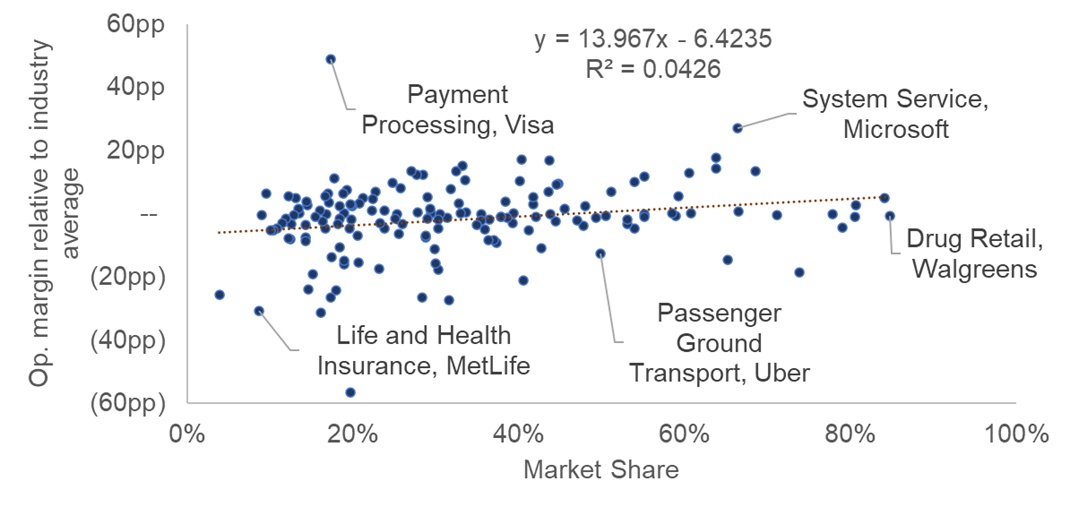
When the goal is to increase market share or defend against a competitor, you need to translate that into different bidding goals for your team:
-
Use Target Impression Share: This is the most direct tool for a market share goal. You can instruct your team to set up campaigns targeting a specific impression share (e.g., "We want to achieve an 80% impression share on all searches for 'X competitor alternative'") on high-priority, non-branded keywords. This tells the algorithm to prioritize showing up over achieving a specific CPA.
-
Set Strategic (and lower) ROAS Targets: To gain volume and visibility, you might deliberately set a less aggressive ROAS target. For example, while your profit-driven target might be 300%, you could create a specific campaign for market share growth with a target of 200%. This is a strategic decision to invest margin in growth.
The key is to segment your campaigns by objective. You can't use a one-size-fits-all target.
How to Manage Smart Bidding: Take Control of Your Bids
The article 'How to Manage Smart Bidding' offers a strategist's perspective on this. It explains why a single ROAS target is a flawed approach and how to think about targets based on their role in the buyer's journey.
Please read the section titled '4. Setting Better ROAS Targets'. Focus on the subsection 'Keyword Importance & Place in Buyer’s Journey'. This part explains why you might set different ROAS targets for brand-building keywords versus bottom-of-funnel keywords, directly tying into the market share objective.
The article reinforces a critical leadership concept: you must guide your team to differentiate their targets based on the strategic importance of a keyword or campaign, not just its immediate conversion performance. A top-of-funnel keyword might have a low ROAS but be essential for feeding the funnel and growing your share of voice.
4. An Advanced Framework: Value-Based Bidding (VBB)
So, how do you manage all these different targets? How do you bid for profit on some products, for market share on others, and account for lead quality in a B2B context? The answer lies in a framework called Value-Based Bidding (VBB).
VBB is a bidding approach where you move beyond telling Google how many conversions you want (Maximize Conversions) or at what cost (Target CPA), and instead tell it how much value you want (Maximize Conversion Value / Target ROAS).
The strategic layer you add is in defining that "value." It doesn't have to be just revenue. It can be profit, predicted lifetime value (LTV), or a weighted value based on lead quality.
Everything You Need To Know About Value-Bidding in ...
The article 'Everything You Need To Know About Value-Bidding in Google Ads' provides a superb, structured guide on how to implement this. It includes a step-by-step process and a real-world example.
First, read the section 'Who should use value-based bidding?' to see its wide applicability. Then, review the 'step-by-step guide to bidding like a pro' to understand the strategic framework. Finally, carefully study the 'Value Bidding Real Example' of the SaaS company. This example is a perfect case study of translating complex business goals (free signups, paid users, LTV by country) into a concrete, value-based bidding strategy.
Your Role as a Leader in VBB
The SaaS example in the article is the perfect illustration of your future role. You are not the one calculating standard deviations or setting up Google Ads Value Rules. Instead, your job is to:
- Define the Value Formula: Work with Finance and Analytics to define what "value" means. Is it product margin? Is it the predicted LTV of a new user from a specific country?
- Champion Data Integration: Ensure your technical teams are equipped to pass this economic value back to the ad platforms, whether through dynamic value tracking, offline conversion imports, or server-to-server integrations.
- Set Tiered Bidding Goals: Guide your team to structure campaigns or portfolio bid strategies around these value tiers. For instance:
- High-Margin Products Portfolio: Target ROAS of 400%
- Low-Margin "Loss Leader" Portfolio: Target ROAS of 150%
- Market Share "Top of Funnel" Portfolio: Target Impression Share of 75%
- Oversee the System: Ask questions based on the VBB framework: "Are we passing back profit data or just revenue?", "How are we valuing leads from different sources?", "Do our bidding targets reflect the different LTVs of our customer segments?"
Conclusion
You have now learned the essential frameworks for translating high-level business strategy into actionable bidding goals. This is a quantum leap from simply optimizing campaigns to steering the entire marketing engine toward financial and competitive success.
Key Takeaways:
- Translate Profit, Don't Just Track Revenue: Use unit economics to calculate your contribution margin and derive a profit-based Target CPA or Target ROAS.
- Bid for Position, Not Just Profit: When market share is the goal, use Target Impression Share or strategically lower ROAS targets on specific campaigns to gain visibility and volume.
- Segment Your Strategy: A one-size-fits-all bidding target is inefficient. Your primary role is to guide your team in setting different goals for different products, keywords, or customer segments based on their strategic importance.
- Embrace Value-Based Bidding (VBB): VBB is the technical and strategic framework that allows you to feed your nuanced business logic (profit, LTV, lead quality) directly into the ad platforms' algorithms.
Preview of the Next Lesson:
We've touched on the idea of setting different targets for products with different margins. In the next lesson, we will dive deeper into this concept. You will learn how to develop a framework for segmenting products or services by margin to inform differentiated bidding targets. This will give you a practical methodology for one of the most powerful applications of the strategies we discussed today.