Hello! Welcome to your next lesson in the "AI for Fund Operations and Portfolio Support" module.
In our last session, we outlined the essential components of a standard Limited Partner (LP) report, covering both the quantitative financials and the qualitative narrative. We established what you need to communicate to your investors to build trust and maintain strong relationships.
Today, we'll focus on the how. This lesson directly addresses the learning outcome: to automate aspects of LP reporting and communication using AI tools. For you, as a prospective solo GP aiming to launch an AI-native accelerator, this isn't just about efficiency; it's a core part of your operational strategy. Mastering these tools will allow you to deliver an institutional-grade experience to your LPs without the overhead of a large back-office team.
1. From Manual Chore to Strategic Advantage
Traditionally, compiling quarterly LP reports is a time-consuming, manual process involving spreadsheets, data reconciliation, and hours of writing. As a solo GP, your time is your most valuable asset. Automating this process frees you to focus on finding great startups and supporting your founders.
The application of AI in LP reporting provides several key benefits:
- Efficiency: Drastically reduces the time spent on compiling data and drafting reports.
- Accuracy: Minimizes the risk of human error by automating data flows from a single source of truth, enhancing the credibility of your reports.
- Personalization at Scale: Enables you to tailor communications to individual LP interests, something previously only possible with a dedicated investor relations team.
- Professionalism: Delivers a polished, data-rich, and responsive experience that builds LP confidence and sets you apart from other emerging managers.
Let's explore the technologies and workflows that make this possible.
2. The Mechanics of AI-Powered Reporting
Automating LP reporting isn't about a single magic button. It's a systematic process that involves integrating data, generating reports, and drafting narratives. Your background in computer science will give you a solid intuition for how these systems work together.
How AI is Powering the Rise of Solo General Partners in ...
To start, let's get a high-level view of how AI is reshaping LP relations. The article 'How AI is Powering the Rise of Solo General Partners' from the VC Fund Institute provides an excellent overview tailored specifically to your situation as a solo GP.
Please read the section titled 'AI in LP Reporting'. Pay close attention to the four key benefits discussed: AI-powered reporting tools, personalized communication, error reduction, and AI-augmented Q&A.
As the article highlights, the process can be broken down into a few key areas of automation.
a) Data Aggregation: Creating a Single Source of Truth
The foundation of any automation is clean, consolidated data. AI reporting tools work by connecting to various data sources to create a unified view of your fund and portfolio.
This involves:
- Fund Administration Platforms: Your fund administrator (the firm you hire to handle your fund's accounting and compliance) will use a platform like Allvue, Carta, or AngelList. These systems are the central repository for your fund's financial data—capital calls, distributions, and LP capital accounts.
- Portfolio Company Data: These platforms can often integrate directly with the accounting software of your portfolio companies (e.g., QuickBooks, Xero). This allows for the automatic ingestion of key performance indicators (KPIs), reducing the need for you to manually chase down numbers from founders each quarter.
This integration is what enables the real-time, accurate reporting we'll discuss next.
b) Automated Report and Dashboard Generation
Once the data is centralized, AI-powered tools can generate reports with remarkable speed.
Private Equity Investor Reporting: Best Practices, Metrics & ...
Let's dig deeper into how these tools work. The Qubit Capital article, 'Private Equity Investor Reporting', provides more technical detail on how AI accelerates the process.
Please read the subsections 'Accelerate Insights with AI-Powered Analytics' and 'Implement Integrated Reporting Platforms'. Focus on how these systems reduce reporting latency, process data from multiple sources, and consolidate it into unified dashboards.
This automation manifests in two primary ways:
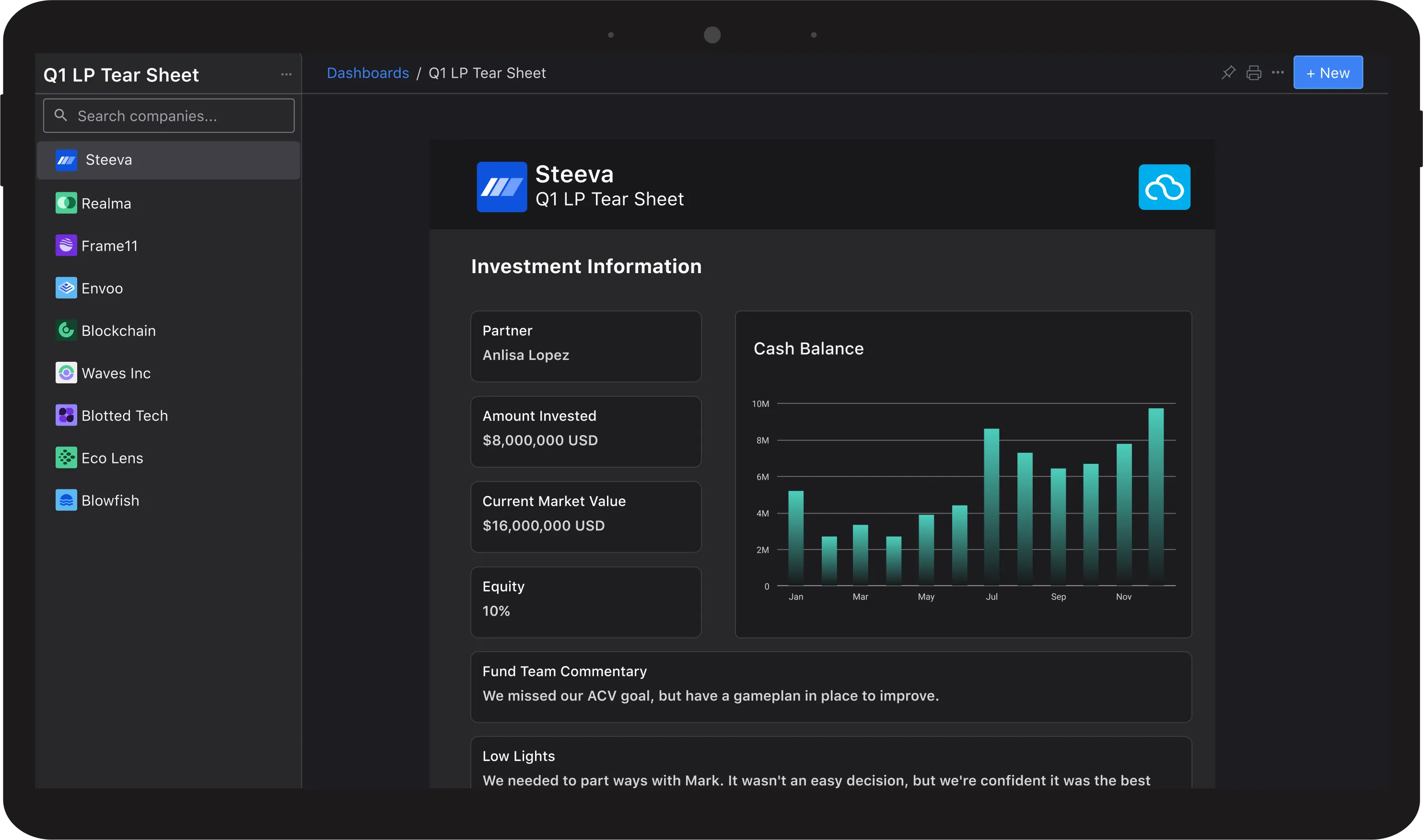
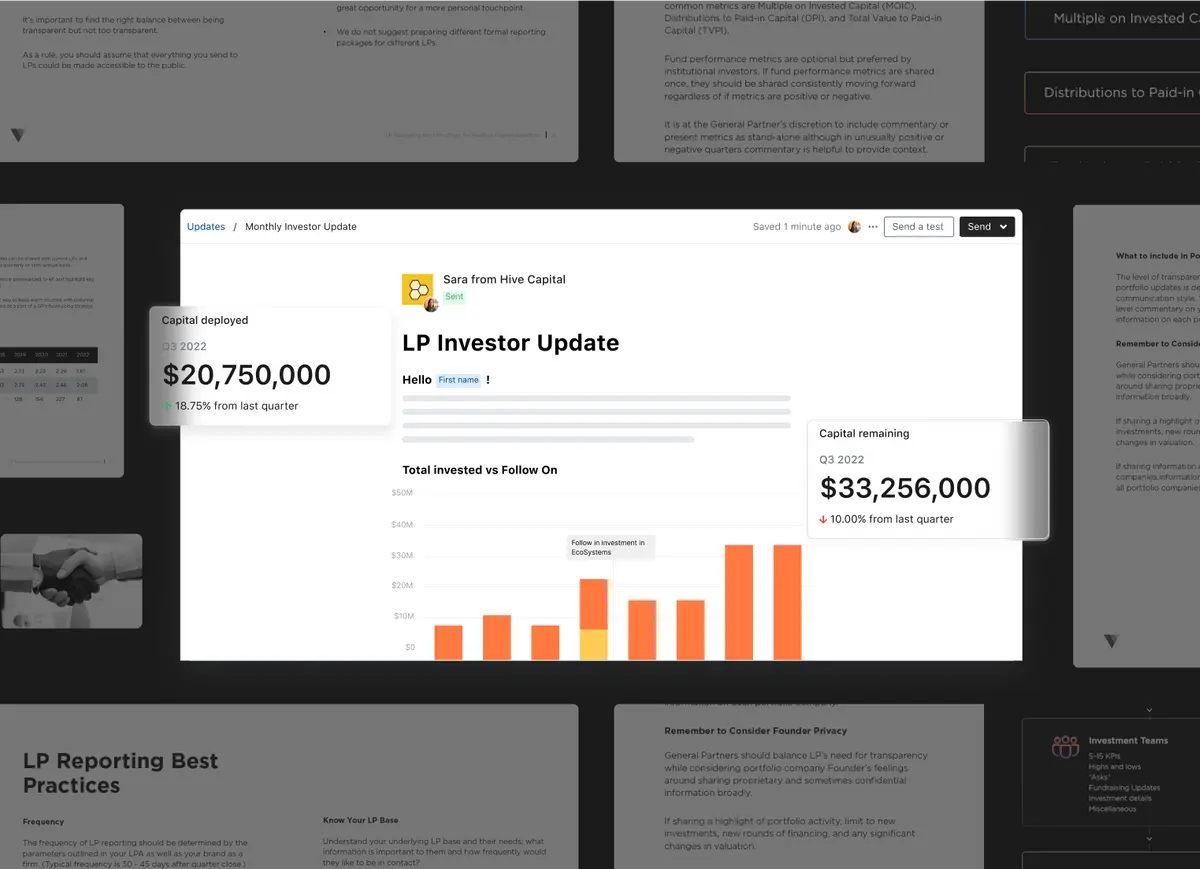
- Static Reports: Tools can automatically populate a pre-designed template (like the ones we saw in the previous lesson) with the latest financial metrics (TVPI, IRR, etc.), portfolio tables, and performance charts. What used to take days of work in Excel and PowerPoint can be generated in minutes.
- Dynamic Dashboards: Many modern platforms provide a secure portal where LPs can log in and explore fund data themselves. This offers on-demand transparency.
Here are examples of what these automated outputs can look like:
c) AI-Generated Narrative and Commentary
This is where recent advances in large language models (LLMs) become a game-changer for a solo GP. Beyond just populating numbers, AI can now help you write the narrative that provides context and insight.
As mentioned in both the VC Fund Institute and Qubit Capital articles, these tools use Natural Language Processing (NLP) to:
- Summarize Performance: Automatically generate an executive summary explaining key changes in the fund's metrics.
- Draft Commentary: You can provide the AI with bullet points—such as market observations, new investment theses, or portfolio company milestones—and it will generate a polished, well-written narrative draft.
- Explain Data: The AI can look at a chart and generate a sentence explaining the trend, e.g., "Revenue for Company X grew 30% quarter-over-quarter, driven by the launch of their new enterprise tier."
Your role shifts from being the primary writer to being the editor-in-chief, ensuring the AI-generated text reflects your authentic voice and strategic insights.
d) Personalized Communication at Scale
AI enables a level of personalization that was previously unfeasible for a small firm. By analyzing LP data (e.g., their industry, past questions, stated interests), the system can:
- Generate Custom Reports: Automatically create a short, bespoke report for an LP who is particularly interested in your AI or fintech investments, highlighting only the relevant companies.
- Power Q&A Chatbots: Some advanced platforms offer AI assistants that can answer common LP questions instantly (e.g., "What is the fund's current Net Asset Value?"), providing a highly responsive experience.
This allows you to deliver a "high-touch" feel that builds strong relationships, all while leveraging technology to do the heavy lifting.
3. An Automated Reporting Workflow for a Solo GP
Let's translate these concepts into a practical, step-by-step quarterly workflow.
- Data Synchronization (Automated): Your fund administration platform automatically pulls the latest financial statements and KPIs from your portfolio companies at the end of the quarter.
- Initial Report Generation (AI-Assisted): You log into your platform (e.g., Kruncher, Carta, Allvue) and trigger the report generation. The system automatically populates all financial tables, charts, and key fund metrics (TVPI, DPI, IRR).
- Drafting the Narrative (AI-Assisted):
- You write a few bullet points for your market commentary in a text box.
- For each portfolio company, you provide a few key updates (e.g., "Landed key customer: Acme Corp," "Hired new VP of Engineering," "Needs intro to B2B SaaS marketers").
- You use the platform's NLP feature to expand these bullet points into a full narrative draft for the report.
- Review, Edit, and Finalize (Your Role): You read through the entire AI-generated report. You correct any inaccuracies, refine the tone to match your voice, and add your most critical strategic insights. This human oversight is non-negotiable. The goal of AI is to produce the first 90% of the report, not the final 100%.
- Distribution and Tracking (Automated): You use the platform to email the finalized reports to your LPs. The system can automatically attach the correct personalized statement to each LP and track who has opened the report.
This workflow transforms a multi-day administrative burden into a focused, half-day strategic exercise.
Test your understanding!
You are preparing your Q2 LP update. Your fund data is managed on a platform like Carta. You have three main updates:
- New Investment: You just invested in "SynthAI," a generative AI company.
- Portfolio Markup: "DataWeave," an existing portfolio company, just raised a Series A at a significant valuation uplift.
- Market Trend: You've noticed a slowdown in enterprise sales cycles across your SaaS portfolio due to macroeconomic pressures.
How would you use an AI-powered reporting workflow to efficiently create your LP update? Describe the AI's role and your role for each of the three updates.
Show answer
Here's a possible workflow:
-
DataWeave (The Markup):
- AI's Role: The platform would automatically detect the new valuation from the Series A closing documents uploaded to Carta. It would then recalculate the fund's TVPI and RVPI and update the financial snapshot and portfolio table to reflect DataWeave's new, higher value.
- Your Role: In the narrative section, you would review the AI's summary of the markup and add your own context, perhaps naming the top-tier firm that led the Series A to signal quality and validate your initial investment decision.
-
SynthAI (The New Investment):
- AI's Role: The platform would add SynthAI to the portfolio table with the initial investment amount. You could then feed your investment memo's bullet points (e.g., "Strong technical team from Google Brain," "Large TAM in creative industries," "Proprietary model architecture") into the NLP tool to generate a draft of the "New Investments" section.
- Your Role: You would edit the AI-generated text to perfect the story, ensuring it clearly and compellingly communicates your investment thesis to LPs.
-
Market Trend (The Commentary):
- AI's Role: You would write a simple prompt like: "Draft a paragraph for my market commentary section. Explain that while we're seeing slower enterprise sales cycles due to macro headwinds, our portfolio companies are adapting by focusing on NRR and product-led growth. Our focus remains on capital-efficient businesses." The AI would generate a polished paragraph based on this.
- Your Role: You would review and refine the AI's text, adding your unique perspective and reassuring LPs that you are actively monitoring the situation and guiding your portfolio companies through the challenge.
Conclusion
For a solo GP, leveraging AI for LP reporting is a critical strategy for operating a lean, high-performing venture firm. It allows you to automate the time-consuming and error-prone aspects of report creation, freeing you to focus on the high-value work of investing and portfolio management.
Key Takeaways:
- Automation is a Process: Effective automation relies on integrated platforms that create a single source of truth for fund and portfolio data.
- AI Handles the Heavy Lifting: AI tools excel at aggregating data, generating financial tables and charts, and drafting initial narratives from your bullet points.
- Your Role is Strategic: Your job shifts from manual data entry to strategic oversight—editing the AI's output, adding your unique voice and insights, and ensuring the final report is a powerful relationship-building tool.
- The Result is Professionalism at Scale: By using these tools, you can provide your LPs with timely, accurate, and personalized communication that rivals that of much larger, more established venture funds.
Preview of the Next Lesson
We've now covered how to use AI for both internal portfolio analysis and external investor communication. Next, we'll turn our attention to another critical aspect of running an accelerator: adding direct value to your startups. In the next lesson, we will evaluate AI-driven methods for matching startups with mentors based on specific needs, exploring how you can use technology to scale one of the most valuable resources you can offer your founders.