Hello! Welcome to your next lesson.
In our last session, we designed a process to use AI for interpreting portfolio data and flagging at-risk companies. This internal analysis is crucial for managing your time and capital as a solo GP. Today, we'll focus on the other side of the coin: communicating your fund's performance to your investors.
This lesson directly addresses the learning outcome: to outline the key components of a standard Limited Partner (LP) report. This is a fundamental responsibility of a fund manager, and getting it right is essential for building and maintaining the trust of those who have backed your vision. We will cover not just the required financial data, but also the narrative components that transform a simple report into a powerful relationship-building tool.
1. More Than a Report: The Strategic Role of LP Updates
Before we dive into the specific components, it's important to understand that an LP report is far more than a financial statement. For a solo GP, these updates are one of your primary tools for managing your most important relationships—those with your Limited Partners.
A consistent, transparent, and insightful report serves several strategic purposes:
- Builds Trust: Regular updates demonstrate professionalism and transparency, building confidence that you are a capable steward of your LPs' capital. This is crucial for securing their investment in your future funds.
- Activates Your Network: A well-crafted update can mobilize your LPs to help your portfolio companies with hiring, customer introductions, or expert advice.
- Reinforces Your Thesis: It's an opportunity to show how your investment decisions connect to your overarching fund strategy and to share your unique perspective on the market.
To understand what makes an LP update effective from the investor's perspective, let's start with the article 'How to write LP updates' from Signature Block. It provides excellent context on the strategic importance of these communications and what LPs actually want to see.
Please read the introduction, 'Why LP updates are important', and the section 'What LPs want to see'. Pay close attention to the recurring themes of transparency, relationship building, and the desire for both quantitative and qualitative information.
As you can see, LPs value both the "what" (performance metrics) and the "why" (your insights and commentary). A great LP report is a hybrid document that combines hard data with a compelling narrative.
2. The Anatomy of a Standard LP Report
A comprehensive LP report can be broken down into two main categories of content: the qualitative narrative and the quantitative financials. Let's use the structure proposed in the Signature Block article as our framework and then deep-dive into each part.
The Signature Block article also provides a fantastic, practical template. We will use this as the blueprint for our lesson.
Please read the section titled 'LP update template'. Familiarize yourself with the eight listed components, from the Introduction to Personal Updates. We will explore the most critical of these sections in more detail.
Based on this template, a standard report includes:
Qualitative Narrative:
- Introduction/Summary: A high-level overview of the quarter.
- Commentary: Your analysis of market trends and your fund's strategy.
- New Investments: Your rationale for adding new companies to the portfolio.
- Portfolio Updates & Asks: Highlights from existing companies and specific requests for help.
Quantitative Financials:
5. Markups: Updates on portfolio companies that have raised subsequent funding rounds.
6. Performance Snapshot: Key financial metrics for the fund as a whole.
7. Portfolio Snapshot: A table of all holdings.
Let's break down the financial components first.
3. The Quantitative Core: Financial Reporting
This section is the foundation of your report. It provides the objective, data-driven evidence of your fund's performance. Since you have no prior background in finance, we'll focus on understanding what these metrics mean, not on the complex accounting behind calculating them (which is typically handled by a fund administrator).
Essentials of Venture Capital Fund Reporting [Part II]
For a detailed, formal breakdown of the financial metrics, we'll turn to 'Essentials of Venture Capital Fund Reporting' from Seraf. This resource lists the standard metrics expected in the venture capital industry.
Please read the sections 'Common "Fund Overview" Elements Included in All Regular Statements' and 'LP Specific Measures to be Reported on a Per LP Per Statement Basis'. Don't worry about memorizing every acronym. Instead, focus on understanding the types of information being presented.
Let's simplify and group these metrics into three key areas:
a) Fund-Level Performance Metrics
These numbers give a snapshot of the entire fund's health. The most important ones are often called "multiples":
- TVPI (Total Value to Paid-In Capital): The total value of the fund (current holdings + exited investments) divided by the capital contributed by LPs. A TVPI of 2.5x means that for every $1 an LP invested, they now have $2.50 in value (though it might not be liquid cash yet).
- DPI (Distributed to Paid-In Capital): The total cash returned to LPs divided by their contributed capital. This is the "cash-on-cash" return. A DPI of 1.0x means LPs have gotten their original investment back.
- RVPI (Residual Value to Paid-In Capital): The current value of the remaining investments in the fund, divided by contributed capital.
- It's a simple relationship: TVPI = DPI + RVPI
- IRR (Internal Rate of Return): A more complex metric that measures the fund's performance over time, expressed as an annualized percentage. It answers the question: "What is the fund's compound annual growth rate?"
b) LP-Specific Information
Each LP's report must be personalized to reflect their individual stake in the fund. This includes:
- Capital Committed, Called, and Outstanding: How much they promised, how much you've asked for so far, and how much is left to call.
- Their specific share of the fund's value, returns, and holdings.
c) The Portfolio Table
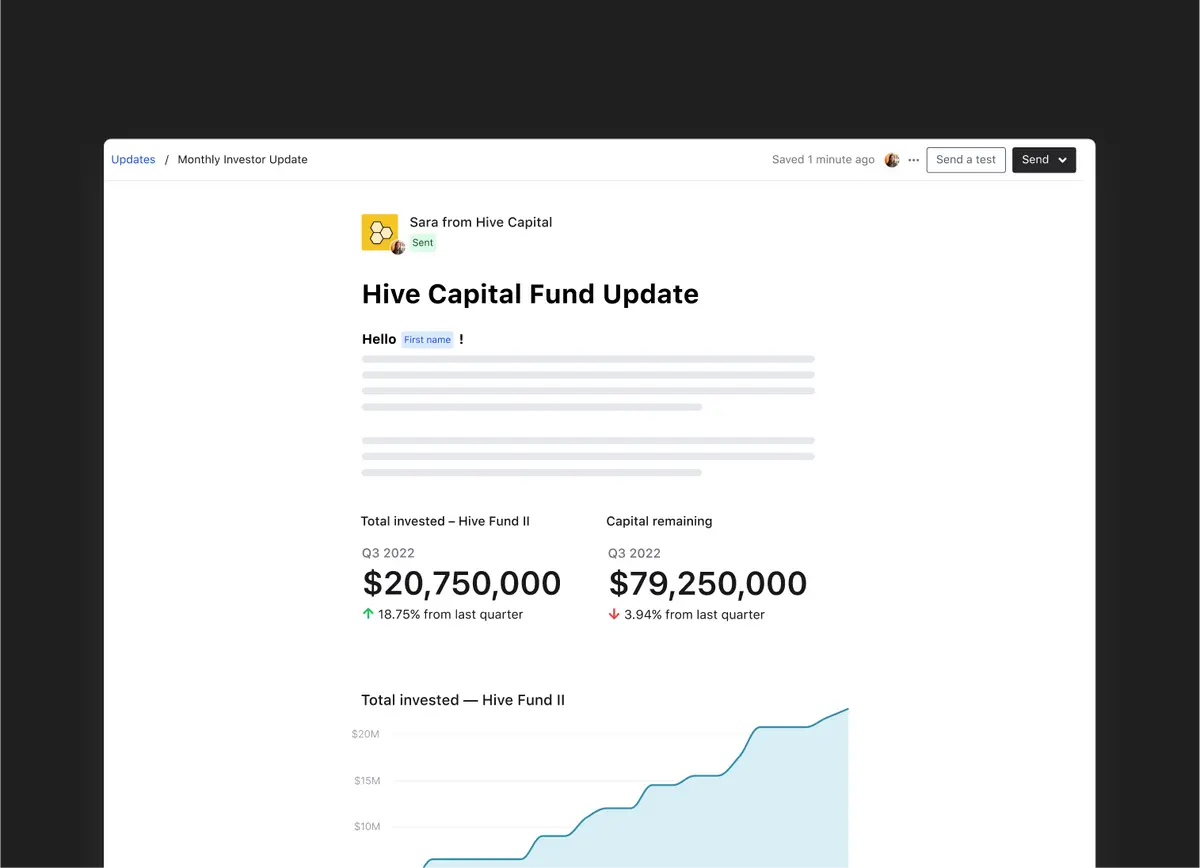
This is a detailed list of every company the fund has invested in, often including the amount invested, the current valuation of the stake, and the ownership percentage.
Here are some visual examples of how this financial data is often presented:

4. The Qualitative Narrative: Telling the Story
The numbers tell you what happened, but the narrative tells your LPs why it happened and what it means. This is where you, as the GP, add your unique value and insight.
Referring back to the template from Signature Block (LINK), let's highlight the most important narrative sections:
- Commentary: This is your "state of the union." What are you seeing in the market? Are you adjusting your strategy? This demonstrates your thought leadership and gives LPs a macro view they can't get elsewhere.
- New Investments: This is arguably the most exciting part of the report. For each new company, you should explain your investment thesis. Why this team? Why this market? Why now? This continuously reinforces the value of your fund.
- Portfolio Updates & "Asks": This section brings your portfolio to life. Share major milestones (product launches, key hires, big customer wins). Crucially, this is where you can make specific "asks" on behalf of your founders (e.g., "Company X is looking for an introduction to marketing executives at Fortune 500 retail companies"). This transforms your LPs from passive investors into an active, value-adding network.
Test your understanding!
Imagine you are writing your quarterly LP report. You have two significant updates:
- Company A, a portfolio company, just raised a Series A round at a 5x increase in valuation from where your fund invested.
- Company B, another portfolio company, is struggling with product-market fit. They have enough cash for 12 more months but are not growing. This is a "Zombie" company, as we discussed in the last lesson.
In which section(s) of the LP report would you discuss each company, and what is the key message you want to convey for each?
Show answer
-
Company A (The Success Story):
- Section: Primarily in the "Markups" section, and likely highlighted in the introductory "Summary" as well.
- Message: This is a moment to celebrate and validate your investment strategy. The message should be about the successful outcome. You would name the lead investor of the new round (e.g., "led by a top-tier firm like Sequoia") to add credibility. You'd also update the financial metrics in the "Performance Snapshot" to reflect the new, higher valuation, which will positively impact your TVPI and RVPI.
-
Company B (The "Zombie"):
- Section: This would be handled more subtly, likely within the "Portfolio Updates" section or simply reflected in the main "Portfolio Snapshot" table without a dramatic narrative.
- Message: Transparency without causing panic is key. The message isn't about failure, but about the current status and your management of the situation. You might write a neutral update like, "Company B is currently focused on product iteration to accelerate customer acquisition and has a runway of 12 months." You would not call it a "Zombie" in an LP report. The financial table would reflect its valuation as flat (not written up or down yet). This transparently communicates the lack of growth without creating unnecessary alarm, showing you are actively monitoring the situation.
Conclusion
Creating a compelling LP report is a core function of a fund manager. It is a powerful tool for maintaining investor confidence and building a long-term, supportive partnership with your LPs. As a solo GP, mastering this process will be critical to your success.
Key Takeaways:
- Dual Purpose: LP reports fulfill your legal duty to report financial performance and your strategic goal of building trust and engagement with investors.
- Hybrid Structure: An effective report combines a quantitative core (TVPI, DPI, IRR, portfolio table) with a qualitative narrative (market commentary, new investment theses, portfolio updates).
- Financial Metrics: You need to understand and report key metrics like TVPI, DPI, and IRR, which measure the fund's overall value, cash returned, and time-weighted performance.
- Narrative is Key: The story you tell around the numbers is where you add your unique value, share your insights, and activate your LP network to support the portfolio.
Preview of the Next Lesson
We have now outlined what goes into a standard LP report. The next logical step is to think about efficiency. In our next lesson, "Automate aspects of LP reporting and communication using AI tools," we will explore how you can leverage technology to streamline the creation and distribution of these reports, freeing up your time to focus on what you do best: finding and supporting great startups.