Hello! Welcome to your next lesson in the "AI for Fund Operations and Portfolio Support" module.
In our last lesson, we focused on automating external communications by using AI to streamline LP reporting. We saw how this technology allows a solo GP to deliver an institutional-grade experience to investors efficiently.
Today, we shift our focus from external stakeholders to internal value creation—one of the most critical functions of your accelerator. This lesson addresses the learning outcome: to evaluate AI-driven methods for matching startups with mentors based on specific needs. A high-quality mentor network is a cornerstone of any successful accelerator. For a solo GP, manually and effectively matching hundreds of mentor-mentee interactions is a significant operational bottleneck. Leveraging AI here is not just an optimization; it's a strategic necessity that enables you to scale your program's impact.
1. The Strategic Case for AI in Mentor Matching
While your prior experience in consultancy has given you a deep understanding of what startups need, manually connecting them to the right mentors in a large program is time-consuming and difficult to scale. As you build your accelerator, you'll be managing a growing community of founders and a valuable network of mentors. Doing this matching by hand is not only inefficient but also susceptible to unconscious bias.
AI-powered matching systems address three key challenges:
- Scalability: They can process thousands of data points to suggest optimal pairings in seconds, a task that would take a human manager days or weeks.
- Objectivity: By focusing on data-driven criteria, algorithms can help mitigate "homophily"—our natural tendency to connect people who are similar to ourselves—thereby promoting more diverse and potentially more impactful connections.
- Efficiency: Automating the matching process frees up your time to focus on higher-value activities like founder coaching, fundraising for your fund, and building the mentor network itself.
The return on investment is significant. Let's look at a concrete example of the time and cost savings.
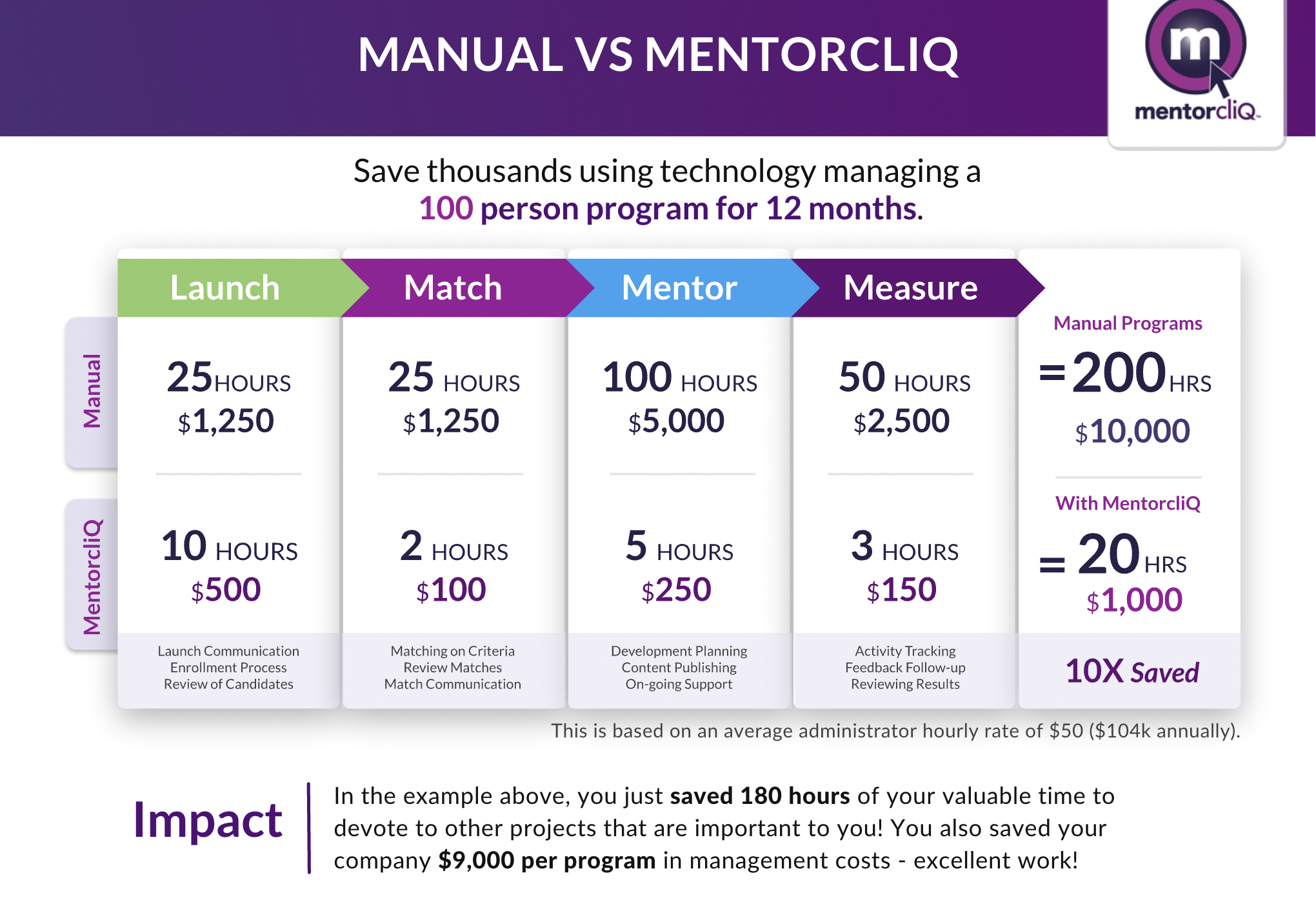
To build an effective system, however, we first need to understand its foundations.
2. The Foundation: Garbage In, Garbage Out
An AI matching algorithm is only as good as the data it's fed. The first step in designing an AI-driven matching process is to create comprehensive intake profiles for both your founders (mentees) and mentors.
Mastering Mentor-Mentee Matching: Strategies for Lasting ...
The article 'Mastering Mentor-Mentee Matching' from Qooper.io provides an excellent strategic overview of this process. It explains why data collection is the critical first step before any matching can occur.
Please read the sections titled 'The Foundation: Designing for Matching Success' and 'Core Matching Criteria That Predict Long-Term Success'. Pay close attention to the list of data points that high-impact matching surveys should capture.
As the article highlights, you need to go beyond basic information like job titles. A robust data set for your AI model should include:
- For Mentees (Founders):
- Specific Needs/Goals: What are the top 1-3 challenges they need help with right now? (e.g., "building a B2B sales pipeline," "setting up a DevOps environment," "preparing for a seed round").
- Industry & Business Model: e.g., Vertical SaaS, B2C Marketplace, Deep Tech.
- Stage of Development: Pre-product, post-launch, pre-revenue, etc.
- Communication Style: Preference for structured meetings vs. asynchronous chat.
- For Mentors:
- Core Expertise & Skills: What are they world-class at? Be specific. "Marketing" is too broad; "Performance marketing for D2C brands" is better.
- Operational Experience: Have they scaled a company? Managed a large team? Navigated an acquisition?
- Industry Context: Experience in specific verticals (e.g., fintech, healthtech).
- Availability & Commitment Level: How many hours per month? How many mentees can they take on?
This structured data forms the bedrock of your matching algorithm.
3. Under the Hood: How AI Finds the "Perfect" Match
With your CS background, you'll appreciate that the "magic" of AI matching is a combination of sophisticated algorithms processing both structured and unstructured data. Let's break down the core techniques.
Smarter Mentoring Matches with AI-Powered Insights
The article 'Smarter Mentoring Matches with AI-Powered Insights' from MentorEase provides a fantastic, technically-grounded explanation of the NLP techniques used to analyze unstructured text from profiles and resumes.
Read the introductory section and the list of 'AI integrations'. Focus on understanding what 'Key Phrase Extraction', 'Sentiment Analysis', and especially 'Text Embeddings' are designed to do. This will give you a clear picture of how AI interprets free-form text.
As the MentorEase article describes, AI engines analyze participant profiles in several ways:
-
Analyzing Unstructured Data with NLP: This is where the system goes beyond simple checkboxes to understand the nuances of what people write in their bios, goals, and resumes.
- Key Phrase & Entity Extraction: The AI scans the text to identify specific skills, technologies, companies, or industries. For example, it can pull out "Python," "AWS," "growth marketing," and "Series A" as distinct concepts.
- Lemmatisation: It intelligently groups related words (e.g., "manage," "managing," "management") to understand conceptual overlap, preventing mismatches based on slightly different terminology.
- Sentiment Analysis: This technique can identify a mentee's needs by analyzing the tone of their writing. A phrase like "I’m struggling with public speaking" is a clear signal. The AI can detect this negative sentiment and match it with a mentor who has listed "presentation coaching" or "public speaking" as a strength.
- Text Embeddings: This is a more advanced technique. It converts a block of text (like a bio) into a high-dimensional vector (a series of numbers). The key insight is that semantically similar texts will have vectors that are "close" to each other in this multi-dimensional space. The system can then calculate the mathematical distance between a mentee's vector and all mentor vectors to find the closest, most relevant matches.
-
Combining Scores for a Final Recommendation:
A sophisticated system doesn't rely on just one method. It calculates an overall match score by combining different signals. As noted in the MentorEase resource, this often looks like:- Field Score: A score based on matching structured data (e.g., checkboxes for "Industry" or "Help Needed").
- AI Score: A score based on the NLP analysis of unstructured text.
- Overall Score: A weighted combination of the two, resulting in a single compatibility percentage.
This final score is what you see in the user interface, making a complex analysis simple to act upon.

Test your understanding!
A founder in your program writes the following in their "Help Needed" section: "We have a solid product, but we're totally lost when it comes to getting our first 10 enterprise customers. Our team is all technical, and we find the sales process really intimidating."
You have three potential mentors:
- Mentor A: A serial CTO who has scaled multiple engineering teams. Bio mentions "technical leadership" and "product architecture."
- Mentor B: A former VP of Sales at a large SaaS company. Bio mentions "building GTM strategy," "enterprise sales," and "coaching founders."
- Mentor C: A CEO who recently exited their company. Bio is generic, mentioning "leadership" and "strategy."
How would an AI matching system use the techniques we discussed to rank these mentors for this founder?
Show answer
Here's how the AI would likely evaluate the mentors:
-
Key Phrase Extraction: The system would extract "enterprise customers" and "sales process" from the founder's request. It would find direct matches for "enterprise sales" in Mentor B's bio, a strong positive signal. It wouldn't find these key phrases for Mentors A and C.
-
Sentiment Analysis: The AI would pick up on the negative sentiment in "totally lost" and "intimidating." It would then look for mentors with experience that directly addresses these anxieties. Mentor B's mention of "coaching founders" is a strong indicator they can handle this.
-
Text Embeddings: In vector space, the founder's request vector would be semantically closest to Mentor B's vector, as they both center on the concepts of sales, go-to-market, and customer acquisition. Mentor A's vector would be further away, located in a "technical/product" region of the space. Mentor C's vector would be too generic to be a close match.
Conclusion: The AI would rank Mentor B as the top match by a significant margin, Mentor A as a poor match (mismatched expertise), and Mentor C as a low-quality match (too generic).
4. How to Evaluate and Choose a Mentor Matching Tool
As you prepare to launch your accelerator, you may decide to buy an off-the-shelf solution rather than building one from scratch. Here is a framework for evaluating potential platforms:
- Matching Methods: Does the tool offer the right approach for your program's size and goals? A hybrid approach is often best.
Mastering Mentor-Mentee Matching: Strategies for Lasting ...
The Qooper.io article provides a helpful comparison of different matching methods.
Please review the section 'Mentor Matching Strategies' and the 'Comparison Table'. This will help you understand the pros and cons of algorithmic matching versus other methods like self-matching.
-
Human-in-the-Loop: The goal of AI is to assist, not replace, your judgment. A good system should allow you to:
- Review suggestions: See why the AI recommended a match.
- Manually override: Adjust pairings based on your own contextual knowledge that the AI might lack.
- Tune the algorithm: Adjust the weights of different criteria (e.g., make "industry experience" more important than "communication style" for a specific program).
-
Bias Mitigation: Ask vendors how their algorithm is designed to reduce unconscious bias. As the Qooper article notes, a key benefit of algorithmic matching is its ability to disrupt homophily and create more equitable access to mentorship.
-
Integration and User Experience: The platform should be easy for you, your founders, and your mentors to use. It should integrate with your other systems (like a CRM or communication platform) to create a seamless operational workflow.
Conclusion
For your AI-native accelerator, using technology to scale your mentor program is a perfect example of "eating your own dog food." It demonstrates the power of AI in a core operational function and directly contributes to the value you provide your portfolio companies.
Key Takeaways:
- AI-driven mentor matching provides scalability, efficiency, and objectivity, which are critical for a solo GP.
- The process starts with collecting high-quality structured and unstructured data from both mentees and mentors.
- AI algorithms use NLP techniques like key phrase extraction, sentiment analysis, and text embeddings to understand needs and expertise from free-form text.
- The best systems combine this analysis with structured data to generate a single, actionable compatibility score, while still allowing for human oversight and final judgment.
- When evaluating tools, focus on the quality of matches, the ability to tune the algorithm, and its capacity for reducing bias.
Preview of the Next Lesson
We have now explored how AI can enhance two critical operational areas: LP reporting and mentor matching. With these internal systems in mind, we'll now shift to the very top of your funnel. In our next lesson, we will begin the final module of the course and learn how to develop core positioning and a marketing message tailored to your ideal startup profile. This is the crucial first step in attracting the high-quality, AI-focused startups you want for your program.