
Hello again. In the previous lesson, you reviewed radians and right-triangle trigonometry, including the key pattern that an angled force can be split into horizontal and vertical effects using sine and cosine. This lesson makes that pattern precise through vectors.
Vectors are essential throughout physics: displacement, velocity, acceleration, force, momentum, and electric field all have both magnitude and direction. Here you will learn to translate freely between the two standard descriptions of a two-dimensional vector:
- magnitude-direction form: a size and an angle;
- Cartesian component form: its signed horizontal and vertical changes.
A vector is a change, not a location
A scalar has magnitude only: , , and are scalars. A vector needs direction as well: east, downward, or a force at an angle.
We can draw a vector as an arrow. Its:
- length represents magnitude;
- arrowhead indicates direction;
- tail is its starting point;
- head is its ending point.
A vector is unchanged if we slide it to another place without rotating it or changing its length. For instance, a velocity of to the right is the same vector wherever it is drawn.
In a Cartesian coordinate system, we describe a vector using its horizontal and vertical components:
The first number, , is the signed change in the -direction. The second, , is the signed change in the -direction.
- Right gives a positive -component; left gives a negative -component.
- Up gives a positive -component; down gives a negative -component.
Thus,
means “move units right and units down.” The pair is not automatically a point’s coordinates. It describes a change. It becomes the coordinates of the arrow’s tip only when the arrow begins at the origin.
Introduction to vector components | Vectors | Precalculus | Khan Academy
Watch “Introduction to vector components” from Khan Academy for a compact visual account of the two equivalent vector descriptions.
Watch components to see why a component pair records horizontal and vertical displacement. Continue through a triangle model, which builds components from a magnitude and angle. Finish with the reverse process, where components are used to recover magnitude and direction. Pay particular attention to the distinction between a vector and the coordinates of a point.
The geometry behind components
Every two-dimensional vector can be viewed as the hypotenuse of a right triangle. Its components form the two perpendicular legs.
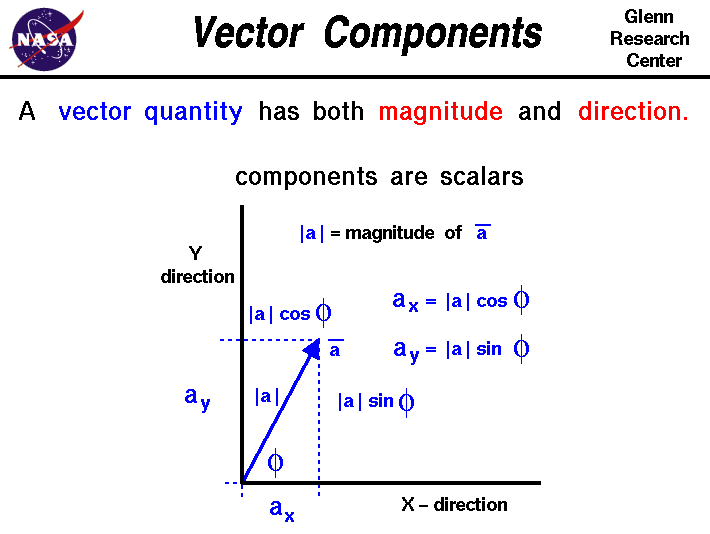
Suppose a vector has magnitude and standard direction angle , measured counterclockwise from the positive -axis. The horizontal component is adjacent to , and the vertical component is opposite it. From cosine and sine,
Multiplying both equations by gives the central conversion formulas:
These formulas include the signs automatically, provided that is the standard angle from the positive -axis.
Example: magnitude and direction to components
A drone has a displacement of magnitude
at
above the positive -axis.
The components are
Therefore,
The components are both positive because the vector lies in quadrant I: rightward and upward.
A useful interpretation is that the one diagonal displacement has the same net effect as performing two perpendicular displacements: right and up. It does not mean the drone traveled ; its actual straight-line displacement magnitude is still .
Signs and direction conventions
The formulas do not change from one quadrant to another. What changes are the signs of sine and cosine.
| Quadrant | Direction of vector | Sign of | Sign of |
|---|---|---|---|
| I | right and up | positive | positive |
| II | left and up | negative | positive |
| III | left and down | negative | negative |
| IV | right and down | positive | negative |
For example, let
and
Because is in quadrant II,
So
The negative horizontal component says the force points westward; the positive vertical component says it points northward.
Compass directions: translate the words before calculating
Physics problems often describe direction in forms such as “ north of west” rather than giving a standard angle. Interpret the phrase from the first named direction, turning toward the second.
For a vector directed north of west:
- Start pointing west, so the horizontal component must be negative.
- Turn toward north, so the vertical component must be positive.
- The angle is measured from the horizontal westward direction.
The horizontal and vertical component magnitudes are therefore
Now attach signs from the direction:
This agrees with the standard-angle method, since north of west is equivalent to a standard angle of .
A brief sketch before calculation is the most reliable way to avoid accidentally assigning the wrong sign or interchanging sine and cosine.
2.2 Coordinate Systems and Components of a Vector - University Physics Volume 1 | OpenStax
Read the relevant portions of OpenStax University Physics Volume 1 to consolidate the formal definition of a direction angle, the role of signs in all four quadrants, and the trigonometric component formulas.
On the page “2.2 Coordinate Systems and Components of a Vector,” begin just after “Check Your Understanding 2.4.” Read the magnitude and quadrant discussion. Then continue in the following passage, beginning with “Let us return to the right triangle,” through the statement that clockwise measurement gives a negative angle. Focus on the convention that a direction angle is measured from the positive x-axis and on why the signs of the components carry directional information.
Components to magnitude and direction
Now take the reverse problem. Suppose we know
Because the components are perpendicular, the Pythagorean theorem gives the vector magnitude:
Notice that a negative component becomes positive when squared. Magnitude cannot be negative.
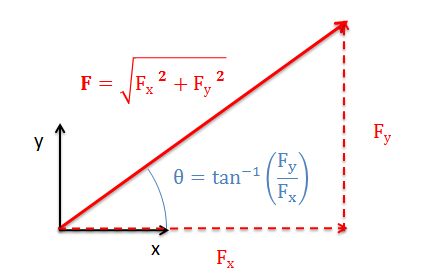
To recover direction, the right triangle gives
Thus the reference angle, the positive acute angle made with the horizontal, is
The absolute values here deliberately give only the triangle’s acute angle. You then use the component signs to place the vector in the correct quadrant.
Example: components to magnitude and direction
Let
First find the magnitude:
The component signs show that the vector points left and up, so it lies in quadrant II. The reference angle is
There are two clear ways to state the direction:
- Compass-style direction: north of west.
- Standard direction angle: start from the positive -axis and move counterclockwise:
Thus the vector can be written in magnitude-direction form as either
or
Both descriptions represent exactly the same vector.
Why inverse tangent alone can be misleading
If you enter
into a basic calculator, it may return approximately
But this angle lies in quadrant IV, whereas the components clearly locate the vector in quadrant II. Tangent has the same value at angles separated by , so inverse tangent by itself cannot always choose the right quadrant.
A reliable hand method is:
- Determine the quadrant from the signs of the components.
- Find the positive reference angle using component magnitudes.
- Convert that reference angle into the requested direction.
Many scientific calculators and programming languages provide an atan2 function. It uses the ordered inputs and automatically accounts for the quadrant:
For the vector , atan2(4,-3) returns , or the equivalent angle in radians if the calculator is in radian mode.
A complete conversion routine
Use this compact routine whenever you encounter a two-dimensional vector.
From magnitude and direction to components
Given magnitude and standard angle ,
Before accepting the result, check:
- Does the quadrant predict the signs you obtained?
- Is each component’s magnitude no greater than ?
- Are the units on both components the same as the original vector’s units?
From components to magnitude and direction
Given
calculate
Then determine the direction using either atan2 or a reference angle plus a quadrant check.
Finally, verify by converting back:
This reverse check is especially useful when the vector lies in quadrants II, III, or IV.
Vectors drawn away from the origin
If a displacement arrow begins at
and ends at
its components are changes in coordinates:
Therefore,
For example, a particle moving from
to
has displacement components
The negative -component means left; the positive -component means up. From there, the same Pythagorean and trigonometric methods give its magnitude and direction.
There are two special cases worth recognizing:
- If and , the vector is vertical, with direction or .
- The zero vector,
has magnitude zero and no defined direction.
Wrap-up
A two-dimensional vector can be represented equally well in either form:
or
The essential formulas are
and, in reverse,
To find direction from components, use the signs to identify the quadrant and then use inverse tangent carefully, or use atan2 when available. A component is a signed horizontal or vertical change, not merely a coordinate.
Next, you will use this component form to add and subtract vectors. That is the reason components are so powerful: once every vector is expressed along the same two perpendicular axes, combining physical effects becomes ordinary algebra.
Can't find a good explanation? Sign up and we'll make it for you
Sign up