
Good to see you again. In the previous lesson, you learned to describe a two-dimensional vector either by its magnitude and direction or by its signed Cartesian components. In particular, a vector such as means units left and units up.
Now we use the payoff of that representation: once vectors are written in common - and -directions, combining them is ordinary signed algebra. This lesson develops reliable methods for adding and subtracting two-dimensional vectors, including cases in which components are negative and cases in which a problem begins with magnitudes and directions.
Net change: why components add
Imagine two successive displacements. The first contributes some horizontal change and some vertical change; the second does the same. The total horizontal change is the sum of the two horizontal changes. Independently, the total vertical change is the sum of the two vertical changes.
Let
and
Their sum, called the resultant vector, is
Its components are
Therefore,
This is not a special trick. It follows directly from interpreting components as signed changes along perpendicular axes.
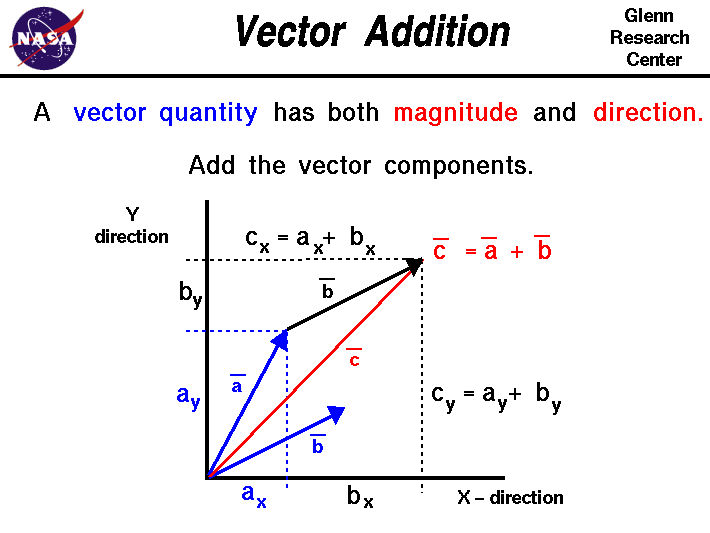
Graphically, we can picture addition by placing the tail of at the head of . The resultant runs from the tail of the first vector to the head of the second. But a sketch is mainly a check on reasonableness. Components give the calculation exactly.
Adding and subtracting vectors
Watch “Adding and subtracting vectors” from Khan Academy for a compact visual explanation of both the component method and the head-to-tail picture.
Watch the component rules first, focusing on why matching components are combined. Then watch addition visually, where the second vector is translated without changing it. Finish with subtraction visually, paying particular attention to why subtracting a vector means adding its opposite.
Adding vectors in component form
Suppose two forces act on the same object:
The negative horizontal component of means leftward; the negative vertical component of means downward. Add horizontal effects together and vertical effects together:
So the net force has a component of to the right and downward. Notice what has not been added: the magnitudes of the original forces. Vector magnitudes generally cannot be added as ordinary numbers unless the vectors point in exactly the same direction.
A useful bookkeeping layout prevents sign mistakes:
| Component | Net | ||
|---|---|---|---|
The answer is the vector formed from the final column.
Cancellation is physically meaningful
Consider
Then
The two displacements exactly cancel. Their individual magnitudes are both , but the magnitude of the sum is zero. This is why vector addition must respect direction.
Vector addition is also commutative:
Taking two legs of a walk in a different order changes the path followed, but not the final displacement.
Subtraction: add the opposite vector
Subtraction requires a little more care because order matters. By definition,
The vector has the same magnitude as , but points in the opposite direction. If
then
So the component rule for subtraction is
Worked example: subtracting a vector with a negative component
Let
and
Calculate :
The parentheses matter: we are subtracting the entire -component of , which happens to be negative.
There is a direct physical interpretation. Since includes a leftward component, subtracting contributes rightward instead.
Unlike addition, subtraction is not commutative:
In fact,
The two results have equal magnitude but opposite directions.
5.2 Vector Addition and Subtraction: Analytical Methods
Read the relevant portion of OpenStax Physics for a textbook presentation of the component procedure, including the connection between vector subtraction and adding a negative vector.
In the section “Analytical Method of Vector Addition and Subtraction,” read the numbered procedure around Figures 5.23 and 5.24, where the text separates the horizontal and vertical totals. Then read the “Worked Example,” focusing on the component calculation. Finish with the subtraction connection, which states the central idea that subtraction is addition of a negative vector.
A full physics-style calculation
Often, a problem gives vectors as magnitudes and directions, while the calculation requires their sum. The procedure is:
- Choose axes and identify the signs of all components.
- Convert each vector into Cartesian components.
- Add the -components and add the -components separately.
- Keep the resultant in component form unless the problem asks for magnitude and direction.
- If required, convert the resultant back using the Pythagorean theorem and inverse tangent.
Suppose a hiker travels east, then at north of east.
The first displacement is already horizontal:
For the second displacement,
Thus,
Now add components:
That component form is already a complete, exact answer: the hiker ends up east and north of the starting point.
If a magnitude and direction are requested, use the methods from the previous lesson:
The direction satisfies
so
The net displacement is therefore , north of east.
Checks that catch most errors
Before accepting a vector addition or subtraction result, make these quick checks:
- Match components with components. Never combine an -component with a -component.
- Keep units consistent. You may add -components of forces measured in newtons, but you cannot add a force to a velocity.
- Use parentheses in subtraction. In particular, write rather than trying to manage signs mentally.
- Sketch a rough diagram. A resultant pointing in the wrong quadrant often reveals a missed negative sign.
- Do not add magnitudes directly. The length of depends on the directions of both vectors.
- Report what was requested. Component form is often the most useful form in later calculations; magnitude and direction are only needed when a problem explicitly asks for them.
Wrap-up
Adding vectors by components means adding independent horizontal and vertical effects:
Subtracting vectors means adding the opposite vector:
The essential habit is to preserve signs and keep the - and -calculations separate. This same method will later allow you to combine forces, velocities, accelerations, electric fields, and momenta.
Next, you will build on component notation again to calculate the dot product, which measures how strongly two vectors align.
Can't find a good explanation? Sign up and we'll make it for you
Sign up