
Good to see you again. In the previous lesson, you learned to read physical meaning from graphs: slopes represent rates of change, while signed areas represent accumulated change. We will now add another part of physics’ mathematical language: angles.
Radians connect rotation to actual distance along a circle, and right-triangle trigonometry lets us infer unmeasured lengths or split a quantity into horizontal and vertical effects. These tools will support circular motion later in the course and prepare you for the vector work in the next lessons.
Angles as physical quantities: why radians matter
Degrees are familiar: one complete turn is . Physics and calculus usually prefer radians because they are defined directly from lengths.
Consider a circle of radius . An angle at its centre cuts out an arc of length . The angle in radians is defined by
Equivalently,
This second form is one of the most useful equations in introductory physics. It tells us how far a point travels along a circular path when it turns through an angle .
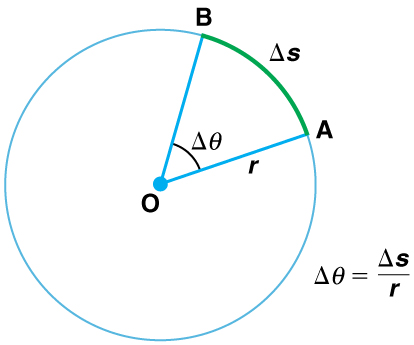
What does one radian mean?
An angle of is the angle that cuts off an arc whose length equals the radius:
A full circle has circumference . Therefore its angular measure in radians is
So the key conversions are
To convert degrees to radians, multiply by :
To convert radians to degrees, multiply by :
A few values should become automatic:
| Degrees | Radians | Fraction of a turn |
|---|---|---|
Although radians are a ratio of two lengths and are therefore dimensionless in strict dimensional analysis, writing remains useful. It tells you that a number represents an angle, not an ordinary pure number.
Distance or arc length from angular displacement | AP Physics 1 | Khan Academy
Watch Khan Academy’s “Distance or arc length from angular displacement.” It develops the relation between turning angle, radius, and distance traveled around a circle, including the important distinction between angular displacement and ordinary linear displacement.
Watch the full turn for the tethered-ball model and the distinction between returning to the starting position and traveling a nonzero distance. Then watch the arc rule, where the arc-length relation is stated, followed by the clockwise case to see how a negative angular displacement still corresponds to a positive path distance.
Using in a physical model
Suppose a bicycle wheel has radius
and turns through
A point on the rim travels an arc length
The radius must be in metres if we want the resulting arc length in metres.
Now suppose instead that a rotating arm of radius turns through . We must convert the angle to radians before using :
Then
The formula works directly only when is in radians. If you put into the formula while treating it as though it were a radian value, the result is physically meaningless.
Signed angle versus distance traveled
Physics often adopts this sign convention:
- Counterclockwise angular displacement is positive.
- Clockwise angular displacement is negative.
Thus, if a point moves clockwise through radians,
Its signed arc displacement is
For a radius of ,
The negative sign records the chosen direction along the circular path. But the distance traveled is positive:
This parallels the distinction from the previous graph lesson: signed quantities retain direction, whereas distance records total path length.
Right triangles: the geometry behind sine, cosine, and tangent
A right triangle has one angle. Relative to a chosen acute angle , its three sides are:
- Hypotenuse: the side opposite the right angle; always the longest side.
- Opposite side: the side directly across from .
- Adjacent side: the non-hypotenuse side next to .
The words opposite and adjacent are not permanent labels. They depend on which acute angle you choose as . The hypotenuse does not change.
The basic trigonometric ratios are
The mnemonic SOH-CAH-TOA summarizes them:
- sine: opposite over hypotenuse;
- cosine: adjacent over hypotenuse;
- tangent: opposite over adjacent.
Each ratio is dimensionless because it compares lengths measured in the same unit. For instance, is simply .
5.4 Right Triangle Trigonometry - Precalculus 2e
Read OpenStax Precalculus 2e, Section 5.4, “Right Triangle Trigonometry.” It gives a compact review of the side labels and trigonometric ratios, then shows the standard method for solving a physical right-triangle model.
Begin with the subsection “Understanding Right Triangle Relationships.” Read the ratio summary, identifying how the selected angle determines opposite and adjacent. Then find the subsection “Using Trigonometric Functions.” Read from the solving procedure. Focus on choosing a ratio that contains both the known side and the unknown side. Finally, read the subsection “Using Right Triangle Trigonometry to Solve Applied Problems,” from the applied-model procedure. Notice the emphasis on making a sketch before writing an equation.
Choosing the appropriate ratio
Do not begin by trying to remember whether a problem “uses sine” or “uses tangent.” Instead, label the triangle relative to the angle you know, then select the ratio containing:
- the known quantity, and
- the unknown quantity.
For example, suppose a cable is long and makes an angle of with level ground. The cable is the hypotenuse. Let be its vertical rise, which is opposite the angle.
The ratio involving opposite and hypotenuse is sine:
Rearrange:
If instead we wanted the horizontal distance , that side is adjacent to the angle. We use cosine:
The Pythagorean theorem provides a check:
The small discrepancy comes from rounding.
Calculator mode matters
A calculator needs to know whether an entered angle is in degrees or radians.
- For , use degree mode.
- For , use radian mode.
This is not merely a technical detail. An angle of radians is much larger than an angle of , so the resulting sine, cosine, or tangent is completely different.
Physical model: measuring a height indirectly
Trigonometry often turns an inaccessible measurement into a solvable right triangle.
Suppose you stand from a vertical tower on level ground. Your eye is above the ground, and the angle from horizontal eye level to the tower’s top is .
Let be the tower’s total height. The vertical side in the right triangle is not ; it is the height above your eyes:
The horizontal separation is adjacent to the angle, and the vertical rise above eye level is opposite. Therefore,
Rearrange carefully:
The mathematical calculation is straightforward once the diagram is correct. The modelling assumptions deserve attention:
- the ground is level;
- the tower is vertical;
- the measured is a horizontal distance;
- the angle is measured relative to horizontal;
- the observer’s eye height is included.
A sketch makes these assumptions visible and prevents one of the most common errors: confusing the tower’s entire height with the vertical side of the observer’s triangle.
Trigonometry as a way to resolve a physical quantity
Right triangles also arise when a physical quantity acts at an angle. For now, think of a pull directed above the horizontal. Its horizontal and vertical effects form the legs of a right triangle, while the pull itself is the hypotenuse.
If the angle is measured from the positive horizontal direction, then
For this example,
Cosine appears in the horizontal component because the horizontal side is adjacent to the measured angle. Sine appears in the vertical component because the vertical side is opposite the angle.
The magnitude remains consistent with the Pythagorean theorem:
This pattern will be central to the next two lessons on vectors. For now, the important point is that trigonometry converts a magnitude plus direction into physically meaningful horizontal and vertical quantities.
When an angled quantity points leftward or downward, the magnitude formulas still use the acute reference angle, but the relevant component receives a negative sign according to the chosen coordinate directions.
Wrap-up
Radians and right-triangle trigonometry are not separate tricks. Both express geometry in a form that can model physical quantities.
The central ideas are:
- A radian is defined by the ratio of arc length to radius:
- The circular-path relation
requires in radians.
- A full rotation is
- In a right triangle, identify opposite, adjacent, and hypotenuse relative to the chosen angle before choosing a trig ratio.
- Use sine, cosine, and tangent to infer inaccessible distances and to resolve an angled quantity into horizontal and vertical parts.
- Check calculator mode whenever working with trigonometric functions.
Next, you will formalize that last idea by converting two-dimensional vectors between magnitude-direction form and Cartesian components.
Can't find a good explanation? Sign up and we'll make it for you
Sign up