
Hello. In the previous lesson, you learned that grouping symbols, exponents, and operation order determine the exact structure of a numerical expression. That structural awareness now becomes the tool for reading algebraic language precisely.
This lesson focuses on translating words into algebraic expressions. You will learn to represent an unknown quantity with a variable, recognize operation words, preserve the correct order in subtraction and division, and use parentheses when a phrase describes a complete subexpression. These translations will be the starting point for simplifying expressions and, later, solving equations.
Expressions are mathematical descriptions
An algebraic expression combines numbers, variables, and operations. A variable stands for a quantity that can vary or is not yet known.
For instance, if represents “a number,” then:
means “a number increased by five.”
An expression does not contain an equals sign. It describes a value, but does not state that it is equal to another value. For example:
| Verbal phrase | Algebraic expression |
|---|---|
| five more than a number | |
| three times a number | |
| the quotient of a number and four |
Later, a complete statement such as “five more than three times a number is 26” will become an equation:
For now, stop before the equals sign: your task is to construct the expression that represents the quantity being described.
A reliable habit is to ask two questions before writing symbols:
- What quantity is unknown or variable? Choose a variable for it, such as , , or a letter suggested by the context.
- What operation is being performed on what? Identify the main operation, then identify the quantities it connects.
The core vocabulary of translation
Words in an algebra phrase often signal an operation. They are clues, not shortcuts: you must still identify the correct quantities and their order.
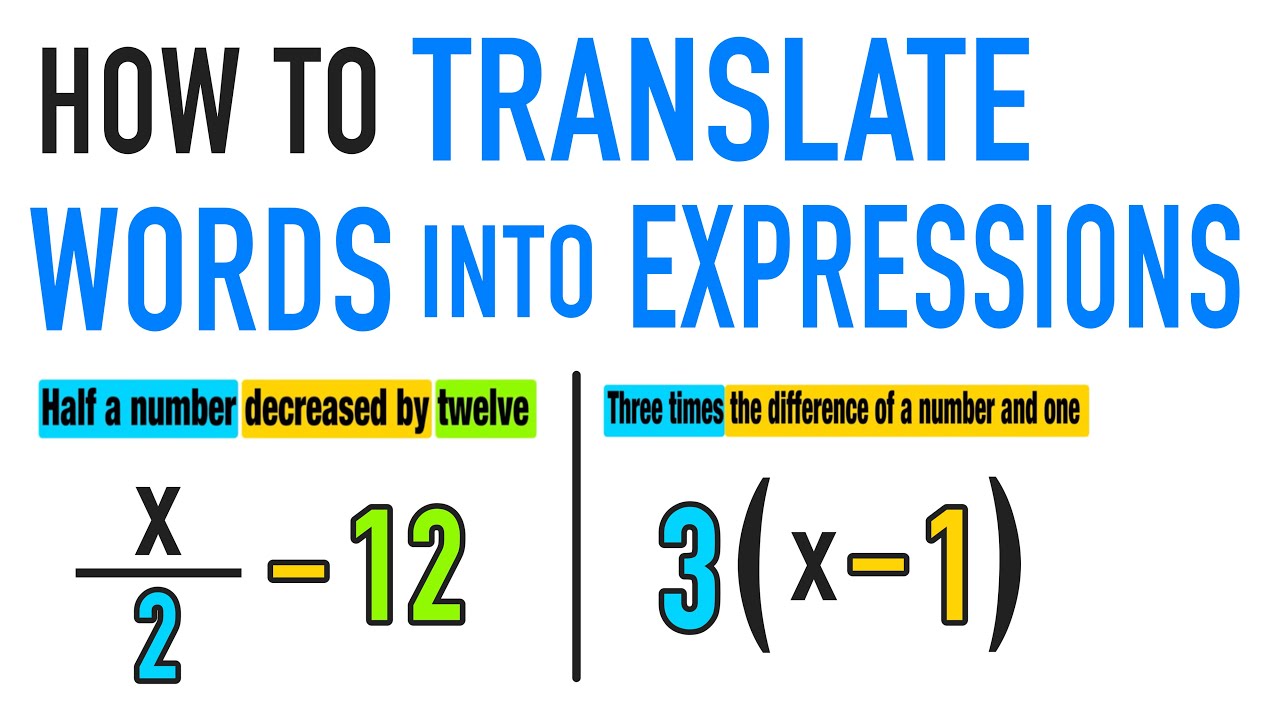
| Operation | Common verbal signals | Example |
|---|---|---|
| Addition | plus, sum, more than, increased by, total | “the sum of and 8” is |
| Subtraction | minus, difference, less than, decreased by | “ decreased by 8” is |
| Multiplication | times, product, twice, triple | “twice ” is |
| Division | divided by, quotient, ratio | “the quotient of and 5” is |
Read the following Khan Academy article for a concise operation-word reference and its especially important discussion of subtraction order.
Writing expressions | Math (article) | Khan Academy
In “Writing expressions” from Khan Academy, use the operation-word table as a reference, then concentrate on the explanation of why subtraction phrases must retain the order stated in the words.
Begin at the article’s opening and read the section “Different words for addition, subtraction, multiplication, and division,” including its table. Then read the subsection beginning “Let’s take a look at a trickier example,” through the discussion of “m decreased by 7.” The article explains that mathematical notation is more precise than verbal wording; read that motivation before the table. In the subtraction example, follow the order-of-terms explanation carefully. Finally, skim the “More complicated expressions” and “Word problems” examples to see how a variable represents a changing quantity.
Addition and multiplication are flexible in order
Addition and multiplication are commutative: switching the order does not change the value.
So “six more than ” may be written as either or . In conventional algebra, it is often clearest to write the variable term first:
Likewise, multiplication is commonly written without a multiplication sign:
Do not write in algebra if the symbol might be confused with the variable . A dot or simple adjacency is clearer.
Subtraction and division are not flexible in order
Subtraction and division are different. Reversing their terms changes the meaning:
That is why the wording matters so much.
Compare these phrases:
| Phrase | Start with | Expression |
|---|---|---|
| decreased by 6 | ||
| 6 decreased by | 6 | |
| the difference of and 6 | ||
| the difference of 6 and | 6 | |
| the quotient of and 6 | ||
| the quotient of 6 and | 6 |
The phrase “less than” deserves particular attention. It tells you that the quantity after “than” is the starting amount.
Read it in a full sentence:
Seven less than a score means start with the score and subtract seven.
This does not mean that every appearance of the word “than” automatically reverses something. Instead, translate the meaning: “7 less than ” means “7 subtracted from .”
Translate the structure, not merely individual words
A short phrase generally has one operation. A longer phrase can contain operations inside other operations. The aim is to identify the full pieces before combining them.
Watch the first eight examples in this short video, which moves from basic vocabulary to products and quotients built from complete sums or differences.
Writing Verbal Phrases as Algebraic Expressions (Examples)
In “Writing Verbal Phrases as Algebraic Expressions,” James Elliott works through increasingly structured translations. Watch for how he identifies the operation first and then determines the quantities to which it applies.
Watch basic phrases for the use of a variable and the reversal needed in “less than.” Then watch products and quotients, noticing that a square belongs to the variable and that a difference can become an entire denominator. Finish with grouped expressions; focus especially on why multiplication of a sum or difference requires parentheses.
“Of” and “and” often reveal the two inputs
Phrases of the form “the ___ of ___ and ___” state both the operation and the two quantities it acts on:
For example:
the quotient of 18 and a number
The main word is quotient, so division is required. The first quantity, 18, is the numerator; the second quantity, , is the denominator:
Words such as twice, half, square, and cube
Some common expressions can be translated efficiently:
| Phrase | Expression |
|---|---|
| twice a number | |
| three times a number | |
| half of a number | |
| one third of a number | |
| the square of a number | |
| the cube of a number |
The word of can indicate multiplication, particularly with fractional amounts:
Your previous work with exponents matters here. “The square of a number” means:
whereas “twice the number” means:
These have entirely different values. If , then , while .
Parentheses preserve a phrase’s meaning
Parentheses are not decorative. They record that several terms belong together before another operation is performed.
Consider the difference between these two statements:
Five times the sum of and 2
The main operation is multiplication: five times a sum. Since the sum is one complete factor, write:
Now compare it with:
The sum of five times and 2
The main operation is addition: a product plus 2.
The expressions are not equivalent. If , then:
but
The placement of the words tells you the structure. A useful reading strategy is to identify the main operation first.
Building nested expressions from the inside out
When a phrase contains a smaller phrase, translate the inner phrase first. Then treat its expression as one unit.
Example 1:
Three times the difference of a number and 4
- “the difference of a number and 4” is
- “three times” that whole difference is
Example 2:
Eight less than the product of 7 and
- “the product of 7 and ” is
- “eight less than” that product means subtract 8 from it
A common incorrect version is:
That would mean “the difference of 8 and the product of 7 and ,” which is a different phrase.
Example 3:
The quotient of 12 and the sum of and 3
The numerator is 12. The denominator is the entire sum :
The parentheses are essential. Without them, the expression
would describe a quotient first and then an addition outside it.
The OpenStax text provides further examples of this distinction, including the contrast between “times the sum” and “the sum of times.”
2.2 Evaluate, Simplify, and Translate Expressions
In the OpenStax Prealgebra section “Evaluate, Simplify, and Translate Expressions,” focus on its translation table and on the examples that show how parentheses capture the grouping described in words.
Read the subsection “Translate Words to Algebraic Expressions,” beginning with the operation table and continuing through the examples about “more than” and “less than.” The text emphasizes how operation phrases name two quantities; read that observation and use it as a parsing routine. Next read Example 2.25 and the surrounding discussion, where “five times the sum” is contrasted with “the sum of five times.” Finally, read Examples 2.26 and 2.27 in the later application section, focusing on how the author first states what the target quantity represents before writing its expression.
From a situation to an expression
In a word problem, the first task is not calculation. It is deciding what the variable represents and what quantity you have been asked to describe.
Consider this situation:
A rectangular garden has width meters. Its length is 3 meters more than its width. Write an expression for its length.
The variable is already defined:
The target is the length, not the width. “Three more than its width” means add 3 to the width:
The expression represents the length.
Now consider a more layered example:
A streaming service charges a monthly fee of 12 dollars plus 4 dollars for each movie rented. Let be the number of movies rented. Write an expression for the total monthly cost.
There are two parts of the cost:
- a fixed fee:
- a charge that depends on :
The total is:
Nothing is solved because no specific number of movies has been given. The expression is a model that works for every possible value of .
A context-based example with subtraction
Maya has points. After a penalty of 15 points, write an expression for her score.
Start with Maya’s original score, , and remove 15:
The reversed expression,
would represent the penalty amount minus Maya’s original score, not Maya’s remaining score.
A context-based example with grouping
A club buys shirts at 9 dollars each and then receives a 12-dollar discount from the total. Write an expression for the final cost.
First form the total before the discount:
Then subtract the 12-dollar discount:
Now change one phrase:
A club pays 9 dollars for each shirt after applying a 12-dollar discount to the price of each shirt. The original price per shirt is dollars.
The discount applies to each shirt’s price, so the adjusted price per shirt is:
For 9 shirts, the total is:
The context tells you whether subtraction applies once to a total or repeatedly to each item. Parentheses make that decision visible.
Check a translation before moving on
A good translation can be checked without solving any equation. Use these three checks.
1. Read your expression back in words
If you wrote
read it aloud:
Four times the quantity .
That matches “four times the sum of and 5.”
If the expression cannot be read back as the original phrase, revisit the structure.
2. Check the order of subtraction and division
For a phrase involving “less than,” “difference,” “decreased by,” “quotient,” or “divided by,” identify the starting quantity.
For example:
the difference between and 7
must begin with :
For:
the quotient of 3 and
3 is divided by the whole quantity :
3. Substitute a simple value as a meaning check
This does not prove a translation is correct, but it can expose a mistaken order or missing parentheses.
Suppose the phrase is:
twice the difference of a number and 3
The correct expression is:
Choose . In words, the difference is , and twice that is 4:
If you had written , substitution gives:
That expression says “three less than twice a number,” not “twice the difference.”
Key takeaways
Translating verbal statements into algebraic expressions means preserving the statement’s mathematical structure, not simply replacing individual words with symbols.
Keep these principles in view:
- Use a variable to represent an unknown or changing quantity.
- Identify the main operation and the quantities it connects.
- Addition and multiplication may be reordered, but subtraction and division cannot.
- “Less than” requires careful interpretation: “7 less than ” is .
- Parentheses show that a sum or difference is being treated as one complete quantity.
- In a word problem, define the variable and make sure your expression represents the requested quantity.
Next, you will use these translated expressions as raw material for simplifying algebraic expressions: combining like terms and applying the distributive property while preserving the structure you have learned to write accurately.
Can't find a good explanation? Sign up and we'll make it for you
Sign up