
Hello. In the previous lesson, you translated verbal statements into algebraic expressions by identifying operations, respecting the order of subtraction and division, and using parentheses to preserve a complete quantity such as “the sum of and 5.”
Now we take the next step: making an expression simpler without changing its value. You will learn to recognize which terms can be combined, use the distributive property to remove parentheses, and handle negative signs reliably. These skills prepare you to solve equations in the next lessons.
What “simplify” means
To simplify an expression is to rewrite it in an equivalent form that is shorter, clearer, or easier to use.
For example,
and
have the same value for every value of . The second expression is simplified because it has fewer terms.
Before simplifying, identify the terms: pieces separated by addition or subtraction signs.
In
the terms are:
Treat the sign in front of a term as part of that term. Thus, is one term, not merely “4 after a minus sign.”
Like terms
Like terms have exactly the same variable part. Their coefficients may differ.
| Terms | Like terms? | Why |
|---|---|---|
| and | Yes | Both contain |
| and | Yes | Both contain |
| and | Yes | Both are constants |
| and | No | Different variables |
| and | No | Different powers of |
| and | Yes | Same variable part, |
When combining like terms, add or subtract their coefficients while keeping the variable part unchanged:
But do not combine unlike terms:
is already simplified, because an -quantity and a -quantity represent different kinds of algebraic objects. Likewise,
cannot be combined: and are not the same kind of term.
A useful analogy is units of measurement. You can combine 3 meters and 5 meters, but not 3 meters and 5 square meters. In algebra, the variable part, including its exponent, plays a similar role.
Combining like terms carefully
Consider:
First group terms by type, keeping their signs:
Now combine the -terms and the constants:
The terms were rearranged only to make the matching types easier to see. Addition allows us to regroup terms without changing the expression’s value.
When an expression contains subtraction, rewrite it mentally as addition of a negative:
means
So the coefficient calculation is simply:
Therefore,
Be especially alert for a coefficient of or :
For example,
Parentheses: distribute before combining across them
Often, terms inside parentheses cannot be combined with terms outside until the parentheses are removed. The tool for this is the distributive property:
and
The factor outside the parentheses multiplies every term inside.
For instance:
means three groups of . Distribute the 3:
Multiply:
Notice what did not happen: does not become . The 3 must multiply both terms.
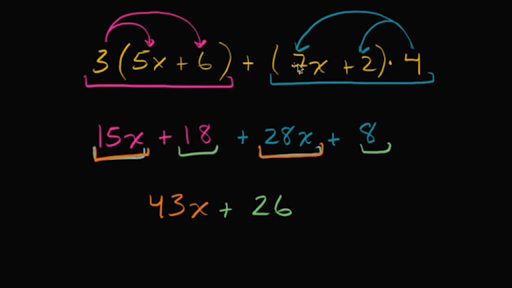
The image shows the standard overall strategy:
- Distribute every factor that is attached to parentheses.
- Rewrite the expression without parentheses.
- Identify and group like terms.
- Combine their coefficients and constants.
Watch Math with Mr. J’s walkthrough for two examples that use exactly this sequence: one with a single set of parentheses and one with two variable types.
Simplifying Algebraic Expressions | Distributive Property & Combining Like Terms | Math with Mr. J
Watch “Simplifying Algebraic Expressions” by Math with Mr. J. It demonstrates why distribution must come before combining across parentheses, and it models a clear way to reorganize like terms.
In the first example, watch one distribution. Follow how 4 multiplies both a and 9, after which 13a and 4a can be combined. Then watch two distributions. Focus on the distinction between g-terms and h-terms, and notice that regrouping terms is used only after all parentheses have been removed.
A complete example: distribute, then combine
Simplify:
The parentheses contain two unlike terms, and , so they cannot be combined. But the 2 can be distributed:
Now all parentheses are gone. Group the like terms:
Combine:
So,
The two expressions have identical values. For a quick check, let :
and
Substitution is not the simplifying method itself, but it is a useful check when you are unsure whether a sign or distribution step was handled correctly.
Negative factors and subtraction before parentheses
The most common errors arise when a negative sign appears immediately before parentheses.
Consider:
The subtraction means that the entire product is being subtracted. A reliable method is to treat the outside factor as :
Now distribute to every term:
Combine like terms:
Thus,
The key point is that both signs inside the parentheses are affected by the negative factor:
Here is another example where one term inside is already negative:
Treat the outside factor as :
Distribute:
The final appears because a negative times a negative is positive:
Combine:
A helpful habit is to write every distributed product explicitly before doing any combining. Skipping directly from the original expression to a final line makes a dropped sign harder to detect.
A more involved example
Simplify:
There are two grouped expressions. Distribute the 7 through the first parentheses:
For the second group, the subtraction means we distribute , not :
Put those results together:
Now group like terms:
Finally,
Therefore,
This expression is the central pattern to master: distribution handles the structure created by parentheses; combining like terms handles the terms that remain afterward.
A dependable simplification checklist
For expressions at this stage of algebra, use this order:
- Locate grouping symbols. Look for parentheses or brackets attached to a number, variable, or negative sign.
- Distribute completely. Multiply the outside factor by each term inside each group.
- Write every resulting term with its sign. This prevents sign errors.
- Remove the grouping symbols.
- Sort by type. Place -terms together, -terms together, other variable types together, and constants together.
- Combine only like terms.
- Write the result in a readable order. When appropriate, write higher powers first, then lower powers, with constants last.
For example, after distribution you might obtain:
Group matching terms:
Then simplify:
The terms and combine, while the -terms form a separate group. The exponent is part of a term’s identity.
Common mistakes and how to prevent them
Combining unlike terms
Incorrect:
The number 5 has no , so it is not an -term. The expression is already simplified:
Distributing to only one term
Incorrect:
Correct:
The 4 multiplies the and the 3.
Losing the negative sign
Incorrect:
Correct:
The second product is:
Combining before removing parentheses
In
you cannot combine with the inside the parentheses yet. First distribute:
Only then can the like -terms combine:
Key takeaways
A simplified expression is equivalent to the original expression but written more efficiently.
Remember:
- Terms are like only when their variable parts, including exponents, match exactly.
- Constants combine only with constants.
- To combine variable terms, add or subtract their coefficients.
- Use the distributive property to multiply an outside factor by every term inside parentheses.
- A subtraction before parentheses can be handled by distributing a negative factor.
- In expressions that use both ideas, distribute first and combine like terms afterward.
Next, you will evaluate algebraic expressions by substitution: replacing variables with given numbers and using the order of operations to calculate a value.
Can't find a good explanation? Sign up and we'll make it for you
Sign up