
Hello again. In the previous lesson, you practiced the four operations with signed fractions and decimals. Those skills are now ingredients in a larger task: evaluating a complete numerical expression without changing its meaning along the way.
This lesson introduces the order of operations and shows how integer exponents fit into that order. By the end, you should be able to evaluate expressions containing grouping symbols, positive, zero, and negative exponents, multiplication or division, and addition or subtraction—while handling negative signs accurately.
Why expressions need an agreed order
Consider:
If someone adds first, they get . If someone multiplies first, they get . The arithmetic in both attempts may be correct, but mathematics needs one shared interpretation of the written expression. The order of operations supplies that interpretation.
Math Antics - Order Of Operations
Watch Math Antics – Order of Operations by mathantics for a clear visual explanation of why the rules exist and how the levels of priority work.
Watch the purpose to see why a common calculation order matters. Then watch grouping symbols and exponents. Finish with equal priorities, focusing especially on why multiplication and division, as well as addition and subtraction, must be handled from left to right.
The common mnemonic is PEMDAS:
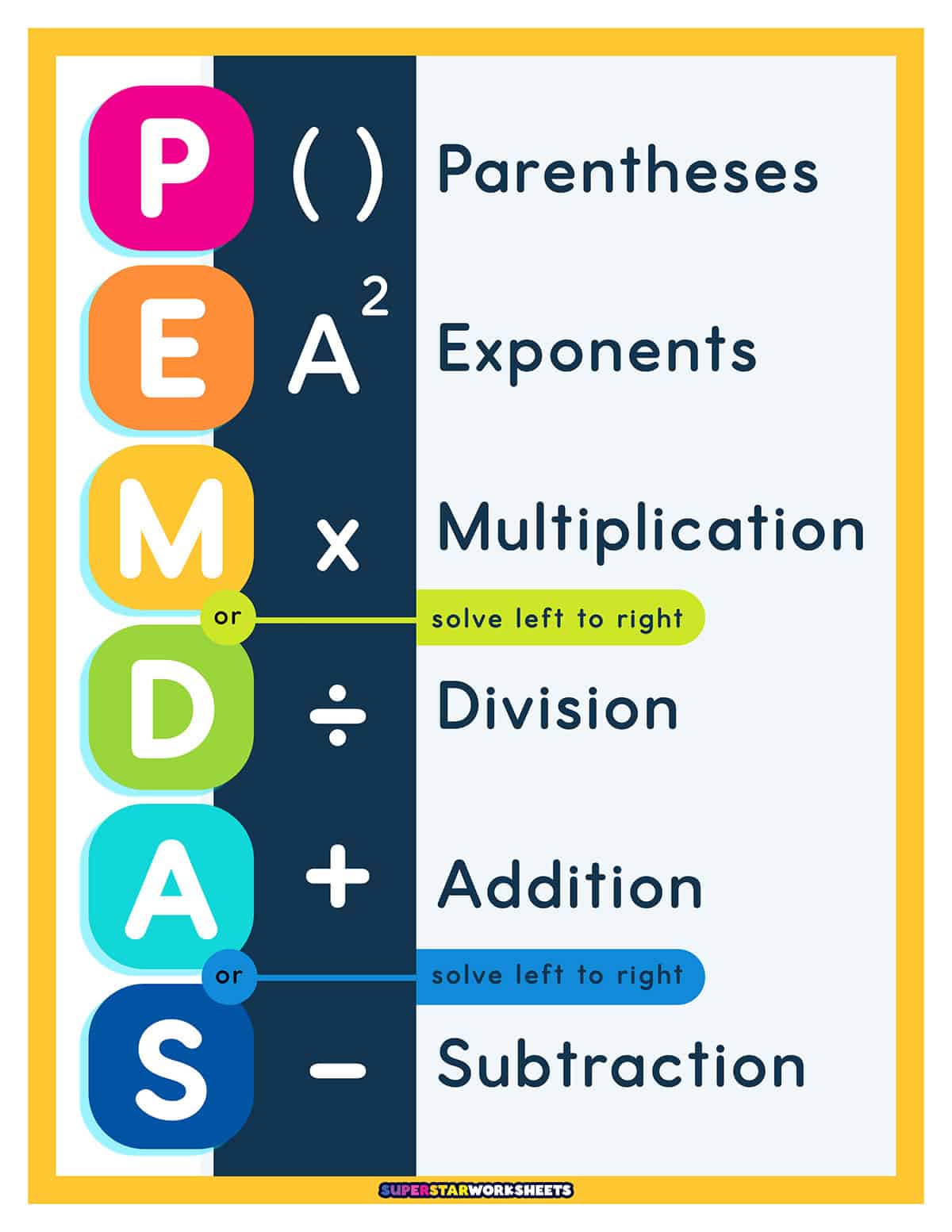
The letters are useful, but they can lead to two serious misunderstandings. PEMDAS is not a strict six-step ladder:
- Multiplication and division have equal priority.
- Addition and subtraction have equal priority.
The actual rules are:
- Simplify inside parentheses and other grouping symbols. With nested grouping, begin with the innermost group.
- Evaluate exponents.
- Perform multiplication and division, working from left to right.
- Perform addition and subtraction, working from left to right.
A fraction bar is also a grouping symbol: simplify its numerator and denominator before carrying out operations outside the fraction.
Grouping symbols establish what belongs together
Parentheses tell you to treat the enclosed material as a unit. Compare these two expressions:
The same numbers and operations produce different values because the parentheses change the structure.
When parentheses contain several operations, do not merely calculate the first operation you notice. Apply the full order of operations inside the parentheses first. For example:
The innermost parentheses simplify first:
Evaluate the exponent within the brackets:
Then finish the bracketed expression:
Brackets and parentheses have the same purpose here. They are often used together simply to make nested groups easier to read.
Exponents: repeated multiplication, with careful attention to the base
An exponent describes repeated multiplication. In
the base is , and the exponent is . It means:
In general, for a positive integer ,
The exponent applies to its base only. Parentheses determine whether a negative sign is part of that base.
Compare:
with
In the first expression, the base is , because the negative sign is inside parentheses. In the second, the exponent applies to alone; the negative sign remains outside.
This distinction matters especially for even exponents:
| Expression | Meaning | Value |
|---|---|---|
A useful habit is to circle or mentally identify the entire base before evaluating the power.
Zero and negative integer exponents
Integer exponents can also be zero or negative.
For every nonzero number ,
So,
The special case is considered undefined in this setting.
A negative exponent represents a reciprocal:
provided . For example,
and
A negative exponent does not make the answer negative by itself. It tells you to take a reciprocal. The sign of the final value depends on the base and whether its positive exponent is even or odd.
Evaluating a complete expression
The safest method is to write one clear step per line. Do not try to perform several priority levels mentally at once.
Consider:
Start with the parentheses:
Now evaluate all exponents:
Next comes division:
Finally, addition and subtraction have equal priority, so work left to right:
Therefore,
Notice several important details:
- The parentheses in make the entire sum the base.
- The parentheses in make the negative sign part of the base.
- Division occurs before the remaining addition and subtraction.
- The final is evaluated from left to right.
Fractions, exponents, and grouping
Your fraction skills from the previous lesson remain essential. Treat the numerator and denominator of a fraction as grouped expressions.
Evaluate:
First simplify the powers in the numerator and denominator:
Then simplify the numerator:
Now perform the addition:
The key point is that the subtraction belongs entirely to the numerator, while belongs entirely to the denominator. You should not add until the first fraction has been evaluated.
Here is another expression involving a negative exponent:
Evaluate exponents first:
Then multiply:
Finally, work from left to right through subtraction and addition:
So,
Although a negative exponent can produce a fraction, the order of operations does not change.
Common errors to avoid
Most incorrect answers come from a small number of predictable mistakes.
Treating PEMDAS as “multiply before divide”
This is incorrect:
Multiplication and division are tied, so begin from the left:
Calculating first would change the structure of the expression.
Treating addition as always before subtraction
Likewise, addition and subtraction are tied. Work from left to right:
Forgetting that an exponent comes before multiplication
In
evaluate the power before multiplying:
It is not . That would require parentheses.
Ignoring parentheses around a negative base
Keep these meanings separate:
The written grouping, not the way the expression sounds when read aloud, determines the answer.
A practical evaluation routine
For a longer numerical expression, use this short routine:
- Scan for grouping symbols. Simplify the innermost groups first.
- Evaluate each exponent. Identify its complete base before calculating.
- Move through multiplication and division from left to right.
- Move through addition and subtraction from left to right.
- Check signs and size. A squared quantity is nonnegative; a negative exponent with a nonzero base produces a reciprocal; and parentheses may change an expected sign.
Writing intermediate lines is not wasted work. It preserves the expression’s structure and makes an error easier to locate.
Key takeaways
The order of operations gives every numerical expression one agreed meaning. Simplify grouping symbols first, then exponents, then multiplication or division from left to right, and finally addition or subtraction from left to right.
An exponent applies only to its base. Parentheses are therefore essential when a negative number is intended to be the base, as in . Zero exponents give for nonzero bases, while negative exponents create reciprocals.
Next, you will use this same structural awareness to translate verbal statements into algebraic expressions. The order of operations is the grammar that makes those expressions unambiguous.
Can't find a good explanation? Sign up and we'll make it for you
Sign up