
Hello. In the previous lesson, you simplified algebraic expressions by distributing factors and combining like terms. Simplifying keeps an expression in terms of variables; evaluating goes one step further: you are given numerical values for the variables and calculate one numerical result.
This lesson develops a dependable substitution method for expressions with one or several variables, including negative values, exponents, fractions, and practical formulas. These skills will be useful immediately when equations appear: evaluating checks whether a value makes an equation true, while solving finds the value that does.
Substitution: replacing a variable everywhere
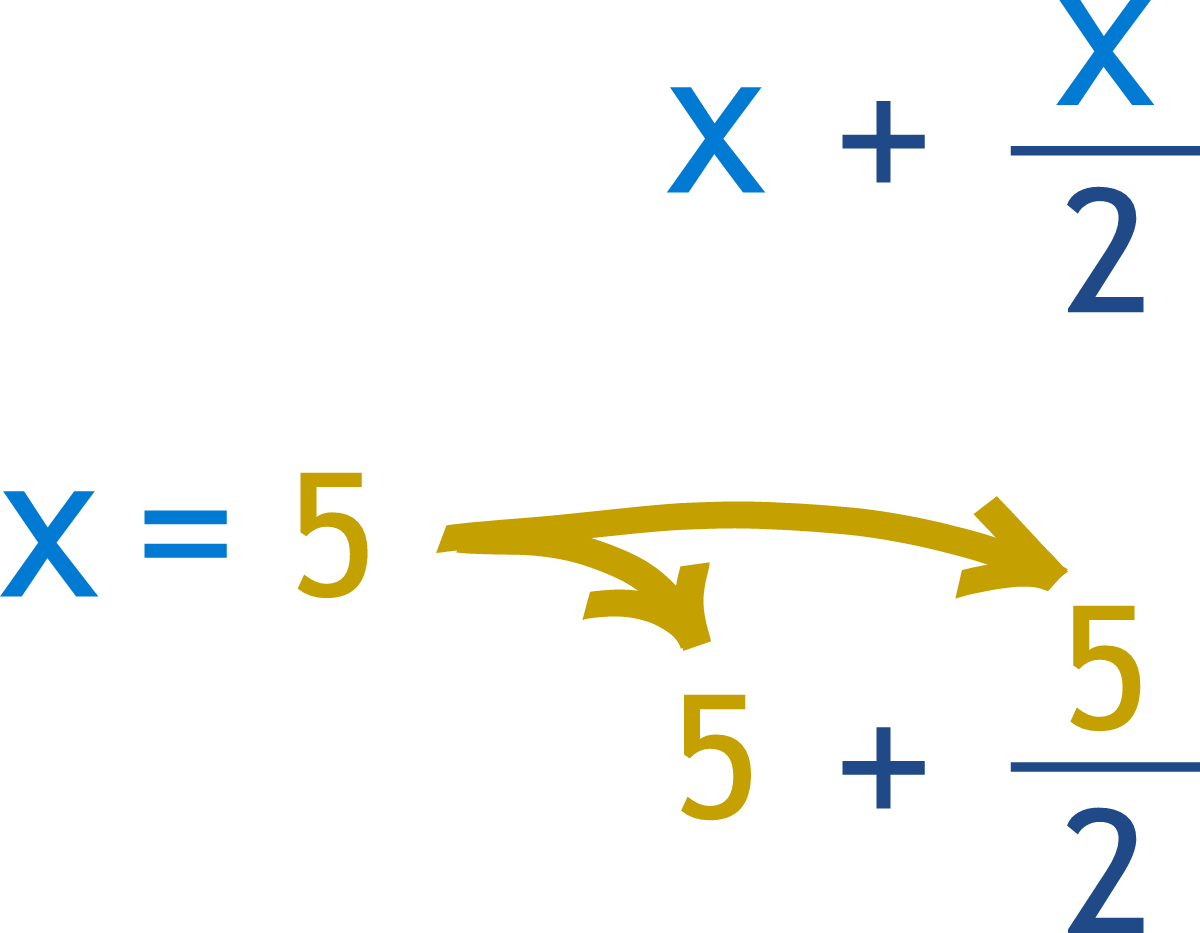
A variable is a symbol that can stand for a number. If you are told that , then every in an expression represents 5.
To evaluate an expression means to find its numerical value after substituting the given value or values.
For example, evaluate
when .
Replace each occurrence of with 5:
Now calculate:
The key idea is not “put a number near the expression.” It is: rewrite the complete expression, replacing every instance of the variable with its assigned value.
A number written directly beside a variable indicates multiplication:
So, if ,
After substitution, use a multiplication dot or parentheses. Writing would mean eighty-five, not multiplied by 5.
Intro to Evaluating Algebraic Expressions | How to Evaluate Algebraic Expressions | Math with Mr. J
Watch “Intro to Evaluating Algebraic Expressions” from Math with Mr. J. It gives a concise model of the full process, from a single substituted value to expressions involving two variables and order of operations.
Watch the overview for the meaning of evaluation. Then watch one variable examples, paying attention to how a coefficient next to a variable becomes explicit multiplication. Finish with multiple variables, and notice that substitution happens before applying the order of operations.
A reliable evaluation routine
Use the same sequence nearly every time:
- Record the given values. For example, and .
- Copy the original expression. Do not calculate mentally before you have rewritten it.
- Substitute every variable value in parentheses. This is essential for negative values.
- Evaluate using the order of operations. Parentheses and exponents come before multiplication and division; multiplication and division come before addition and subtraction.
- Check that no variables remain. If every required value was given, the final result should be a number, sometimes with units.
Consider:
when . Substitute first:
Multiplication occurs before addition:
It would be incorrect to add 5 and 3 first. The expression is not
Parentheses in the original expression—and parentheses inserted during substitution—tell you what is grouped.
Why negative values must be parenthesized
Negative substitutions are where most errors occur. Suppose you must evaluate
when .
Write the negative value in parentheses every time it replaces :
Now follow the order of operations:
The first term is positive because
The second term is also positive because subtracting a negative becomes addition:
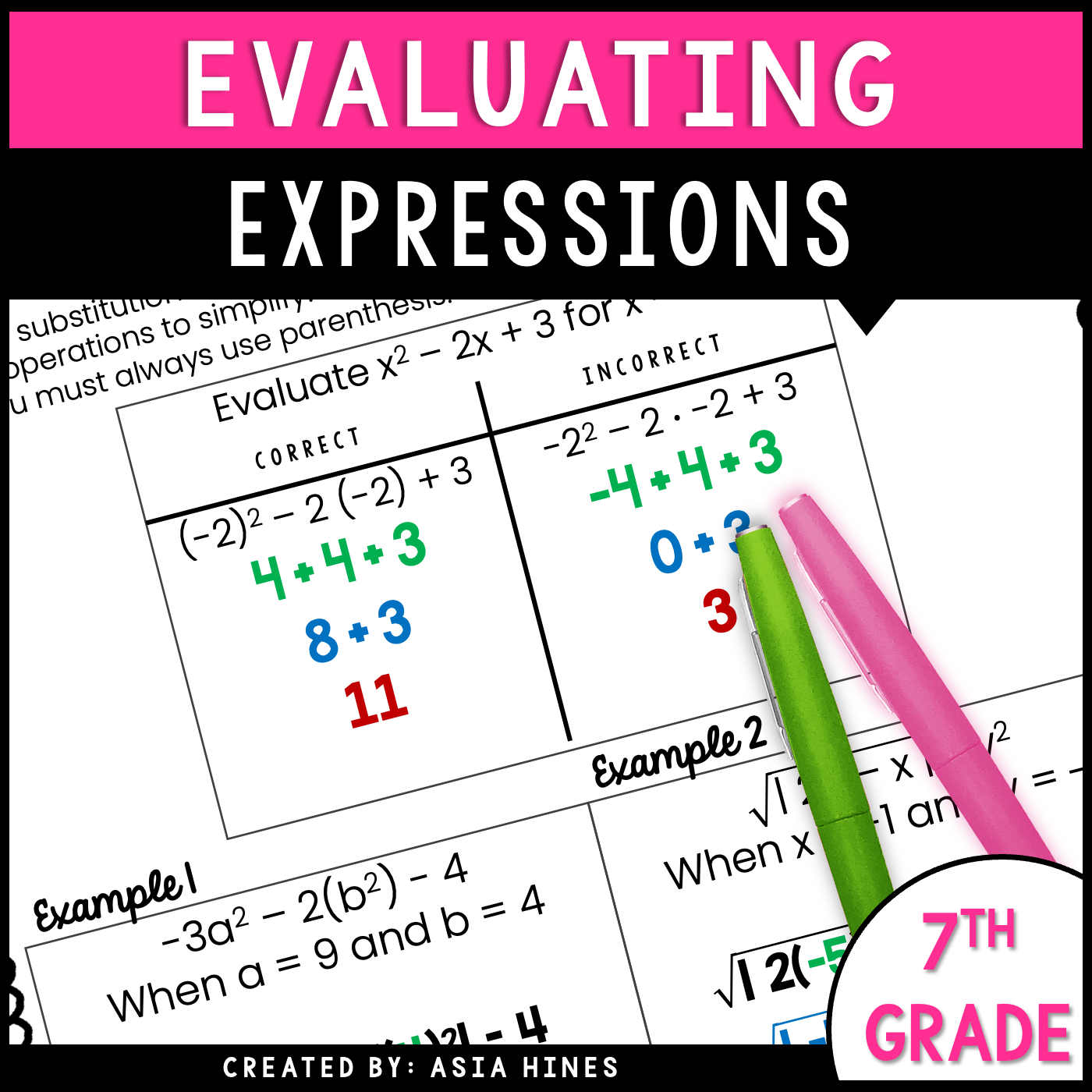
Compare these two expressions carefully:
but
The exponent in the second expression applies to 2 only; the negative sign is outside the exponent. When substituting a negative value for a variable with an exponent, parentheses remove ambiguity:
becomes
not
A dependable rule is:
Put parentheses around a substituted negative value, even if you think they are unnecessary.
For instance, evaluate
when :
Evaluate the exponent first:
Then multiply and subtract:
Expressions with more than one variable
In an expression with several variables, each letter may have a different assigned value. Accuracy depends on putting each value in its proper location.
Evaluate
when
and
First, substitute all values:
Now evaluate exponents, multiplication, and division:
Finally, add and subtract from left to right:
So the expression has value
Notice three structural details:
- means .
- The fraction bar groups the entire numerator and denominator.
- becomes , with parentheses around the negative input.
Here is a shorter example:
when and .
Do not reverse the assigned values. Substituting 10 for and 9 for would evaluate a different expression.
Substitution in formulas
A formula is an equation relating quantities. It often uses variables to describe a general situation. When measurements are known, substitution turns the general formula into a specific calculation.
For a rectangle with length and width , its perimeter is
If
and
substitute each measurement:
Evaluate:
The unit is meters because perimeter measures a total length.
For a trapezoid, the area formula is
where and are the parallel base lengths and is the height. Let
Substitute without changing the formula’s structure:
Calculate the grouped sum and division:
Therefore,
Area has square units because one length is multiplied by another length.
Evaluating Algebraic Expressions
Read the worked examples in “Evaluating Algebraic Expressions” from CK-12. They extend the substitution method to fractions, negative values, and formulas with several variables.
In the subsection “Evaluating an Expression,” begin with the note that recommends parentheses for substituted values. Read the substitution conventions, including the example with a negative value. Then move to “Evaluating an Expression with Multiple Variables” and read the trapezoid-area example through its final value. Start at the formula substitution; focus on preserving the fraction and parentheses while replacing each variable.
Evaluate, simplify, or solve?
These three actions are related but have different goals.
| Action | What you do | Example result |
|---|---|---|
| Simplify | Rewrite an equivalent expression more efficiently | becomes |
| Evaluate | Substitute known values and calculate a number | If , becomes 6 |
| Solve | Find which variable value makes an equation true | has |
You may simplify before evaluating, but you do not have to. Both valid paths should give the same result.
For example, evaluate
when .
You could substitute first:
Or simplify first, using the skills from the previous lesson:
Then substitute:
Both methods produce the same value because the simplified expression is equivalent to the original. In most basic evaluation problems, direct substitution is simplest; simplifying first can help when the original expression has many like terms or parentheses.
Common errors and a final check
Before accepting an answer, scan your work for these issues:
| Potential error | Reliable prevention |
|---|---|
| Replacing only one occurrence of a variable | Point to each occurrence as you substitute. |
| Treating as the number 6 followed by | Rewrite it as after substitution. |
| Dropping a negative sign | Substitute negative values as . |
| Calculating before the full substitution is written | Finish the substitution line before doing arithmetic. |
| Ignoring order of operations | Evaluate exponents, multiplication, and division before addition and subtraction. |
| Losing units in a formula | Attach units to the final answer; use square units for area. |
| Substituting the wrong value for a variable | Keep the given values visible and match letters one at a time. |
A fast self-check is to ask: Did I preserve the original structure? The terms, fraction bars, exponents, and parentheses should all still be visible in your substitution line. Only the letters should have changed into numbers.
Key takeaways
Evaluating by substitution has a simple purpose: replace variables with known values and compute the resulting numerical expression.
Remember:
- Substitute for every occurrence of each variable.
- Make multiplication explicit after substitution, such as .
- Put parentheses around negative substituted values, especially before exponents.
- Apply the order of operations only after the substitution line is complete.
- In formulas, match each quantity to the correct variable and retain meaningful units.
- Simplifying and evaluating can be done in either order when both are appropriate, because equivalent expressions have the same value for the same input.
Next, you will use algebra in the opposite direction: rather than being given a variable value and calculating an outcome, you will solve one-step and two-step equations to find an unknown value.
Can't find a good explanation? Sign up and we'll make it for you
Sign up