
Hello again. In the previous lesson, you learned how signs affect integer operations: subtraction can be rewritten as adding an opposite, and multiplication or division gives a positive result for matching signs and a negative result for different signs. Those same sign principles apply unchanged to fractions and decimals.
This lesson extends that number sense to all four operations. The key is to recognize that fractions and decimals represent place value or parts of a whole. Accuracy comes from choosing the right procedure for the operation, keeping signs attached to numbers, and checking whether the size of an answer makes sense.
Fractions: units matter
A fraction
means parts of size , where . The denominator tells you the size of each part; the numerator tells you how many of those parts you have.
For example,
means three pieces when one whole has been split into eight equal pieces. This is why the denominators have such different roles in different operations:
- For addition and subtraction, the pieces must be the same size first.
- For multiplication, fractions act as scaling factors, so multiply across.
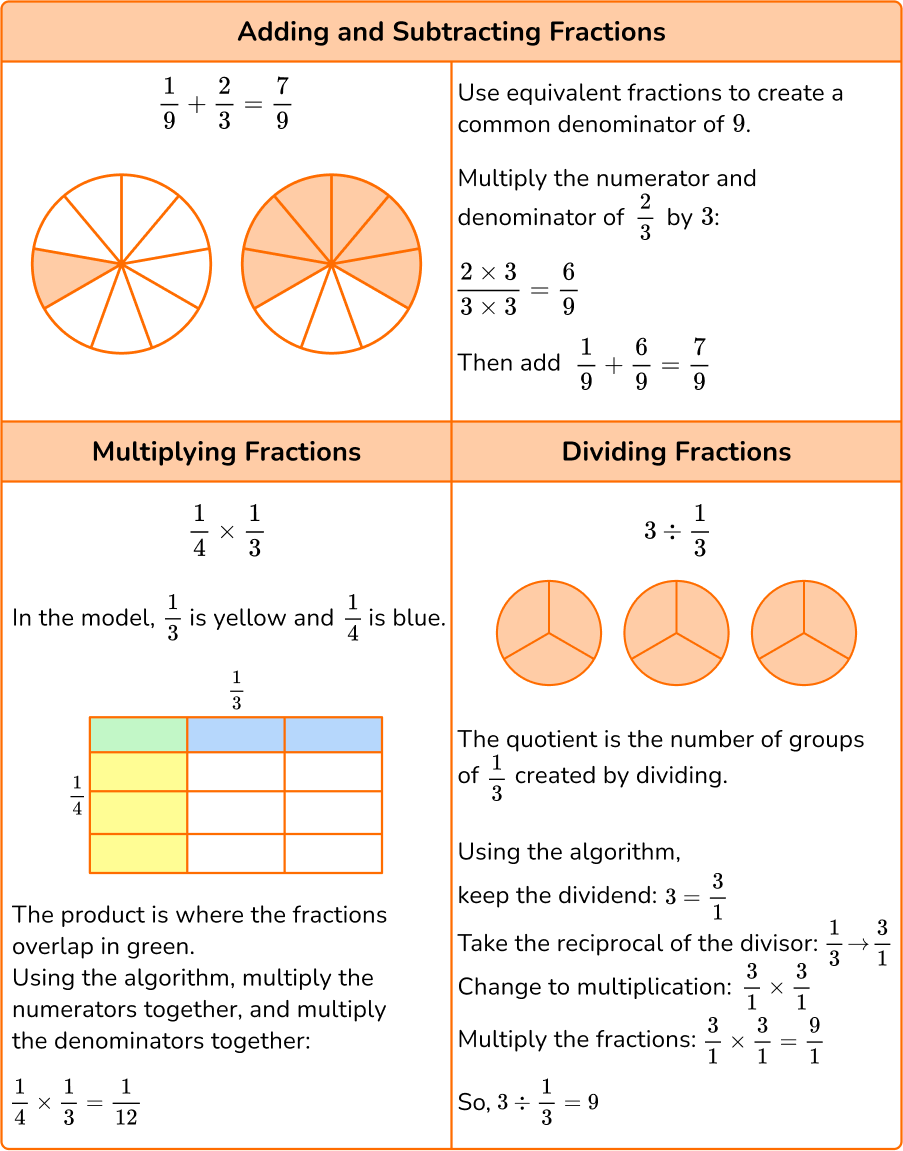
- For division, ask how many groups of one quantity fit in another; this leads to multiplying by a reciprocal.
The following overview image gives a useful visual map of these four procedures.
Equivalent fractions
Equivalent fractions name the same quantity:
Multiplying the numerator and denominator by the same nonzero number preserves the value:
For example,
This principle is the foundation of adding or subtracting fractions with unlike denominators.
Adding and subtracting fractions
You may add numerators only when the fractions already have a common denominator:
The denominator stays because every piece is an eleventh. You are simply combining elevenths and elevenths.
It would be incorrect to write
because thirds and fourths are different-sized pieces. First express both fractions in a shared unit.
Finding a common denominator
The most efficient shared denominator is usually the least common denominator (LCD): the least common multiple of the denominators.
Consider:
The least common multiple of and is . Rewrite each fraction in twenty-fourths:
Now subtraction is meaningful:
The reliable procedure is:
- Find the LCD of the denominators.
- Rewrite each fraction as an equivalent fraction with that denominator.
- Add or subtract the numerators.
- Keep the common denominator.
- Simplify the result, if possible.
A fraction is in simplest form when its numerator and denominator have no common factor greater than . For instance,
because both and divide by .
Fractions Review | Adding, Subtracting, Multiplying, and Dividing Fractions | Math with Mr. J
Watch “Fractions Review | Adding, Subtracting, Multiplying, and Dividing Fractions” from Math with Mr. J for a worked visual review of finding a common denominator and of fraction division.
First, watch fraction addition. Follow why the denominators must match and how multiplying both parts of a fraction preserves its value. Later, watch fraction division, concentrating on why the divisor, not the dividend, is flipped.
Signed fractions
A negative sign may be written in any one of these equivalent positions:
In calculations, it is clearest to place it in front:
Use the signed-integer rules from the previous lesson after the denominators match. For example,
has LCD :
For subtraction, retain the general principle:
Thus,
becomes
and then
Parentheses make it clear that the negative sign belongs to the entire fraction being subtracted.
Multiplying and dividing fractions
Multiplication does not require a common denominator. Multiply numerators together and denominators together:
For example,
A useful accuracy habit is to simplify before multiplying when possible. This is often called cross-cancelling, but it is only valid when factors are being multiplied.
First reduce factors across the product:
So the product is
Do not cancel terms separated by addition or subtraction. For example, in
the cannot “cancel” with the . Cancellation works only with common factors, not separate added terms.
Division and reciprocals
To divide by a fraction, multiply by its reciprocal. The reciprocal of is .
For example,
becomes
A whole number can be written as a fraction over :
So,
The sign rule remains the same: matching signs produce a positive quotient; different signs produce a negative quotient.
Two restrictions are essential:
- A fraction cannot have a denominator of .
- You cannot divide by . In particular, has no reciprocal.
Decimals: place value determines the setup
Decimals use base-ten place value. For example,
means four ones, six tenths, and three hundredths. Adding a zero to the right of a decimal does not change its value:
This fact makes decimal arithmetic much safer.
Add and subtract by aligning decimal points
When adding or subtracting decimals, line up the decimal points, not merely the rightmost digits. This ensures that ones are combined with ones, tenths with tenths, and so on.
For addition:
write as :
For subtraction:
The result must be negative because the number being subtracted has greater magnitude. Find the positive difference, then attach the sign:
Therefore,
This mirrors signed-integer subtraction. In both cases, it helps to ask: Should the result lie above or below zero?
Multiply and divide decimals
Multiplication
For decimal multiplication, first determine the sign. Then temporarily ignore the decimal points and multiply as whole numbers. Finally, count the total number of decimal places in both original factors.
Consider:
The signs differ, so the answer will be negative. Ignore decimals first:
There are two decimal places in and one in , for three in total. Place the decimal three places from the right:
A quick estimate checks this: is a little more than , and is less than , so a product near , rather than , is reasonable.
Division
When dividing by a decimal, make the divisor a whole number by multiplying both numbers by the same power of . This does not change the quotient because it is equivalent to multiplying the numerator and denominator of a fraction by the same nonzero number.
For example,
has a divisor with two decimal places. Multiply both quantities by :
Then divide:
So,
Notice the distinction between multiplication and division:
| Operation | What determines decimal placement? |
|---|---|
| Addition or subtraction | Align decimal points before calculating |
| Multiplication | Add the numbers of decimal places in the factors |
| Division by a decimal | Shift the decimal in both dividend and divisor until the divisor is whole |
How to Add, Subtract, Multiply, and Divide Decimals | A Review of Decimals | Math with Mr. J
Watch “How to Add, Subtract, Multiply, and Divide Decimals” from Math with Mr. J for a clear procedural demonstration of decimal place value in each operation.
Watch decimal addition to see why decimal points, rather than final digits, must be aligned. Then watch decimal multiplication for the total-decimal-places method. Finish with decimal division, focusing on the rule that any shift made to the divisor must also be made to the dividend.
Fractions and decimals: choosing a useful form
Fractions and decimals can express the same value:
For addition, subtraction, multiplication, and division, use the form that makes the calculation clearest:
- Use fractions when exact parts are important, especially when thirds, sixths, or other non-terminating decimals appear.
- Use decimals when working with measurements or money, where tenths and hundredths are natural.
- Do not switch forms partway through unless doing so genuinely simplifies the work.
For example, money is conventionally written to the nearest hundredth:
But an exact fraction such as
does not terminate as a decimal. Writing it as changes its value; is only an approximation.
Accuracy checklist
Before accepting an answer, pause for a brief check:
-
Did I choose the correct operation rule?
Addition and subtraction need common fraction denominators; multiplication and division do not. -
Are the units aligned?
For decimals, align decimal points. For fractions, use a common denominator when adding or subtracting. -
Did I manage signs separately from arithmetic?
Determine the sign first for multiplication and division; use the signed-number rules for addition and subtraction. -
Did I simplify appropriately?
Reduce fractions. Remove unnecessary trailing zeros in decimals unless a context such as money calls for them. -
Is the magnitude reasonable?
Multiplying by a proper fraction or a decimal between and should make a positive quantity smaller. Dividing by a small positive decimal can make a quantity much larger.
Key takeaways
Fractions require attention to the meaning of the denominator: add or subtract only after converting to a common denominator. Multiply fractions straight across, and divide by multiplying by the reciprocal of the divisor.
Decimals depend on place value: align decimal points for addition and subtraction, count total decimal places for multiplication, and shift both dividend and divisor equally to make a decimal divisor whole. The sign rules from integer arithmetic apply throughout.
Next, you will combine these skills in longer numerical expressions by using the order of operations and integer exponents.
Can't find a good explanation? Sign up and we'll make it for you
Sign up