
Hello, and welcome to the first lesson in Mathematics — Algebra Foundations. This module builds the numerical fluency behind later algebra: before solving equations or simplifying expressions, you need to be able to treat positive and negative quantities reliably.
In this lesson, you will learn to add, subtract, multiply, and divide signed integers. Integers are whole numbers, their negatives, and zero: for example, , , and . The central aim is not merely to memorize sign rules, but to understand what those rules mean so that you can check whether an answer is reasonable.
Signed numbers: position, direction, and opposites
A positive integer describes an amount above, ahead of, gained, or added. A negative integer describes an amount below, behind, lost, owed, or removed. The meaning depends on the context, but the mathematics stays the same.
A number line organizes the integers around , called the origin:
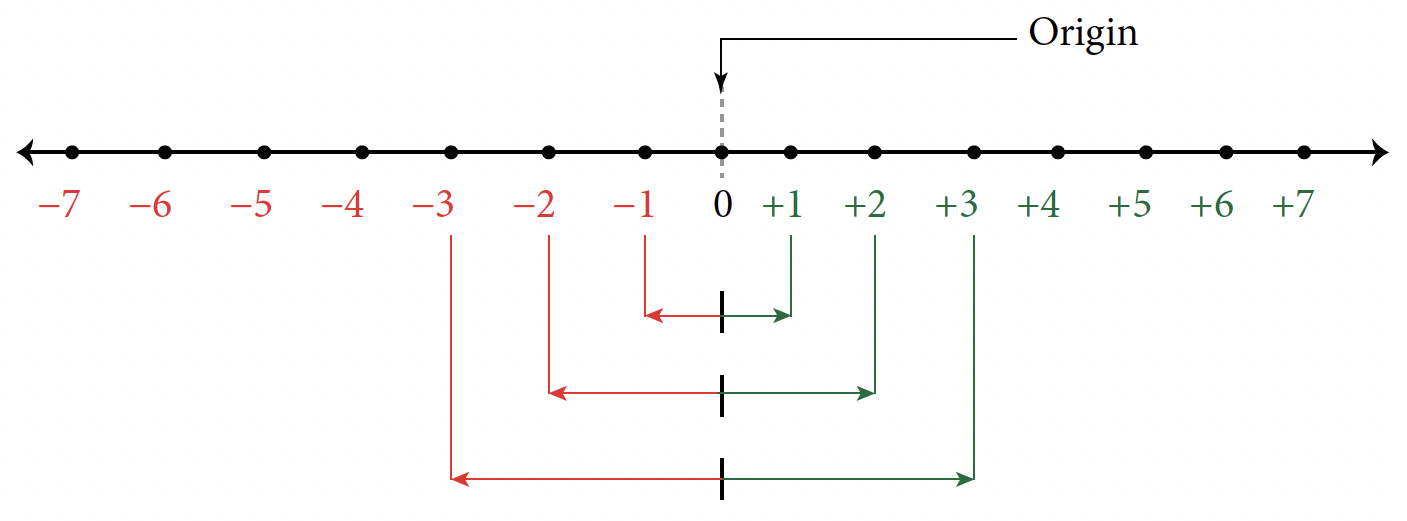
Every nonzero integer has an opposite:
- The opposite of is .
- The opposite of is .
- The opposite of is .
A number and its opposite add to zero:
This is why they are also called additive inverses. Keep this idea separate from absolute value. Absolute value is distance from zero, so it is never negative:
Opposites have different signs; their absolute values are the same.
Adding signed integers
Addition combines changes. On a number line, begin at the first number:
- Adding a positive number moves right.
- Adding a negative number moves left.
For example,
means start at , then move units left. You land at .
A concrete way to understand this is to imagine positive and negative counters. One positive counter paired with one negative counter has total value zero. The pair cancels:
OpenStax uses this “neutral pair” model before moving to the faster mental rules.
3.2 Add Integers - Prealgebra 2e
Read this OpenStax section to connect integer addition rules to neutral pairs: a positive and a negative of equal size cancel to zero. This gives a reason for the rules rather than treating them as isolated sign tricks.
In the opening section, read from the counter model, then work through Examples 3.14–3.17 under “Model Addition of Integers.” Next, in “Simplify Expressions with Integers,” read the explanation beginning the transition to rules. Focus on what happens when signs match and on why opposite-signed counters cancel.
Same signs: combine magnitudes and keep the sign
If both integers are positive, ordinary addition applies:
If both are negative, combine their magnitudes and keep the negative sign:
Think of the second expression as starting units below zero and then moving another units left. You end units below zero.
Different signs: compare magnitudes
For different signs, the quantities partially cancel. Subtract the smaller absolute value from the larger absolute value, then give the result the sign of the number with the larger absolute value.
The absolute values are and . Their difference is . Because has the greater absolute value and is positive:
Now reverse which magnitude is larger:
Again, the difference in magnitudes is , but the larger magnitude belongs to . Therefore:
A compact addition guide is:
| Signs of addends | What to do | Sign of result |
|---|---|---|
| Same | Add absolute values | Keep the shared sign |
| Different | Subtract smaller absolute value from larger | Use the sign of the larger absolute value |
Do not decide the sign merely by looking at which number appears first. In
the negative number has the greater absolute value, so:
The first number tells you where you start on the number line; the total movement determines where you finish.
How to Add, Subtract, Multiply, and Divide Integers | A Review of Integers | Math with Mr. J
Watch “How to Add, Subtract, Multiply, and Divide Integers” from Math with Mr. J for a concise visual review of the full set of sign rules. The first part gives two useful perspectives on addition: comparing absolute values and tracking movement from a starting value.
Watch integer addition. Pay particular attention to the contrast between 12 + (-7), where signs differ, and (-8) + (-10), where signs match. Then watch subtraction for the “add the opposite” method and the debt interpretation of subtracting a negative. Finish with multiplication and division, noting that multiplication and division use the same same-sign/different-sign rule.
Subtracting signed integers: add the opposite
Subtraction asks you to remove a quantity. The reliable general rule is:
In words: to subtract an integer, add its opposite.
The parentheses are important because they keep the sign attached to the number being subtracted.
Consider:
The number being subtracted is . Its opposite is , so rewrite:
Subtracting a negative increases the value because you are removing a negative quantity. In a financial interpretation, a negative amount can represent debt; removing a debt improves the balance.
Now consider:
The opposite of is :
And with two negative signs:
The opposite of is :
A dependable three-step routine prevents sign errors:
- Locate the subtraction sign.
- Change subtraction to addition.
- Replace the subtracted number with its opposite, then use the addition rules.
For example:
Avoid the vague phrase “two negatives make a positive.” That shortcut is incomplete and can cause errors. What actually happens is that the subtraction operation changes to addition, and the integer being subtracted changes to its opposite:
3.3 Subtract Integers - Prealgebra 2e | OpenStax
This OpenStax reading supplies a counter-based explanation for why subtraction becomes addition of the opposite. Use it to reinforce the procedure before relying on it mentally.
Read “Model Subtraction of Integers,” especially Examples 3.32 and 3.33, beginning when neutral pairs are needed. Then read “Simplify Expressions with Integers” through Examples 3.36 and 3.37, starting the subtraction property. Focus on why adding neutral pairs does not change a value, yet makes it possible to remove the requested counters.
Multiplying signed integers
Multiplication is repeated scaling or repeated groups. For integer multiplication, first multiply the absolute values, then determine the sign.
| Signs of factors | Sign of product |
|---|---|
| Same signs | Positive |
| Different signs | Negative |
Thus:
because the signs differ, while
because the signs are the same.
Why does negative times negative become positive?
The rule follows from patterns that must remain consistent. Look at this sequence:
Each time the first factor decreases by , the product increases by . Continue the pattern:
So a negative times a negative must be positive if the multiplication pattern is to remain consistent.
When working quickly, use this two-part process:
- Multiply the magnitudes.
- Assign the sign using “same signs positive, different signs negative.”
Examples:
A multiplication symbol is often omitted in algebra. For example, means . Being secure with integer signs now will matter when variables appear in the next lessons.
Dividing signed integers
Division uses the same sign rule as multiplication:
- Same signs produce a positive quotient.
- Different signs produce a negative quotient.
For example:
because and the signs match.
But:
because and the signs differ.
You can verify a division result by multiplication:
is correct because
One essential exception: division by zero is undefined.
has no value, because no integer multiplied by can equal . In contrast,
is valid as long as the divisor is not zero.
A method for accurate work
Signed-integer errors tend to happen when signs are handled informally or when several symbols blur together. Use a structured approach.
For addition
- Identify whether the signs are the same or different.
- Same signs: add magnitudes and retain the shared sign.
- Different signs: subtract magnitudes and take the sign of the greater magnitude.
For subtraction
- Rewrite it as addition of the opposite.
- Then apply the addition procedure.
For multiplication and division
- Work with magnitudes first.
- Same signs give a positive result; different signs give a negative result.
Use parentheses to make signs visible
Write a negative number in parentheses when it follows another operation sign:
This is especially useful in written work because these two expressions have very different meanings:
Finally, perform a quick reasonableness check. For instance, adding a negative number should move the result downward on the number line; if produced , the direction check would reveal the error immediately.
Key takeaways
Signed integers describe quantities on either side of zero. Opposites have equal absolute values and sum to zero.
- Addition: same signs mean add magnitudes; different signs mean subtract magnitudes and use the sign of the greater absolute value.
- Subtraction: rewrite as addition of the opposite.
- Multiplication and division: same signs give a positive result; different signs give a negative result.
- Never divide by zero.
- Parentheses help keep a negative sign attached to the correct number.
Next, you will extend this number sense to fractions and decimals, where the same signed-number principles continue to apply.
Can't find a good explanation? Sign up and we'll make it for you
Sign up