
Welcome back. In the previous lab, you created an unconstrained supply plan with a controlled organization and item scope, a demand schedule, a planning calendar, and explicit netting choices. That plan now needs a sourcing policy. Without one, Supply Planning may fall back to the item’s make-or-buy attributes or a broader sourcing assignment, neither of which proves the intended buy-or-transfer design.
In this lab, you will build one effective-dated sourcing rule that allocates a test item between an internal transfer source and an external supplier. You will then link that rule to the exact destination item-organization through an assignment set, select that set in the supply plan, and prove the resolved rule with View Sourcing before checking plan recommendations. The key distinction is simple: a sourcing rule defines possible sources; an assignment set determines where that rule applies.
Use the same test item and demand organization from the previous lesson. Reserve about 40 minutes.
Design the controlled buy-or-transfer scenario
Use names that make the configuration traceable. Substitute your own valid master data.
| Element | Lab value | Requirement |
|---|---|---|
| Destination organization | DEST | The organization carrying demand for the item |
| Transfer source organization | SRC | An internal organization that can ship the item to DEST |
| Item | FG-TEST | Assigned to DEST and SRC where transfer supply is intended |
| External supplier and site | SUP-TEST / MAIN | Valid supplier site for the buying organization |
| Assignment set | ASG_<initials>_FG_TEST_DEST | New, dedicated test assignment set |
| Sourcing rule | SR_<initials>_FG_TEST_BUY_XFER | New, dedicated rule |
| Effective test date | A date inside the rule’s effective period and the plan horizon | Use the same date later in View Sourcing |
For the first test, define a rank-one split:
| Source type | Source | Allocation percent | Rank |
|---|---|---|---|
| Transfer From | SRC | 70 | 1 |
| Buy From | SUP-TEST / MAIN | 30 | 1 |
This is intentionally a split, not a fallback design. In unconstrained supply planning, only rank-one sources are considered. A configuration with Transfer From at rank 1 and Buy From at rank 2 is therefore not a valid way to test “transfer first, buy if needed” in your unconstrained baseline. It would also violate the requirement that allocations within each rank total 100 percent unless rank 2 itself totals 100 percent.
The expected outcome, assuming a net requirement of 100 units and no order modifiers, is approximately 70 units from transfer and 30 units from purchase. In a real plan, minimum order quantities, fixed lot multiples, lead times, calendars, or existing supply can change the exact quantities. Your primary validation is that the plan recognizes both permitted source types and resolves the intended rule.
Before configuration, confirm:
- FG-TEST is collected and visible for DEST. For transfer testing, it should also be valid in SRC.
- DEST and SRC are both included in the supply plan scope created in the prior lesson.
- The supplier and supplier site are active and selectable.
- The plan horizon includes your test date and enough time to accommodate transfer and purchase lead times.
- There is demand or a controlled shortage for FG-TEST in DEST. Without a net requirement, the plan has no reason to recommend either source.
Understand the two levels of sourcing logic
Read Oracle’s overview before configuring. Focus on the difference between a source inside a rule, a rule assigned to an item-organization, and the hierarchy that resolves conflicting assignments.
Assignment Sets, Sourcing Rules, and Bills of Distribution
Read Oracle’s sourcing overview to establish the exact meaning of Transfer From, Buy From, allocation percentage, rank, assignment sets, and View Sourcing.
In the opening discussion before “Bills of Distribution,” read the allocation and rank rule. Notice in particular that lower numeric ranks have higher priority and that unconstrained supply planning considers rank one. Then read the “Assignment Sets” section, beginning with why assignment sets exist. Continue into “Sourcing Assignment Hierarchy,” focusing on the supply sourcing hierarchy. Finally, in the material describing View Sourcing, read the resolution check. This is the verification method you will use after setup.
There are two different kinds of “priority” that are often confused during interviews and implementation troubleshooting:
| Concept | Question answered | Controlled by |
|---|---|---|
| Assignment hierarchy | Which sourcing assignment applies to this demand context? | Assignment level, such as Item and Organization versus Category and Organization |
| Source rank | Within the active sourcing rule, which source rank is eligible first? | Rank on each source row in the sourcing rule |
| Allocation percent | How is planned quantity divided among sources at the same rank? | Allocation percent on each source row |
For this lab, an Item and Organization assignment at DEST is deliberately specific. It should take precedence over a category-level, organization-level, item-only, or global assignment. The View Sourcing result, rather than the assignment set grid alone, is your proof that this is true in the environment.
Create the sourcing rule
Oracle’s worked example is useful because it shows the relationship between effective dates, source rows, allocation percentages, and ranks.
Use Oracle’s example as a pattern for entering effective-dated sourcing rule rows, then linking rules to assignment-set records.
In “Create Your Sourcing Rules,” start at the paragraph beginning the rule configuration example. Compare its source types and ranks with the controlled two-source design in this lesson; do not copy its multiple-source values blindly. Then read “Assign Your Sourcing Rules,” from the assignment illustration. Focus on the distinction between a category assignment, an item assignment, and an item-and-customer assignment. For this lab, you will instead use the more targeted Item and Organization level.
Configuration steps
-
Navigate to Supply Chain Planning.
-
Open the Tasks drawer and select Manage Sourcing Rules.
-
Select Create.
-
Enter:
- Name:
SR_<initials>_FG_TEST_BUY_XFER - Description:
Rank 1 transfer and buy split for FG-TEST at DEST - Organization Assignment Type: Global
Use Global for this controlled rule because applicability will be restricted by the assignment set. A Local sourcing rule can be appropriate when the rule itself must be restricted to one organization, but do not use it merely because the test concerns one destination organization.
- Name:
-
In Sourcing Rule Effective Dates, add an effective record:
- Start Date: today, or an earlier date within your plan horizon
- End Date: leave blank for the lab unless you are specifically testing a future policy change.
-
In the Sources area for that effective period, add the first source:
- Type: Transfer From
- Organization: SRC
- Allocation Percent: 70
- Rank: 1
-
Add the second source:
- Type: Buy From
- Supplier: SUP-TEST
- Supplier Site: MAIN
- Allocation Percent: 30
- Rank: 1
-
If your environment exposes Supplier Site Source System, select the source system associated with the collected supplier-site record. Do not choose an identically named supplier site from an unrelated source system.
-
Save and reopen the sourcing rule. Confirm that:
- both rows have the same active date range;
- transfer uses an Organization, not a supplier;
- buy uses a Supplier and Supplier Site, not an organization;
- the rank-one allocation total is exactly 100 percent.
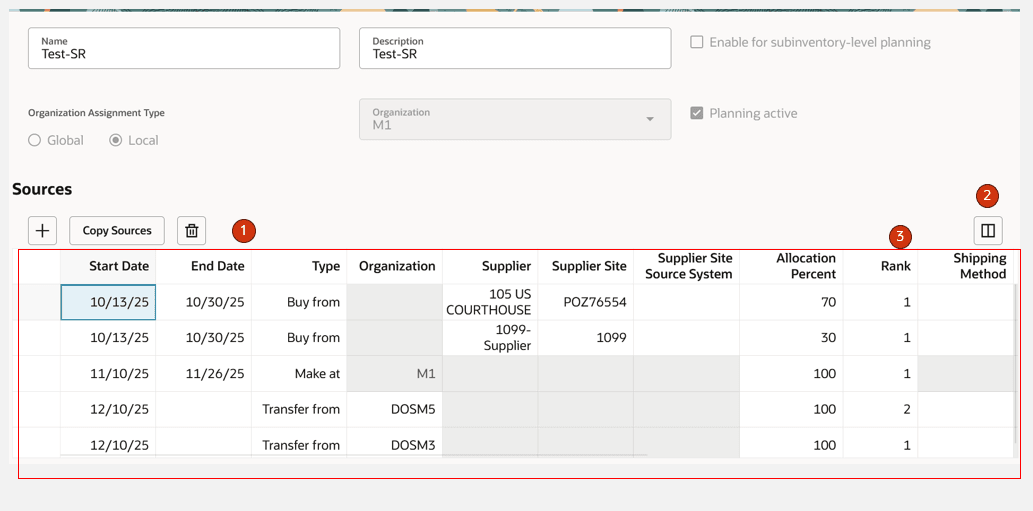
A sourcing-rule source row is not a supply order. It is a planning policy. The plan will use it only when the rule is active for the relevant date, successfully assigned to the item and destination context, selected by the plan, and supported by valid collected master data.
Create the assignment set and target the destination item-organization
Now link the rule to the exact demand location.
-
In the Tasks drawer, select Manage Assignment Sets.
-
Select Create.
-
Enter:
- Name:
ASG_<initials>_FG_TEST_DEST - Description:
Item and organization sourcing assignment for FG-TEST at DEST - Catalog: Select the catalog used for your item classification. A catalog is especially relevant for category-based assignments; use the approved planning catalog in your environment rather than creating a new one for this lab.
- Name:
-
In Sourcing Assignments, select Add.
-
Create one assignment with:
- Assignment Level: Item and Organization
- Organization: DEST
- Item: FG-TEST
- Sourcing Type: Sourcing Rule, if this field is shown
- Sourcing Rule or Bill of Distribution:
SR_<initials>_FG_TEST_BUY_XFER
-
Save the assignment set.
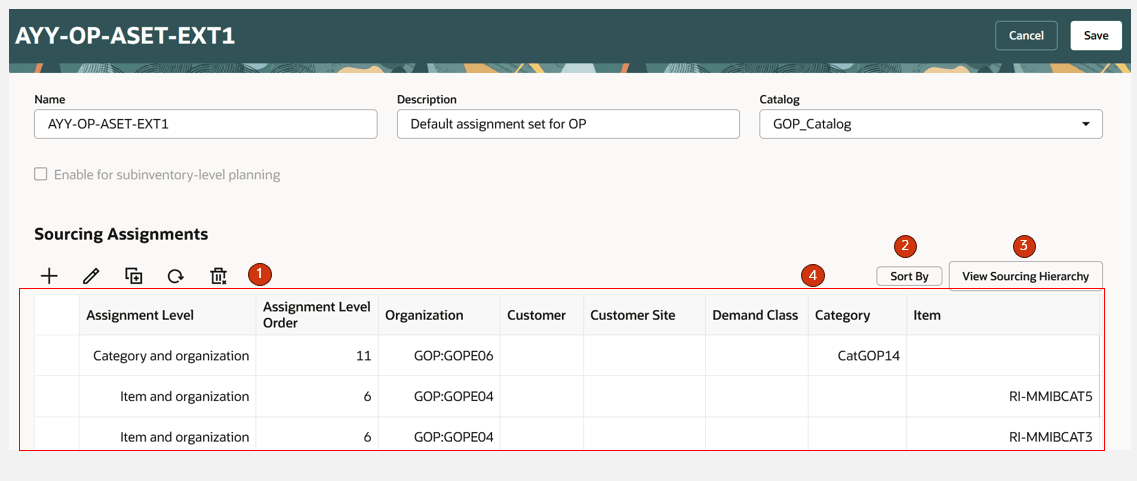
Do not interpret the Assignment Level Order shown in the grid as the rank of a source. It is system-derived context about assignment specificity. The source Rank remains the value entered on the sourcing-rule source rows.
Attach the assignment set to the supply plan
Creating the assignment set does not automatically make the supply plan use it.
-
Navigate to Manage Plans and open
SUP_LAB_<initials>_BASE. -
Select Edit Plan Options.
-
In the Supply options, open the General area or the area containing the Assignment Set field. The exact tab placement can vary slightly by page flow.
-
Select
ASG_<initials>_FG_TEST_DESTas the plan’s sourcing assignment set. -
Save the plan options.
-
Reopen the plan options and confirm that the selected assignment set still displays. Capture this screen as evidence.
This gives you three linked configuration records:
| Object | Role in the design |
|---|---|
| Sourcing rule | Defines 70 percent transfer from SRC and 30 percent buy from SUP-TEST |
| Assignment set | Assigns the rule to FG-TEST at DEST |
| Supply plan option | Tells the specific supply plan which assignment set to use |
Prove that the assignment is effective
Configuration evidence is necessary, but it is not yet proof of sourcing resolution. View Sourcing resolves the assignment hierarchy for a specified item, organization, and date.
First proof: View Sourcing
-
Return to Manage Assignment Sets and open
ASG_<initials>_FG_TEST_DEST. -
Select View Sourcing. In some page layouts, the button is labeled View Sourcing Hierarchy.
-
Enter:
- Assignment Set:
ASG_<initials>_FG_TEST_DEST - Organization: DEST
- Item: FG-TEST
- Date: your effective test date
- Assignment Set:
-
Review the result.
Your success criteria are:
SR_<initials>_FG_TEST_BUY_XFERappears among the applicable rules.- It is identified as the Active Rule.
- The rule is valid on the date selected.
- Its rank-one source policy contains both SRC as a transfer source and SUP-TEST / MAIN as a purchase source.
If the result shows another rule as active, do not change source quantities to force an outcome. Record the active rule name and investigate whether a more specific assignment exists, such as an item-customer, item-demand-class, or other assignment relevant to the demand context.
Second proof: plan recommendation behavior
After View Sourcing confirms the active rule:
-
Confirm FG-TEST has a net requirement at DEST. For a clean test, use demand that exceeds available on-hand and open supply.
-
Run the supply plan from Manage Plans using Actions and Run Plan, or use the equivalent run action available in your 26B environment.
-
Open the completed plan and navigate to Supplies and Demands.
-
Filter to:
- Organization: DEST
- Item: FG-TEST
- Dates inside the planning horizon
-
Add or expose columns that identify:
- order type;
- planned order quantity;
- suggested due date;
- source organization;
- supplier;
- supplier site.
-
Look for planned transfer supply associated with SRC and planned purchase supply associated with SUP-TEST / MAIN.
With no lot-sizing constraints, a 100-unit shortage should broadly follow the 70/30 policy. If it does not divide exactly, check item order modifiers before declaring the sourcing setup defective. A fixed lot multiple, minimum order quantity, or calendar-related date shift can create a legitimate quantity difference while the source selection remains correct.
Root-cause path for failed sourcing validation
Use this sequence rather than changing multiple settings at once.
| Symptom | Likely cause | Verification and correction |
|---|---|---|
| Rule does not appear in View Sourcing | Wrong assignment set, item, organization, or effective test date | Recheck all four View Sourcing parameters and the source rule’s effective dates. |
| A different rule is Active | A more-specific assignment overrides the lab assignment | Search the assignment set for item-customer, item-demand-class, category-organization, item-only, or global assignments. Preserve production design; use a distinct test item if needed. |
| Rule is Active but only transfer recommendations appear | Buy source unavailable, no purchase need after netting, or order constraints distort the result | Verify supplier site, purchase lead time, item purchasing setup, demand quantity, and existing supply. |
| Rule is Active but only purchase recommendations appear | Transfer source is not viable for the scenario | Verify SRC is in plan scope, the item is valid at SRC, interorganization shipping data is configured, and relevant calendars and lead times are collected. |
| Plan creates make recommendations | The plan is using a different assignment set, the assignment is ineffective, or the item make-or-buy fallback is being used | Reconfirm the plan’s assignment-set field, View Sourcing results, and rerun the plan after saving. |
| Allocation result differs from 70/30 | Allocation totals or ranks are wrong, or order modifiers affect quantities | Confirm both sources are rank 1 and total 100 percent. Then inspect minimum, maximum, fixed lot multiple, and lead-time conditions. |
| Supplier site cannot be selected | Supplier-site record is inactive, inaccessible, or from a different source system | Validate supplier setup, source-system association, collection status, and planning data access. |
A useful troubleshooting discipline is to ask four questions in order:
- Is the rule structurally correct? Check effective dates, source types, allocation, and rank.
- Is it assigned at the intended level? Check Item and Organization for FG-TEST at DEST.
- Does the assignment resolver select it? Use View Sourcing with the correct date.
- Can the plan execute its sources? Check scope, item setup, supplier data, transfer network, calendars, lead times, and net requirement.
Evidence and interview explanation
Capture these artifacts for your lab record:
- the sourcing-rule source rows and effective dates;
- the assignment-set row for FG-TEST and DEST;
- the supply plan option showing the selected assignment set;
- View Sourcing showing the active rule;
- Supplies and Demands results showing planned transfer and/or planned purchase recommendations.
A concise senior-functional explanation is:
“I model alternative supply methods in a sourcing rule, but I do not assume the rule is active just because it exists. For my buy-or-transfer scenario, I created concurrent rank-one transfer and buy sources with allocations totaling 100 percent. I assigned the rule at Item and Organization level, selected the assignment set in the supply plan, and used View Sourcing with the exact item, destination organization, and effective date to confirm the active rule. Only then did I validate planned order types in Supplies and Demands, accounting for order modifiers, lead times, calendars, and existing supply before judging the allocation result.”
Wrap-up
You have now established and verified a sourcing policy that the supply plan can use:
- Transfer From represents internal interorganization replenishment; Buy From represents external supplier replenishment.
- Sources at the same rank must have allocations totaling 100 percent.
- In an unconstrained supply plan, a rank-one split is the appropriate controlled test for buy-and-transfer sourcing.
- A sourcing rule defines source options, while an assignment set attaches the rule to item and organizational context.
- View Sourcing is the decisive configuration check because it reveals which assignment is actually active for an item, organization, and date.
- Plan outputs provide the operational confirmation, subject to master-data feasibility and order-modifier behavior.
Next, you will use Plan Inputs to validate the item, lead time, order modifier, bill of material, resource, calendar, supplier-capacity, and other data dependencies that determine whether this sourcing policy produces feasible recommendations.
Can't find a good explanation? Sign up and we'll make it for you
Sign up