Hello! Welcome back to our course on global e-commerce.
In our last lesson, you took a major step by setting up and launching your first TikTok Shop ad campaign. You learned how to structure the campaign for product sales, define your audience, and, most importantly, create a shoppable video ad using the interactive product card.
Now that your campaign is live and gathering data, we move to the most critical phase: analysis and optimization. Launching an ad is just the beginning; turning it into a consistent, profitable sales engine is the real goal.
Today's lesson directly addresses the learning outcome: Analyze TikTok Ads performance data and optimize campaigns for conversions. We will focus on three practical steps:
- Setting up your Ads Manager dashboard to see the metrics that truly matter.
- Understanding what these metrics tell you about your campaign's performance.
- Applying a clear decision-making framework to either kill underperforming ads, scale winning ones, or give the algorithm more time to learn.
Your experience with Facebook Ads will be an asset here, as the core principles of analyzing a conversion funnel are similar. However, we'll focus on the specific metrics and nuances of the TikTok platform.
1. Customizing Your Dashboard: Seeing What Matters
The default view in TikTok Ads Manager is not optimized for e-commerce conversion analysis. To make informed decisions, you first need to customize your columns to see the entire customer journey, from the initial click to the final purchase.
This TikTok Ads Strategy Works Everyday (Stupid Simple & Proven)
The video 'This TikTok Ads Strategy Works Everyday' by Anthony Eclipse provides a very clear, practical guide on how to set up your columns for data analysis. This is the exact setup used by many successful e-commerce advertisers.
Watch the segment from 15:57 to 17:15. Follow the steps to go to 'Custom Columns' and add the key metrics. The video suggests a specific order, which helps in analyzing the data like a funnel.
Based on the video and best practices, here are the essential columns you should add to your dashboard, in order:
- Cost: Total amount spent.
- CPM (Cost Per 1,000 Impressions): The cost to show your ad 1,000 times.
- CPC (Cost Per Click): The cost for each click on your ad.
- CTR (Click-Through Rate): The percentage of people who click your ad after seeing it.
- Add to Carts (ATC): The total number of times a product was added to the cart.
- Cost per Add to Cart: How much you're paying for each ATC.
- Purchases (or Complete Payments): The total number of sales.
- CPA (Cost Per Acquisition/Purchase): The average cost to acquire one customer.
- ROAS (Return On Ad Spend): The total revenue generated for every dollar spent on ads.
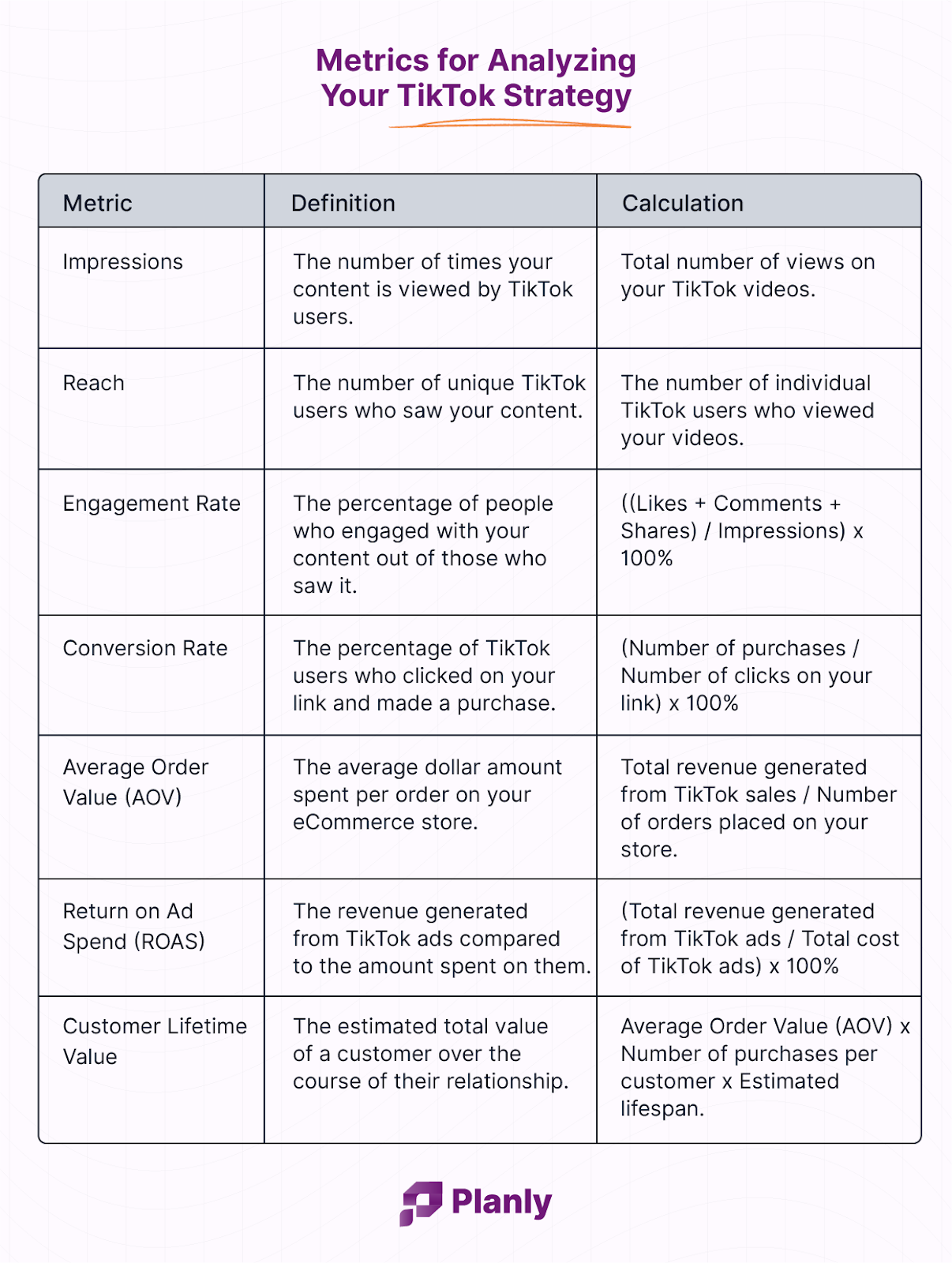
Here is a helpful reference table that defines these key metrics and shows how they are calculated.
2. The KPIs That Drive Decisions
With your dashboard set up, you can now analyze your campaign's performance like a funnel. If there's a problem, you can pinpoint where users are dropping off.
Top of Funnel: Creative & Targeting Performance
These metrics tell you if your ad creative is grabbing attention and if you're reaching the right audience.
- CPC (Cost Per Click) & CTR (Click-Through Rate): A high CPC and low CTR are the first signs that your video creative is not working. The "hook" (the first 3 seconds) might be failing to stop the scroll, or the ad might look too much like a traditional commercial.
Optimize TikTok Ads CTR and Improve Performance
The article 'TikTok Ads CTR' from Strike Social provides an excellent diagnostic checklist for figuring out why your creative might be underperforming.
Read the sections 'What is a Good Click-Through Rate (CTR) for TikTok Ads?' and 'Diagnosing Why Your TikTok Ads CTR Is Low.' Focus on the benchmarks for 'Conversion-Focused Campaigns' and the three-point diagnostic checklist (3-Second Hook Failure, Creative Fatigue, and “Ad-Like” Aesthetics).
Middle of Funnel: Landing Page & Offer Performance
These metrics tell you what happens after a user clicks your ad.
- Cost per Add to Cart (ATC): If you have a good CTR but very few (or expensive) Add to Carts, the problem likely lies in the disconnect between your ad and your product page. This could be due to pricing, shipping costs, or a lack of congruency between the ad's message and what the user sees on the page.
Bottom of Funnel: Conversion & Profitability
This is the ultimate measure of success.
- CPA (Cost Per Acquisition): This is your cost per purchase. Your target CPA should be your product's break-even point (Sale Price - Cost of Goods Sold - Platform Fees). If your CPA is below your break-even point, you are profitable.
- ROAS (Return on Ad Spend): This tells you your revenue multiplier. A ROAS of 3.0 means you're making $3 for every $1 spent. While useful, it can sometimes be misleading.
To understand why focusing on CPA is often more reliable than chasing a high ROAS, watch the following explanation.
This Secret TikTok Ads Testing Strategy Is Changing Lives
In this video, 'This Secret TikTok Ads Testing Strategy Is Changing Lives,' Ethan Dobbins gives a brilliant explanation of why CPA is a more stable and reliable metric for making scaling decisions compared to ROAS.
Watch the segment from 16:45 to 18:43. Pay close attention to the example comparing an ad group with many consistent, low-cost purchases versus an ad group with one lucky, high-value purchase. This highlights why CPA is a better indicator of sustainable success.
3. A Practical Framework: Kill, Wait, or Scale
Now for the most important part: taking action based on your data. Here is a simple, rule-based framework.
When to KILL an Ad Group
You should turn off an ad group early if it shows clear signs of being unprofitable. This saves your budget for more promising ads.
This TikTok Ads Strategy Works Everyday (Stupid Simple & Proven)
The Anthony Eclipse video we referenced earlier provides three simple, data-driven rules for when to kill an underperforming ad. These rules are extremely practical for day-to-day campaign management.
Re-watch the segment from 17:35 to 18:55. The creator outlines three specific rules for turning off an ad creative based on CPC, spend without an Add to Cart, and spend without a purchase relative to the break-even point.
Here's a summary of those kill-switch rules:
- High CPC: The CPC is over $2-$3 with minimal spend. This indicates the creative isn't resonating at all.
- No Middle-Funnel Action: You've spent $10-$15 without a single "Add to Cart." People are clicking but have zero interest in buying.
- Passed the Break-Even Point: You've spent more than your break-even CPA and still have zero purchases. At this point, the ad is losing you money.
When to WAIT (The TikTok Learning Phase)
Unlike other platforms, TikTok's algorithm often needs time to find your ideal customer. Killing an ad too early is a common and costly mistake. This initial period is called the Learning Phase.
Web Auction Best Practices Guide [FINAL]
This official PDF from TikTok, 'Web Auction Best Practices Guide,' explains the concept of the Learning Phase and why it's important to be patient.
Read the section titled 'The Learning Phase' (page 6). The key takeaway is that an ad group needs approximately 50 conversions to exit this phase and stabilize its performance. Making significant edits during this time can reset the process.
Patience can pay off. An ad might look unprofitable on day one but become a winner by day three as the algorithm optimizes.
This Secret TikTok Ads Testing Strategy Is Changing Lives
The Ethan Dobbins video shares a powerful real-world example of this principle in action.
Watch from 12:10 to 14:21. The creator shows a campaign that was unprofitable after day one, but by waiting another day without touching anything, the CPA dropped significantly and the campaign became profitable.
When to SCALE a Winning Ad Group
A "winner" is an ad group that consistently brings in purchases at a CPA well below your break-even point. Once you've identified a winner, it's time to give it more budget.
The simplest and most stable way to scale is by duplicating the winning ad group.
This TikTok Ads Strategy Works Everyday (Stupid Simple & Proven)
The Anthony Eclipse video demonstrates this exact scaling strategy after identifying a profitable ad creative.
Watch from 18:55 to 20:10. Notice how he takes the one winning creative and duplicates it multiple times (e.g., creating 5-10 identical copies). This tells TikTok to find more pockets of the same profitable audience.
When you scale by duplicating, you let the new ad groups run with the same daily budget. You then monitor them and kill off any duplicates that don't perform, keeping only the profitable ones running.
Test your understanding!
You are selling a product for $50. Your cost of goods is $15, and platform fees are $5. Your break-even point is therefore $30 ($50 - $15 - $5).
You have been running three different ad groups for two days. Here is the data:
| Ad Group | Spend | Add to Carts | Purchases | CPA |
|---|---|---|---|---|
| Ad Group 1 | $40 | 1 | 0 | - |
| Ad Group 2 | $35 | 10 | 2 | $17.50 |
| Ad Group 3 | $12 | 0 | 0 | - |
Based on the Kill, Wait, or Scale framework, what action should you take for each ad group?
Show answer
- Ad Group 1: KILL. It has spent $40, which is more than your $30 break-even point, and has zero purchases. This ad group is losing money.
- Ad Group 2: SCALE. It has two purchases at a CPA of $17.50, which is well below your $30 break-even point. This is a clear winner. You should duplicate this ad group to scale it.
- Ad Group 3: KILL. It has spent $12 with zero Add to Carts. This is a strong early indicator that the creative is not resonating with the audience at all. It's better to cut your losses early and reallocate the budget.
Conclusion
You now have a robust, practical framework for analyzing your TikTok ad performance and making data-driven decisions. This is the core skill that separates advertisers who get lucky from those who build sustainable, profitable businesses.
Key Takeaways:
- Customize Your Columns: You can't optimize what you can't see. Set up your dashboard to track the full conversion funnel.
- CPA is Your North Star: Your primary goal is to achieve a Cost Per Acquisition (CPA) that is lower than your product's break-even point.
- Follow the Framework: Use the Kill, Wait, or Scale model. Kill ads that are clearly failing, be patient with ads in the learning phase, and scale winners by duplicating them.
- Patience and Data Beat Emotion: Don't get discouraged by a bad first day. Let the data accumulate before making rash decisions, especially if an ad is showing some positive signs (like cheap clicks or add-to-carts).
Next Up:
Even the best ad creatives eventually suffer from "ad fatigue." To stay profitable, you need a constant stream of new, high-performing video content. One of the best ways to get this content is by working with partners. In our next lesson, we will begin Module 9 by learning how to design a competitive affiliate program structure, a powerful way to recruit partners who can create authentic, effective ad content for your products.