
Hello! Welcome to your next lesson.
In our last lesson, we explored the critical design trade-offs involved in creating wearable sensors, balancing power, size, and performance. We focused on the engineering challenges of acquiring physiological data reliably. Today, we shift our focus from passive measurement to active intervention.
This lesson addresses the learning outcome: Explain the concept of a biofeedback loop and its application in therapeutic interventions.
We will break down the "closed-loop" system that allows a person to see their own physiological data in real-time and learn to control it. This concept is the bridge between simply monitoring a state (like stress) and actively training a user to manage that state, a principle that could be incredibly powerful for the work you're doing at Neuraease.
1. The Biofeedback Loop: Seeing Inside Yourself
At its core, biofeedback is a mind-body technique that makes you aware of physiological functions that are normally involuntary, like heart rate, muscle tension, or skin temperature. By providing real-time feedback on these functions, it enables you to learn how to consciously influence them.
This process is best understood as a closed-loop system, a concept that should be familiar from your engineering background.
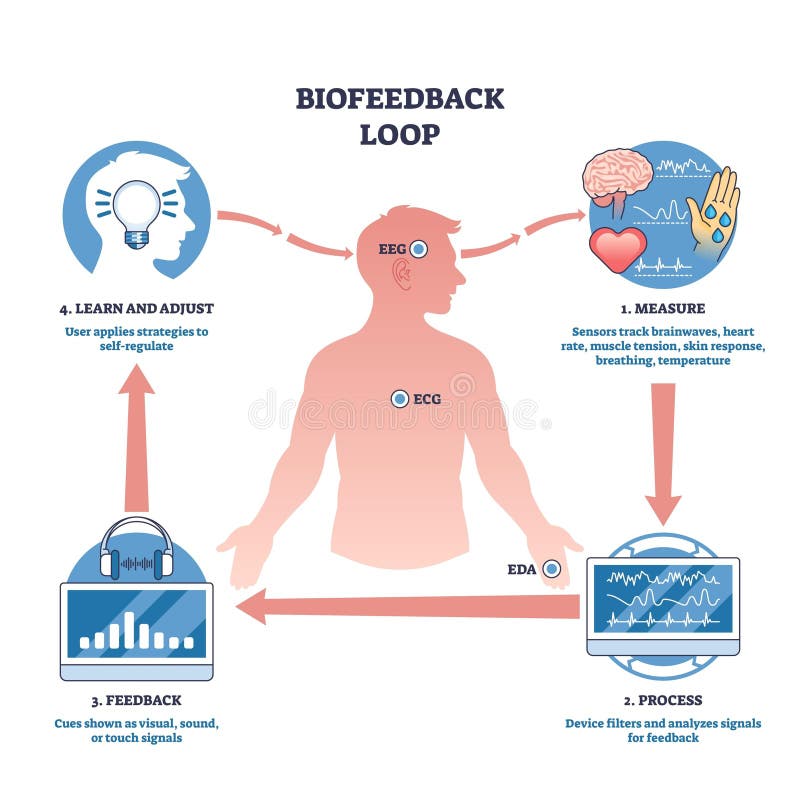
Let's break down these four stages:
- Measure (Biosensing): Sensors are placed on the body to detect a specific physiological signal. This could be anything from heart rate (via ECG or PPG), muscle tension (EMG), skin conductance (EDA/GSR), or brainwaves (EEG). This is the "input" to our system.
- Process: The raw, often noisy signal from the sensor is sent to a processing unit (like a computer or microcontroller). Here, it is filtered, amplified, and analyzed to extract a meaningful feature. For example, raw ECG data is processed to calculate beats per minute (BPM), or raw EEG data is processed to determine the power in a specific frequency band.
- Feedback: The processed information is presented back to the user in an easy-to-understand format. This feedback can be:
- Visual: A graph, a number, or even a game on a screen.
- Auditory: A tone that changes in pitch or volume.
- Haptic: A gentle vibration.
- Learn & Adjust (Self-Regulation): This is where the "bio" and "feedback" come together. The user sees or hears the feedback and tries to change it in the desired direction using mental strategies, like relaxation techniques, focused breathing, or shifting their attention. When they succeed, the feedback confirms it, reinforcing the mental strategy they used.
Crucially, biofeedback is not a passive treatment; it is an active training process. Much like learning to ride a bicycle, the user practices and develops the skill of self-regulation.
To get a formal definition of this loop and its components, please read the introductory section of the following paper.
Biofeedback for Everyday Stress Management
The paper 'Biofeedback for Everyday Stress Management' provides a clear, academic definition of the biofeedback loop and its components.
Please read the introduction, starting from 'Biofeedback is a powerful tool...' down to the end of the second paragraph (...to cope with everyday stress.). Focus on the definition of the four components of the biofeedback loop.
Test your understanding!
Imagine you were to add a biofeedback feature to your Neuraease device to help users learn to lower their acute stress levels. Briefly map the components of this hypothetical feature to the four stages of the biofeedback loop (Measure, Process, Feedback, Learn & Adjust).
Show answer
- Measure: The wearable's sensors would measure physiological signals indicative of stress, such as Heart Rate Variability (HRV) from a PPG sensor and Electrodermal Activity (EDA) from skin conductance sensors.
- Process: The device's microcontroller would process the raw PPG signal to calculate HRV parameters (like RMSSD) and process the EDA signal to quantify sympathetic arousal. It might combine these into a single "stress score."
- Feedback: The companion smartphone app would display this stress score in real-time, perhaps as a color that changes from red to green, or as a calming nature scene that becomes more vibrant as the score improves.
- Learn & Adjust: The app would guide the user through a paced breathing exercise. As the user follows the exercise and successfully lowers their physiological arousal, they see the color turn green or the scene become more beautiful, reinforcing the effectiveness of the breathing technique.
2. Therapeutic Applications: The "Why" of Biofeedback
Now that we understand the "how," let's explore the "why." Biofeedback is used as a therapeutic intervention for a wide range of medical and psychological conditions. The goal is to help patients manage symptoms by gaining control over the underlying physiology.
To see what this looks like in practice, let's watch a brief news report. It focuses on neurofeedback, which is a specialized type of biofeedback that uses EEG to monitor brainwaves. However, the core principle of using game-like feedback to reward desired physiological changes is universal.
What is neurofeedback? Video game-like therapy being used to treat anxiety, ADHD and more
This video from WPTV News shows how neurofeedback is used in a clinical setting. It perfectly illustrates the core principle of using engaging, real-time feedback to help a person learn to regulate their own physiology.
Watch the first 1 minute and 16 seconds. Notice how the system 'rewards' the user when their brain activity moves toward a healthier pattern. This concept of real-time reward is the engine of a biofeedback loop.
Types of Biofeedback
The type of biofeedback is defined by the physiological signal being measured. Given your interest in nervous system indicators for Neuraease, you'll find these highly relevant.
The following resource categorizes the most common types.
Biofeedback for Everyday Stress Management
The paper 'Biofeedback for Everyday Stress Management' also provides an excellent breakdown of the different types of biofeedback based on the physiological signals used.
Please read the section 'Biofeedback Techniques' (from the subheading down to the end of the 'Multimodal Biofeedback' section). Pay special attention to the descriptions of HRV Biofeedback and GSR Biofeedback, as these are directly related to your work with autonomic nervous system indicators.
Based on the reading, the key types include:
- Heart Rate Variability (HRV) Biofeedback: Uses ECG or PPG to help individuals increase their HRV, which is associated with better autonomic balance and stress resilience. This often involves paced breathing techniques.
- Galvanic Skin Response (GSR/EDA) Biofeedback: Uses skin conductance to measure sympathetic nervous system arousal. It's often used in anxiety and stress management to help people learn to calm their "fight or flight" response.
- Respiratory (RSP) Biofeedback: Uses a chest strap to monitor breathing patterns, helping users learn diaphragmatic (deep) and slower breathing for relaxation.
- Electromyography (EMG) Biofeedback: Measures muscle tension. It's widely used for tension headaches, chronic pain, and physical rehabilitation.
- Electroencephalography (EEG) Biofeedback / Neurofeedback: Measures brainwave activity. It's used to train the brain to produce healthier patterns, with applications for ADHD, anxiety, and peak performance training.
Evidence of Efficacy
Biofeedback isn't just an interesting idea; it's an evidence-based practice. Research has established its effectiveness for many conditions.
Biofeedback in medicine: who, when, why and how?
The paper 'Biofeedback in medicine: who, when, why and how?' summarizes the scientific evidence for biofeedback's effectiveness across various medical conditions.
Please review 'Table 1. Efficacy ratings for biofeedback training on various medical conditions'. You don't need to memorize it, but note the conditions rated as 'Efficacious' (Level 4), such as anxiety, ADHD, chronic pain, and hypertension. This demonstrates the proven therapeutic value of this approach.
As you can see from the table, biofeedback is a well-regarded intervention for many stress-related and neurological disorders, reinforcing its potential as a therapeutic tool.
3. The Learning Mechanism: Operant Conditioning
How does simply seeing a signal on a screen lead to physiological change? The process works through a psychological principle called operant conditioning.
In operant conditioning, a behavior becomes more likely to occur if it is followed by a reinforcer (a reward). In biofeedback:
- The behavior is the subtle, internal physiological shift (e.g., relaxing a muscle, slowing your heart rate).
- The reinforcer is the positive feedback (e.g., a pleasant tone, a rising score on the screen).
Biofeedback in medicine: who, when, why and how?
This section from the 'Biofeedback in medicine' paper explains the underlying learning model.
Please read the sections 'Two models of biofeedback training' and 'Operant conditioning and feedback learning'. This will clarify how the feedback acts as a reward to shape physiological behavior.
Over many repetitions, your brain subconsciously learns what mental and physical strategies produce the reward. Eventually, you can produce those physiological states on your own, without the need for the feedback device. You have learned the skill of self-regulation.
Conclusion
In this lesson, we connected the hardware of physiological sensing to the application of therapeutic intervention. We've seen that biofeedback is not just about data, but about creating a real-time, closed-loop system for learning and self-regulation.
Key Takeaways:
- A biofeedback loop is a four-stage process: Measure, Process, Feedback, and Learn & Adjust.
- It is an active training method, not a passive treatment, that gives individuals voluntary control over physiological processes that are normally involuntary.
- The learning process is based on operant conditioning, where positive feedback reinforces desired physiological changes.
- Different types of biofeedback (HRV, EDA, EMG, EEG) are used as evidence-based therapeutic interventions for a wide range of conditions, including anxiety, chronic pain, and hypertension.
Preview of the Next Lesson:
We've now established the general principles of biofeedback. In our next lesson, we will dive deep into one of the most powerful and complex forms of this technology, and one that is highly relevant to your work: Neurofeedback. We will explore how real-time EEG analysis is used for targeted brain training and discuss the design of the systems that make it possible.
Can't find a good explanation? Sign up and we'll make it for you
Sign up