
Hello! Welcome to your lesson on neurofeedback.
In our last session, we established the core concept of a biofeedback loop: a system that allows an individual to gain voluntary control over involuntary physiological processes through real-time feedback. We saw it as an active training process grounded in the principles of operant conditioning.
Today, we're diving deep into neurofeedback, a specialized and powerful form of biofeedback that directly targets the brain. This lesson is designed to address the learning outcome: Describe how neurofeedback systems use real-time EEG analysis for brain training.
We will unpack the "black box" of real-time EEG analysis, exploring what features are extracted from brainwaves and how they are used to guide the brain toward more optimal patterns. This topic is central to your interests, bridging the gap between EEG signal acquisition and practical applications for cognitive and emotional regulation, which is highly relevant to your work at Neuraease.
1. Neurofeedback: Biofeedback for the Brain
Neurofeedback is, quite simply, biofeedback applied to the central nervous system. Instead of measuring heart rate or muscle tension, we measure brainwave activity using EEG. The goal remains the same: to train self-regulation.
The entire process operates on the closed-loop principle we discussed in the last lesson. Let's revisit that loop with a specific focus on the EEG components.
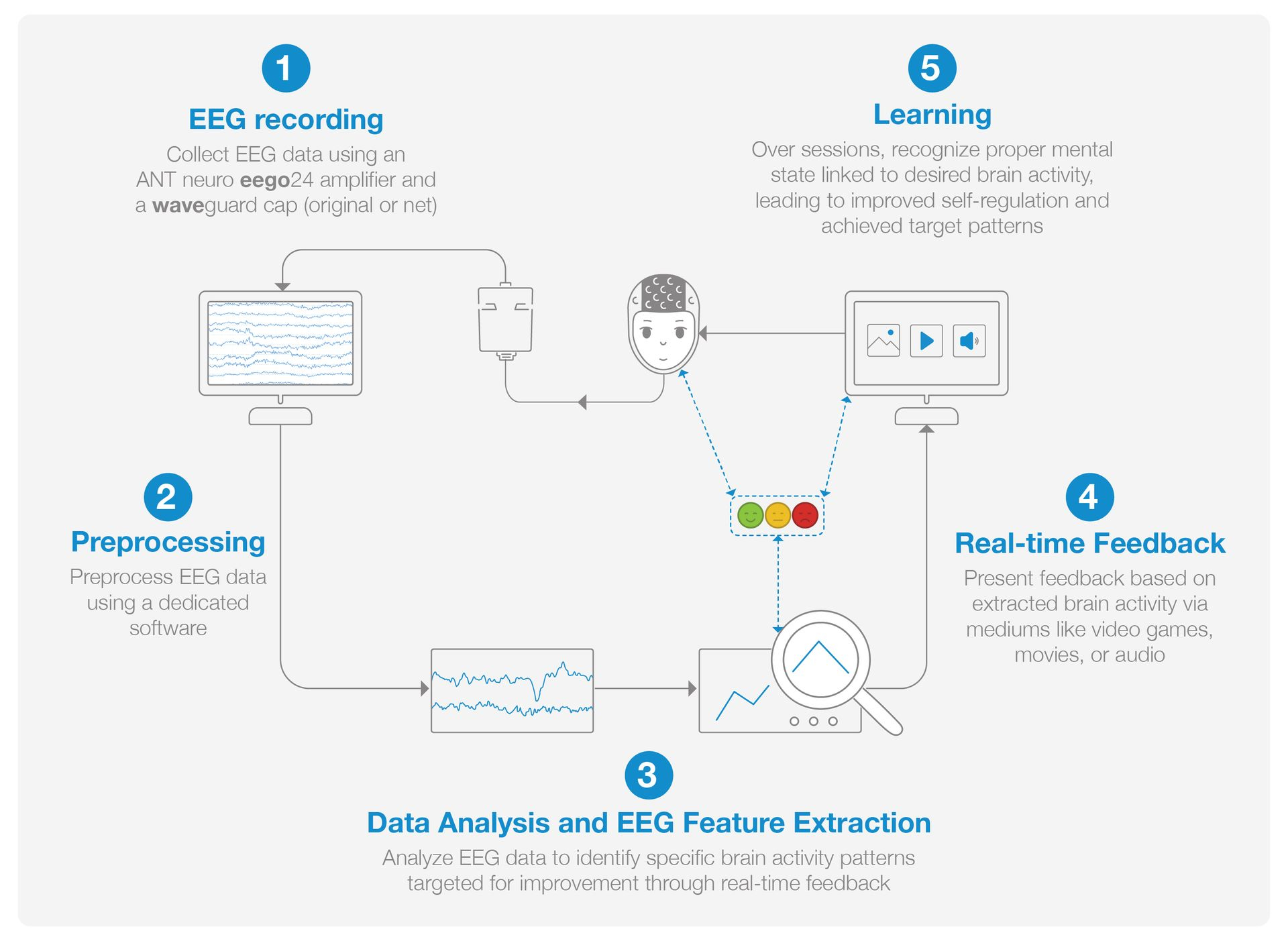
Here’s how it works in a neurofeedback context:
- Measure (EEG Recording): EEG electrodes on the scalp pick up the tiny electrical signals generated by populations of firing neurons.
- Process (Real-time Analysis): This is the core of the system. A computer performs rapid signal processing to extract specific, meaningful features from the raw EEG signal. This could be the power of a certain frequency band (e.g., alpha waves) or the connectivity between different brain regions.
- Feedback: The extracted feature is used to control a visual or auditory stimulus in real time. For example, the brightness of a movie, the speed of a race car in a game, or the pitch of a tone.
- Learn (Operant Conditioning): The brain is rewarded with positive feedback (e.g., the movie gets brighter, the car goes faster) when it produces the desired brainwave pattern. Through this reinforcement, the brain learns to produce this pattern more consistently, leading to lasting changes through neuroplasticity.
To get a better sense of this process and its origins, the following video provides an excellent overview.
Neurofeedback Brain Training and its Types Explained
The video 'Neurofeedback Brain Training and its Types Explained' from The Human Condition channel offers a clear definition of neurofeedback, its relationship to biofeedback, and its historical development.
Please watch from the beginning to 9:27. As you watch, focus on: The distinction between general biofeedback and neurofeedback (0:00 - 4:11). The importance of the feedback being delivered in real time (within 500ms) for the brain to learn (4:11 - 9:27). The evolution from simple single-electrode systems to modern, multi-channel, computer-driven systems using FFTs and qEEG.
2. The "Real-Time Analysis": What Is the System Rewarding?
The critical question is: what exactly is the computer analyzing in real time? The system isn't just looking for "good" or "bad" brainwaves. It's quantifying specific, pre-defined features of the EEG signal that are known to correlate with certain mental states.
Your ECE background in signal processing is very relevant here. The process involves real-time feature extraction from a complex, noisy signal. The two most fundamental features used in neurofeedback are amplitude and coherence. The video you just watched introduced these, and we will now detail them.
A. Amplitude (Power) Training
This is the most common form of neurofeedback. It focuses on the "loudness" or power of specific EEG frequency bands (Delta, Theta, Alpha, Beta, Gamma) at particular locations on the scalp.
- The Goal: To either increase (up-train) or decrease (down-train) the amplitude of a target frequency band.
- Example Application (ADHD): A common protocol for ADHD involves training over the prefrontal cortex. The goal is often to decrease the power of slow-wave activity (theta) and increase the power of fast-wave activity (beta). This helps train the brain toward a more alert and focused state.
- The Feedback: If the user's theta/beta ratio decreases (the desired direction), the game they are playing speeds up. If the ratio increases, the game slows down.
B. Coherence (Connectivity) Training
Coherence is a measure of the degree of synchrony or "crosstalk" between two different brain regions. It tells us how well two areas are communicating. The brain works as a network, but sometimes regions can be too connected (hypercoherent) or not connected enough (hypocoherent).
- The Goal: To either normalize connectivity by increasing or decreasing the coherence between specific electrode pairs.
- Example Application (Anxiety): Some forms of anxiety are associated with hypercoherence—too much crosstalk between emotional centers (like the amygdala) and decision-making centers. Neurofeedback can be used to reward the brain for decreasing this coherence, effectively training the brain to be less "stuck" in an anxious loop.
The following video explains how this reward mechanism drives neuroplasticity and provides a very clear example of a home-use system.
Brain Mapping and Neurofeedback - Can I Do It From Home?
Dr. Trish Leigh's video, 'Brain Mapping and Neurofeedback - Can I Do It From Home?', explains the practical mechanism of feedback and the underlying principles of neuroplasticity.
Please watch from 12:43 to 18:43. Pay close attention to: The explanation of the positive feedback loop (bright/dim screen). The introduction of Hebb's Law ('neurons that fire together, wire together') and how neurofeedback creates and strengthens new, healthier neural pathways.
Test your understanding!
A neurofeedback protocol for promoting a state of calm relaxation might involve up-training the amplitude of alpha waves in the posterior region of the brain. Describe how the feedback system (e.g., a music player) would respond to guide the user's brain.
Show answer
As the user successfully enters a more relaxed state, their posterior alpha wave amplitude will increase. The system's real-time analysis detects this change. In response, the music might become louder, richer, or more harmonious. Conversely, if the user becomes distracted or tense and their alpha amplitude decreases, the music would become quieter or distorted. This immediate feedback continuously reinforces the brain state associated with alpha production.
3. Modern Neurofeedback Systems: The Role of Technology
The effectiveness of neurofeedback hinges on the quality of its real-time analysis. Early systems were limited, but modern systems leverage significant advances in signal processing and machine learning—areas you're particularly interested in.
The resource below contrasts the classic approach with the modern, BCI-based approach.
Modern BCI-based Neurofeedback for Cognitive ...
The article 'Modern BCI-based Neurofeedback for Cognitive ...' from Bitbrain provides an excellent technical summary of what makes modern systems more powerful and precise.
Please read the section 'Modern vs Classic Neurofeedback for Cognitive Enhancement'. Focus on the three key improvements of the modern approach: EEG acquisition technology: Higher quality, more sensors. Artifact filtering: Using advanced algorithms like blind source separation to clean the signal in real time. Inter- and intra-subject variability: Moving from fixed frequency bands (e.g., 8-12 Hz for alpha) to personalized bands based on the Individual Alpha Frequency (IAF).
The key takeaway is that modern neurofeedback is not a one-size-fits-all approach. By calibrating the system to an individual's unique brain patterns and using sophisticated algorithms to ensure a clean signal, the training becomes far more targeted and effective.
This is where Machine Learning (ML) comes in. Your interest in ML is spot-on, as it is becoming integral to neurofeedback. ML algorithms are used to classify brain states, identify artifacts, and even adapt the training protocol in real time.
Consumer-Grade Electroencephalogram and Functional ...
To see how ML fits in, let's look at this section from the paper 'Consumer-Grade Electroencephalogram and Functional...'
Please read the section '3.2. ML/AI Classification'. This section briefly describes how algorithms like Linear Discriminant Analysis (LDA), Support Vector Machines (SVMs), and Artificial Neural Networks (ANNs) are used to classify features extracted from EEG signals into different states or tasks. This is a foundational concept for building intelligent neuro-technologies.
These classification algorithms are the "brains" behind the neurofeedback system's decision-making process, determining moment-by-moment whether the user's brain activity matches the target state and delivering the appropriate feedback.
Conclusion
In this lesson, we moved from the general concept of biofeedback to the specific mechanisms of neurofeedback. You've seen how real-time analysis of EEG signals, based on principles of signal processing and machine learning, forms the engine of a powerful tool for brain training.
Key Takeaways:
- Neurofeedback is a closed-loop system using real-time EEG analysis to train individuals to self-regulate their brain activity.
- The system provides feedback based on quantified EEG features, primarily the amplitude (power) of specific frequency bands and the coherence (connectivity) between brain regions.
- The learning mechanism is operant conditioning, which drives neuroplasticity by reinforcing desired neural patterns.
- Modern systems are far more effective than classic ones due to better hardware, advanced artifact filtering, and subject-specific calibration (e.g., using IAF).
- Machine learning plays a crucial role in classifying brain states from complex EEG data, enabling more intelligent and adaptive neurofeedback.
Preview of the Next Lesson:
We've touched upon the importance of artifact removal and machine learning in modern neurofeedback. In the next lesson, we will fully address the learning outcome: Discuss the role of machine learning in artifact removal, feature extraction, and classification of physiological states. We'll explore these algorithms in more detail and discuss how they can be implemented in practical systems—including the kind of wearable devices you are developing at Neuraease.
Can't find a good explanation? Sign up and we'll make it for you
Sign up