
Welcome to the next step in our exploration of the physics of sound. In our previous lesson, we focused on how to visualize audio using waveforms and spectrograms, learning to "read" a sound's amplitude and frequency content over time. You now know that a complex sound, like a note from a piano, is composed of many different frequencies.
Today, we will connect that physical property of frequency (measured in Hertz) to the musical concepts of pitch and the harmonic series. Our goal is to understand the fundamental mathematical relationship that governs why a note sounds the way it does. This isn't just abstract theory; this knowledge is the bedrock of synthesis, sound design, and even musical harmony. For a producer like deadmau5, who meticulously crafts every synthesizer patch, a deep command of these principles is non-negotiable.
From Vibration to Pitch
At its core, sound is vibration. The speed of that vibration is its frequency, measured in Hertz (Hz), or cycles per second. Our brain interprets this frequency as pitch—our subjective perception of how "high" or "low" a note is. The relationship is direct: a higher frequency results in a higher perceived pitch.
However, our perception of pitch is not linear; it's logarithmic. This is a crucial concept. For example, the note A3 has a frequency of 220 Hz. The note one octave higher, A4, has a frequency of 440 Hz (a difference of 220 Hz). The next octave up, A5, has a frequency of 880 Hz (a difference of 440 Hz). While we perceive the interval of an octave as a consistent "jump" in pitch, the actual change in frequency doubles each time.
This exponential relationship is fundamental to music.
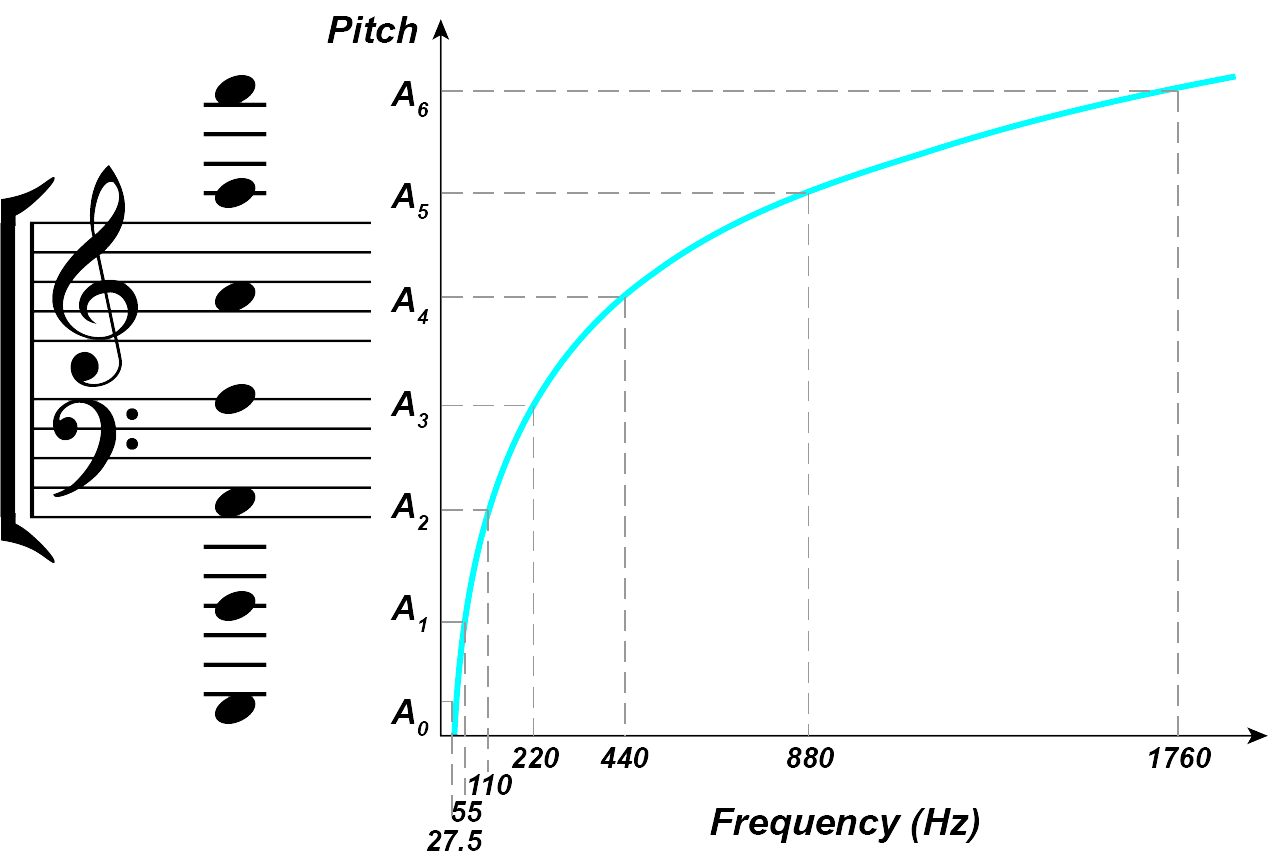
This logarithmic perception is why spectrum analyzers, as we saw in the previous lesson, often use a logarithmic frequency scale. It maps the visual representation of frequencies to the way we actually hear them as musical pitches.
To solidify this, let's read a short section that clearly defines these terms.
Sound, Vibration, and the Harmonic Series | Beat Kitchen
This article from Beat Kitchen provides a concise and clear explanation of the core concepts of frequency, pitch, and the octave.
Please read the first two sections, Frequency: The Speed of Vibration, and The Octave: Exponential Doublings. Focus on the direct link between frequency and pitch, and the 2:1 frequency ratio that defines the octave.
The Harmonic Series: A Sound's "DNA"
A pure sine wave consists of only one frequency. However, almost no musical instrument produces a pure sine wave. When you play a note on a guitar, piano, or synthesizer, you are hearing a complex sound composed of multiple frequencies playing simultaneously.
These frequencies are not random. For most pitched instruments, they follow a beautiful and predictable mathematical pattern known as the harmonic series.
Let's break down the terminology:
- Fundamental Frequency (f₁): This is the lowest and usually loudest frequency in the sound. It is what determines the note's perceived pitch. For A4, the fundamental is 440 Hz.
- Partials: This is a general term for all the sinusoidal frequencies present in a sound (the fundamental plus all the higher frequencies).
- Harmonics: These are partials whose frequencies are integer multiples of the fundamental frequency. The series is
- Overtones: This term refers to any partial above the fundamental. The 1st overtone is the 2nd harmonic (), the 2nd overtone is the 3rd harmonic (), and so on.
The physical origin of this series can be easily visualized. Consider a vibrating string. Its fundamental frequency comes from the string vibrating along its entire length. But it also vibrates simultaneously in halves, thirds, quarters, and so on. Each of these "modes of vibration" produces a harmonic. Your mechanical engineering background provides a solid intuition here, as this is a direct application of the concept of standing waves.

The following resource provides a deep, quantitative dive into the harmonic series.
Harmonic Series - structure, application and background
This article from oberton.org is an excellent technical reference on the harmonic series, which will suit your quantitative background.
Please read the following sections: Start with the Definition at the top. Jump to the section Harmonic Series – Frequency Ratios. This part explains the core mathematical rule of integer multiples and provides clear calculation examples. Continue to Musicians and Physicists. This section contrasts the logarithmic (musical) and linear (physical) views of frequency, which builds on what we've already discussed. Then read Converting Frequencies into Pitches, which explains how frequency ratios translate into the musical intervals we perceive. Finally, review the definitions in the Overtones vs Harmonics section and the Glossary of Terms at the end. This will help you solidify the precise vocabulary.
Timbre: The Recipe of Harmonics
So, if a piano and a lead synth both play an A4, their fundamental frequency is 440 Hz. Why do they sound so different? The answer is timbre (pronounced TAM-ber), or the tonal character of a sound.
Timbre is determined by the harmonic content of a sound—specifically, the number of harmonics present and their relative amplitudes.
Think of it as a recipe. The fundamental frequency sets the pitch, but the unique blend and balance of the harmonics above it create the distinct "flavor" of each instrument. A clarinet, for example, is known for emphasizing odd-numbered harmonics (), giving it a characteristic "hollow" sound. A sawtooth wave, a staple of subtractive synthesis, contains all integer harmonics, making it sound very bright and rich.
This is the key to all sound design. When you use a synthesizer, you are creating and shaping harmonic content. When you use an equalizer (EQ), you are simply turning the volume of specific frequency bands—and therefore specific harmonics—up or down.
The following video from Andrew Huang is a fantastic demonstration of these concepts in action, taking them from the realm of physics into the practical world of Ableton Live.
The most mind-blowing concept in music (Harmonic Series)
In "The most mind-blowing concept in music (Harmonic Series)," popular music production educator Andrew Huang breaks down the harmonic series and shows its direct application in synthesis.
Please watch these segments: The Concept: He introduces the harmonic series and explains the integer multiple relationship. Harmonics and Timbre: This part connects the physical vibration of an instrument to the resulting harmonics and explains how their balance creates timbre. Analysis with EQ: Here, he uses a spectrum analyzer and an EQ in Ableton to visually isolate the harmonics of real instruments, revealing the pure sine wave fundamental underneath. This is a powerful demonstration. Additive Synthesis: He uses Ableton's Operator synth to build a complex tone from scratch by adding sine wave harmonics together. This directly shows how timbre is constructed.
Harmonics and Harmony
Finally, the harmonic series doesn't just define the sound of a single note; it is the physical basis for Western harmony itself. The reason certain note combinations (intervals and chords) sound consonant or "pleasing" is because their harmonic series overlap and align in simple, reinforcing ways.
For example, the 3rd harmonic of a C note is a G. The 5th harmonic is an E. Together, the fundamental, 3rd, and 5th harmonics (C-G-E) outline a C major chord. The chord is literally built into the physics of the single note. Dissonance occurs when the harmonics of two or more notes clash by being very close in frequency, creating a phenomenon known as "beating."
This video from minutephysics offers a wonderfully rigorous explanation of this phenomenon, linking the physics of wave interference to our perception of musical harmony.
This video, "The Physics Of Dissonance," dives into the physical reasons why some note combinations sound consonant and others sound dissonant.
Sine Wave Dissonance: First, see how even two pure sine waves can create "roughness" or beating when their frequencies are close. Overtones in Real Instruments: This section explains how real instruments produce overtones, specifically defining the harmonic series as the pattern for strings and pipes. Harmony and Overtone Alignment: This final clip brings it all together, explaining that musical "in-tuneness" comes from the alignment of the rich overtone series of notes, not just their fundamentals.
Conclusion
In this lesson, we have forged the crucial link between the abstract world of frequency and the musical realities of pitch and timbre. You've seen how a single physical principle—that of integer-multiple vibrations—gives rise to the rich character of musical sound and the very foundation of harmony.
Here are the key takeaways:
- Pitch is our logarithmic perception of frequency (measured in Hz). An octave represents a doubling of frequency.
- The harmonic series is a set of frequencies, consisting of a fundamental and its harmonics (integer multiples of the fundamental).
- The fundamental frequency determines a note's pitch.
- Timbre, the unique character of a sound, is determined by the relative amplitudes of its harmonics.
- Synthesis and sound design are, at their core, the art and science of manipulating harmonic content.
In our next lesson, we will investigate the final fundamental property of a wave: phase. We will explore how the alignment of waves in time leads to constructive and destructive interference, a concept that is critical for understanding audio effects, mixing, and synthesis techniques like phase cancellation and flanging.
Can't find a good explanation? Sign up and we'll make it for you
Sign up