
Welcome back. In our last lesson, we established the crucial link between a sound's physical frequency and our perception of its pitch and timbre. You now understand that a sound is composed of a fundamental frequency and a series of harmonics, and that the unique balance of these harmonics defines a sound's character. However, we've only covered two of a sound wave's three fundamental properties: amplitude and frequency.
This lesson introduces the third and final property: phase. Phase deals with the timing and alignment of waveforms. Our goal is to explain the effect of phase, phase cancellation, and constructive/destructive interference on mixed signals. Understanding this is not an academic exercise; it's a fundamental requirement for creating clean, powerful, and professional-sounding electronic music. When you layer drum samples, design wide synthesizer sounds, or mix multiple recorded parts, you are constantly managing phase relationships. Mastering this concept is a key step toward achieving the punchy and precise sound that defines producers like deadmau5.
What is Phase?
Imagine a point traveling around a circle. Its position at any moment can be described by an angle. A sound wave, being cyclical, can be thought of in the same way. Phase is a measure of a specific point in time along a waveform's cycle, typically expressed in degrees from 0° to 360°.
- 0° represents the start of the cycle, at the center line, moving in a positive direction.
- 90° represents the wave's peak amplitude (maximum positive value).
- 180° is the next time the wave crosses the center line, now moving in a negative direction.
- 270° is the wave's trough (maximum negative value).
- 360° completes the cycle, returning to the starting point.
When we talk about phase in music production, we are almost always discussing the phase difference between two or more signals. This is often caused by a slight time delay between them.
For a rigorous definition of phase and the related concept of polarity, let's consult a technical text.
[PDF] The Physical Nature of Sound - SBE.org
This document from the Society of Broadcast Engineers provides precise, engineering-level definitions for our key terms.
In the PDF, find section 1.1.2b titled "Phase". Please read the paragraph that starts with the definition of phase and phase shift. Then, read the short paragraph on polarity reversal.
As you just read, a key distinction must be made:
- Phase Shift: A delay in time between two signals. A specific time delay (e.g., 1 millisecond) will result in a different phase shift in degrees for every frequency.
- Polarity Inversion: This is not a time delay. It's an instantaneous flip of the waveform's amplitude. All positive values become negative and vice-versa. This is equivalent to a 180° phase shift applied uniformly across all frequencies. In your DAW, this is often a button labeled with the ø symbol.
The "In The Mix" YouTube channel provides an excellent visual clarification of this often-confused topic.
PHASE And POLARITY Matter! - Music Production and Mixing Essentials
This video offers a clear, production-focused explanation of polarity and phase, showing how they relate and differ.
Please watch the first three segments: What is polarity? This segment introduces the concept of polarity and how it relates to speaker movement. Introducing phase. Here, the video demonstrates how phase differences arise from delaying a signal. Clarifying the difference. This part explicitly contrasts flipping polarity with creating a phase shift through delay.
The Principle of Superposition: Constructive and Destructive Interference
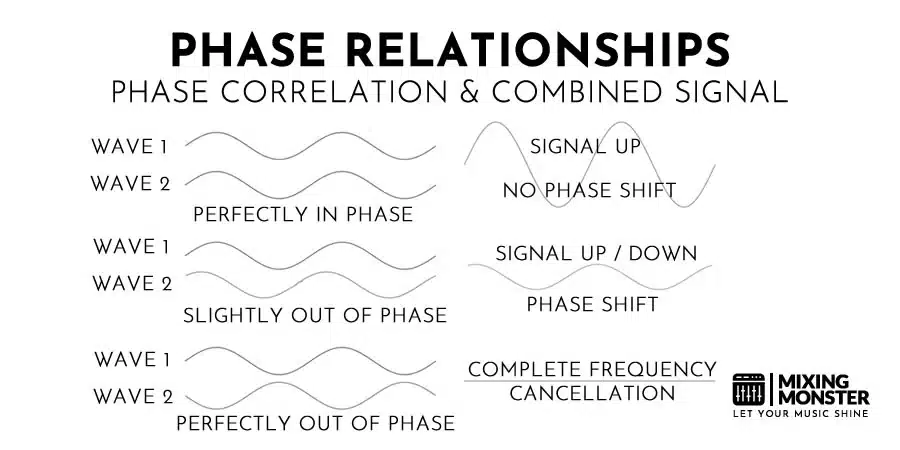
When two or more sound waves occupy the same space—for instance, when you play two tracks simultaneously in Ableton Live—they combine according to the principle of superposition. The resulting waveform is simply the sum of the individual waveforms at every point in time. This summation can lead to two main outcomes: constructive or destructive interference.
-
Constructive Interference: If two waves of the same frequency have a phase difference of 0° (they are "perfectly in phase"), their peaks and troughs align. They add together, resulting in a wave with a larger amplitude. In the ideal case of two identical signals, the amplitude doubles, which corresponds to a 6-decibel (dB) increase in level.
-
Destructive Interference: If two identical waves have a phase difference of 180° (they are "perfectly out of phase"), the peak of one wave aligns with the trough of the other. They cancel each other out, resulting in silence.
Any phase difference between 0° and 180° will result in a partial cancellation or summation, altering the amplitude of the combined signal.
Your background in quantitative finance and engineering makes you comfortable with mathematical formalisms, so let's look at the underlying equation.
The Wikipedia article on Wave Interference provides a solid physical and mathematical foundation for this phenomenon.
First, read the section under the "Mechanisms" heading, from the principle of superposition to the end of the paragraph. This gives the conceptual overview. Next, look at the mathematical derivation under the heading "Real-valued wave functions". Read the text and follow the equations from the derivation. You don't need to memorize it, but see how the final amplitude of the summed wave, 2A \cos(\frac{\varphi}{2}), is directly dependent on the phase difference, \varphi.
The key takeaway from the math is that when the phase difference is 0, , and the amplitude is . When is 180° (or radians), , and the amplitude is 0.
Phase Relationships in Practice
This physics has direct, audible consequences in music production. Poor phase relationships can make a mix sound thin, weak, and "hollow," while good phase relationships create a solid, punchy, and "glued-together" sound.
Layering Samples
A classic example in electronic music is layering kick drum samples to create a single, powerful sound. You might layer a kick with a nice high-frequency "click" with another that has a deep sub-bass "thump." For this to work, the low-frequency portions of their waveforms must be in phase.
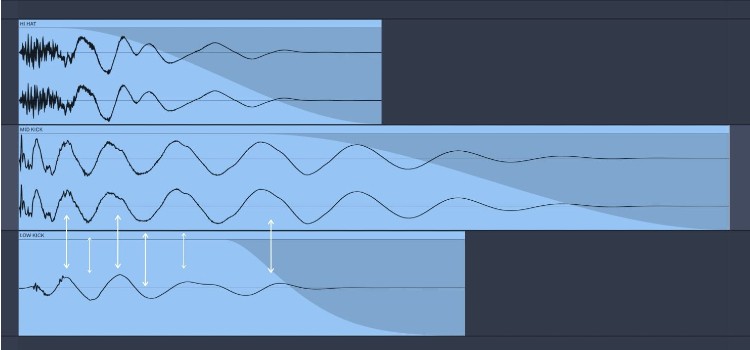
The "In The Mix" video we started earlier has an excellent practical demonstration of exactly this scenario.
PHASE And POLARITY Matter! - Music Production and Mixing Essentials
Let's see what happens when the phase relationship between two kick drum samples is not ideal, and how a simple polarity flip can fix it.
Watch the segment from the kick drum example. Pay attention to how the sound changes from thin to full when the polarity is inverted, and notice the corresponding change in the waveforms and the spectrum analyzer.
As you saw, a simple polarity flip can be the difference between a weak, hollow kick and a powerful, solid one. The first thing to check when layering sounds, especially in the low end, is their phase relationship. Sometimes a polarity inversion is all you need; other times, you may need to nudge one of the samples forward or backward in time by a few milliseconds.
Comb Filtering
When a sound is combined with a slightly delayed version of itself, you get a specific type of destructive interference called comb filtering. The delay causes cancellation at certain frequencies and reinforcement at others. The resulting frequency response looks like the teeth of a comb, which is where the name comes from. This can happen when:
- Recording a single source with multiple microphones (e.g., a piano or drum kit). The sound arrives at each mic at a slightly different time.
- Using very short delay effects (e.g., flangers and phasers, which are effects based entirely on comb filtering).
Comb filtering can make a sound feel hollow, thin, or give it a "swooshing" character. Let's return to the "In The Mix" video for a demonstration with a multi-mic'd piano.
PHASE And POLARITY Matter! - Music Production and Mixing Essentials
This segment demonstrates how phase issues created by multiple microphones can cause an instrument to lose presence and sound "mushy" in a mix.
Watch the final practical example involving a multi-mic'd piano. Notice how reversing the polarity or slightly shifting one track in time makes the piano "fall backwards" in the mix.
Detecting Phase Issues
How can you tell if you have a phase problem?
- Your Ears: The most important tool. Listen for a sudden loss of low-end, a thin or hollow sound, or a strange "swirling" artifact. A good practice is to periodically check your mix in mono. Since mono sums the left and right channels, any out-of-phase stereo information will cancel out, making phase issues very obvious.
- Visual Inspection: Zoom in on the waveforms of the layered tracks in your DAW. Are the initial cycles moving in the same direction?
- Correlation Meter: This is a plugin that analyzes the phase relationship between the left and right channels of a stereo signal.
- +1 indicates a perfectly in-phase mono signal.
- 0 indicates completely uncorrelated signals (e.g., hard-panned sounds) or a 90° phase difference.
- -1 indicates a perfectly out-of-phase signal, which will completely cancel in mono.
As a producer, you want to keep the correlation meter generally in the positive range, especially for low-frequency content.
Conclusion
Today we've added the crucial dimension of phase to our understanding of sound. You now know that sound waves have amplitude, frequency, and phase, and that managing the relationships between them is at the heart of audio engineering and music production.
Here are the key takeaways:
- Phase describes a wave's position in its cycle (0°-360°). In production, we are mainly concerned with the phase difference between signals.
- Polarity inversion is an instantaneous 180° phase flip across all frequencies, whereas a phase shift is the result of a time delay.
- The principle of superposition dictates that when signals are mixed, their amplitudes add.
- Constructive interference occurs when signals are in phase, reinforcing the sound and increasing amplitude.
- Destructive interference occurs when signals are out of phase, canceling frequencies and reducing amplitude. This can result in a thin, weak sound or audible artifacts like comb filtering.
- Managing phase is essential when layering sounds (especially kicks and basses), mixing multi-mic recordings, and ensuring your mix translates well to mono.
We've seen that two identical signals summed in phase can result in a 6 dB boost. But what exactly is a decibel? And why do we use this logarithmic scale to measure amplitude? In our next lesson, we will dive into the world of decibels and logarithmic loudness perception, which is fundamental to understanding every fader, meter, and dynamics processor in your DAW.
Can't find a good explanation? Sign up and we'll make it for you
Sign up