
Welcome back. In our last lesson, we explored the concept of phase and saw how summing two identical, in-phase signals results in a 6 dB increase in level. This left us with a critical question: what exactly is a decibel? This unit appears on every fader, meter, and plugin in your digital audio workstation, yet its meaning is often misunderstood.
This lesson will demystify the decibel and connect it to how we actually perceive sound. Our goal is to define decibels relative to full scale (dBFS), the standard for digital audio, and explain the principles of logarithmic loudness perception. For someone with your background in quantitative analysis, understanding this underlying measurement system is not just an academic exercise—it’s the key to making precise, informed decisions when you mix and master your music.
The Problem of Scale: Why We Need Decibels
The range of sound pressures that the human ear can handle is immense. The pressure of the quietest sound we can hear (the threshold of hearing) is about 20 micropascals (µPa), while the pressure of a sound so loud it causes pain is over 20,000,000 µPa—a ratio of one to a million. Using linear units like pascals to describe audio levels is therefore incredibly cumbersome.
To handle this enormous range, audio engineers use the decibel (dB). The decibel is not an absolute unit of measurement like a meter or a gram. Instead, it is a logarithmic unit that expresses the ratio between two values. This approach provides two major benefits:
- It compresses the vast range of audible sounds into a much smaller, more manageable scale (roughly 0 to 140 dB).
- It closely mimics the way our ears perceive changes in loudness, which is also logarithmic.
The YouTube channel Audio University provides a concise and clear explanation of these core concepts.
Decibels (dB) In Audio | The 5 Things You NEED To Know...
This video breaks down the five most important things to know about decibels, starting with why we use a logarithmic ratio scale and how it relates to human perception.
Please watch the first two sections of the video: The first part explains why a logarithmic scale is used to represent the vast range of sound pressures and how this relates to our perception of loudness. The second part reinforces that a decibel is always a ratio and introduces the concept of reference points, which are denoted by suffixes like SPL, u, and FS.
The Mathematics of the Decibel
As you just saw, the decibel expresses a ratio. Because your background is in quantitative fields, let's formalize this with the underlying equations. You will encounter two main formulas for decibels, and understanding the distinction is key.
The decibel is fundamentally a measure of a power ratio. The formula is:
where is the power being measured and is the reference power.
However, in audio we often measure quantities like voltage (in analog circuits) or sound pressure (in the air). Since power is proportional to the square of voltage () and the square of pressure (), the formula changes. Due to the properties of logarithms (), the factor of 10 becomes a 20.
For quantities like voltage or pressure, the formula is:
where is the value being measured and is the reference value.
This distinction explains some common rules of thumb you might hear:
- A doubling of power is an increase of dB.
- A doubling of voltage or pressure is an increase of dB. This is why summing two perfectly in-phase signals (doubling the amplitude/pressure) gives a 6 dB boost.
The video from Audio University explains this distinction clearly.
Decibels (dB) In Audio | The 5 Things You NEED To Know...
Let's continue with the same video to solidify the math. This section explicitly addresses why there are two different formulas.
Please watch the segment that explains the two formulas. The explanation of how power relates to voltage squared is the crucial insight here.
dBFS: The Decibel in the Digital World
Because the decibel is a ratio, it is meaningless without a reference point. This reference is indicated by a suffix. You’ll see many types, but for music production in a DAW, the most important one is dBFS, or Decibels Full Scale.
Inside the Decibel and Why It Matters
This article from iZotope provides an excellent, production-focused explanation of the various decibel scales. We will focus on its definition of dBFS.
Find the section titled "Making sure we don't hit our head on the digital ceiling (dBFS and the decibel in digital audio)." Read this short section, starting from the definition of dBFS.
As you've just read, in the digital domain, there is an absolute maximum level that can be represented by the available bits. This maximum level is called Full Scale.
- 0 dBFS is defined as this maximum possible digital level.
- Unlike other dB scales, all measurements in dBFS are negative or zero. A signal at -12 dBFS is 12 decibels below the maximum possible level.
- Any signal that attempts to go above 0 dBFS will be hard-clipped, resulting in severe distortion. This "digital ceiling" is an unforgiving limit.
In practice, your DAW meters are calibrated in dBFS. When you move a fader or watch the level meter on a track, you are working with dBFS. It is standard practice to calibrate analog equipment to a corresponding digital level. A common standard in music production is +4 dBu (an analog voltage reference) = -18 dBFS.
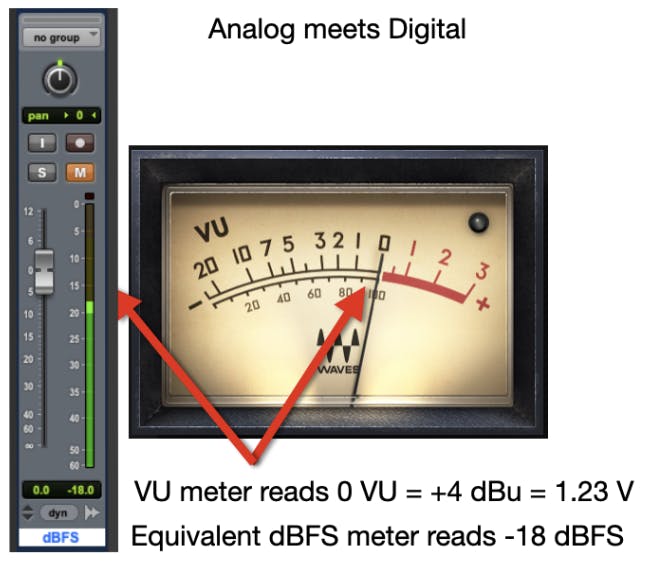
Logarithmic Loudness Perception
The reason a logarithmic scale like the decibel is so effective is that it aligns beautifully with how our ears perceive loudness. Our hearing is not linear; it is logarithmic.
This leads to a fascinating and fundamentally important aspect of audio engineering: our perception of frequency balance changes with loudness. This phenomenon is described by the equal-loudness contours.
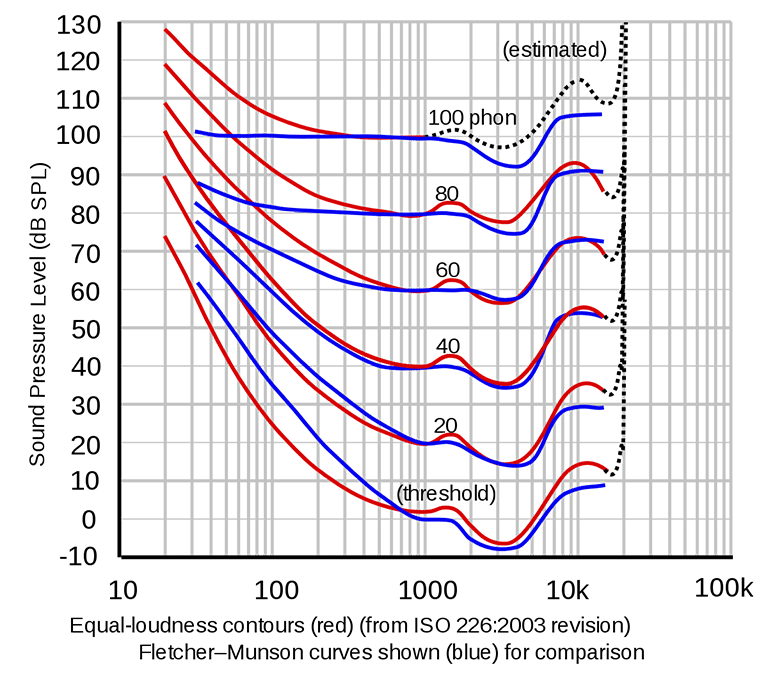
Look closely at the graph.
- The curves are not flat. At low listening levels (e.g., the 20-phon curve), we are much less sensitive to low and very high frequencies than we are to mid-range frequencies (around 1-5 kHz). You need to boost the bass and treble significantly for them to be perceived as equally loud.
- As the overall volume increases (e.g., the 100-phon curve), the curves flatten out. At loud listening levels, our hearing perceives frequencies more evenly.
This has a critical implication for mixing: a mix that sounds perfectly balanced at a loud volume will sound thin and lacking in bass when played back quietly. This is why it's crucial to check your mix at different listening levels.
For a more detailed academic look at loudness perception, the following video provides an excellent summary.
This lecture from the Technical University of Munich dives into the science of loudness perception, defining the units used to measure it.
Watch the following segments: Equal loudness contours: This section explains how the curves are measured and introduces the unit phon, a unit of loudness level tied to the dB SPL of an equally loud 1 kHz tone. The growth of loudness: This part introduces the unit sone, which measures perceived loudness on a ratio scale, and establishes the crucial rule of thumb for doubling loudness.
From the video, you learned two key concepts:
- Phon: A unit of loudness level. Two sounds have the same phon value if they are perceived as equally loud.
- Sone: A unit of perceived loudness. This scale is designed so that if a sound has a value of 2 sones, it is perceived as "twice as loud" as a sound with a value of 1 sone.
The most important practical takeaway is the relationship between decibels and perceived loudness:
For sounds above a moderate level (~40 dB SPL), a 10 dB increase in sound pressure level is perceived as a doubling of loudness.
This is a powerful rule of thumb. When you push a fader up by 10 dB, you are not making the sound a little louder; you are making it sound twice as loud to a listener.
Conclusion
In this lesson, we've translated the numbers on your screen into physical and perceptual reality. You now have a solid, technical understanding of the units used to measure and control level in your music.
Here are the key takeaways:
- The decibel (dB) is a logarithmic ratio used to measure audio levels, compressing a vast dynamic range into a manageable scale.
- The formula for decibels depends on whether you are measuring a power quantity () or a non-power quantity like voltage or pressure ().
- dBFS (Decibels Full Scale) is the standard for digital audio, where 0 dBFS represents the absolute maximum level before clipping. All other levels are negative.
- Human hearing is also logarithmic. Our perception of frequency balance changes with listening volume, as described by the equal-loudness contours.
- As a general rule, an increase of 10 dB is perceived as a doubling of loudness.
We've now established a firm grasp on the fundamental properties of sound: frequency (pitch), amplitude (loudness, measured in dB), and phase (timing). With this physical foundation in place, we are ready to explore the building blocks of synthesis. In the next lesson, we will examine the four basic waveforms—sine, square, saw, and triangle—and discover how their unique harmonic content gives them their distinct character.
Can't find a good explanation? Sign up and we'll make it for you
Sign up