
Welcome to the next lesson in our journey through the physics of digital sound. In our previous sessions, we've established a solid understanding of the core properties of sound waves: frequency, which governs pitch; amplitude, which we learned to measure precisely using decibels; and phase, which determines how waves interact.
Now, we move from these fundamental properties to the fundamental materials of sound synthesis. This lesson is about the raw clay from which electronic sounds are molded: the basic waveforms. Our goal is to identify the four primary waveforms—sine, square, sawtooth, and triangle—not just by their distinct shapes, but by their sound and, most importantly, their underlying harmonic content. This knowledge is the bedrock of subtractive synthesis, the technique behind many of the iconic sounds in progressive house, including the rich, evolving textures central to the deadmau5 style.
Timbre, Harmonics, and the Spectrum
When a musical instrument plays a note, say a C2, you don't just hear a single, pure frequency. You hear a rich tapestry of sound. The lowest and loudest frequency you hear is the fundamental, and it's what determines the note's pitch (C2). However, layered on top of this are a series of higher, usually quieter, frequencies called harmonics or overtones.
The specific combination and relative loudness of these harmonics determine the sound's timbre—its unique character or tonal color. This is why a piano and a guitar playing the same note sound distinctly different. They have the same fundamental frequency, but their harmonic structures are unique.
Given your background, you'll recognize this principle as a direct application of Fourier analysis: any periodic signal can be represented as a sum of simple sine waves at different frequencies, amplitudes, and phases. The basic waveforms of synthesis are simply periodic signals with very specific, well-defined Fourier series—that is, very specific recipes of harmonics.
The following video provides an excellent visual and auditory introduction to this concept. Using Ableton's own Spectrum analyzer, it demonstrates how the fundamental and harmonics combine to create the timbre of different sounds.
The Science of Sound Design Part 1: Sculpting Harmonics | Ableton Live Tutorial
This video from Catalyze Music Academy explains the relationship between the fundamental frequency (pitch) and harmonics (timbre) in a very practical way.
Please watch the first part of the video, from the beginning up to the end of the harmonic sequence explanation. Pay close attention to how the Spectrum analyzer visually represents the different harmonic content of a piano versus a guitar, even when they play the same note.
Now that we've established that timbre is a function of harmonic content, let's dissect the four cornerstone waveforms of synthesis.
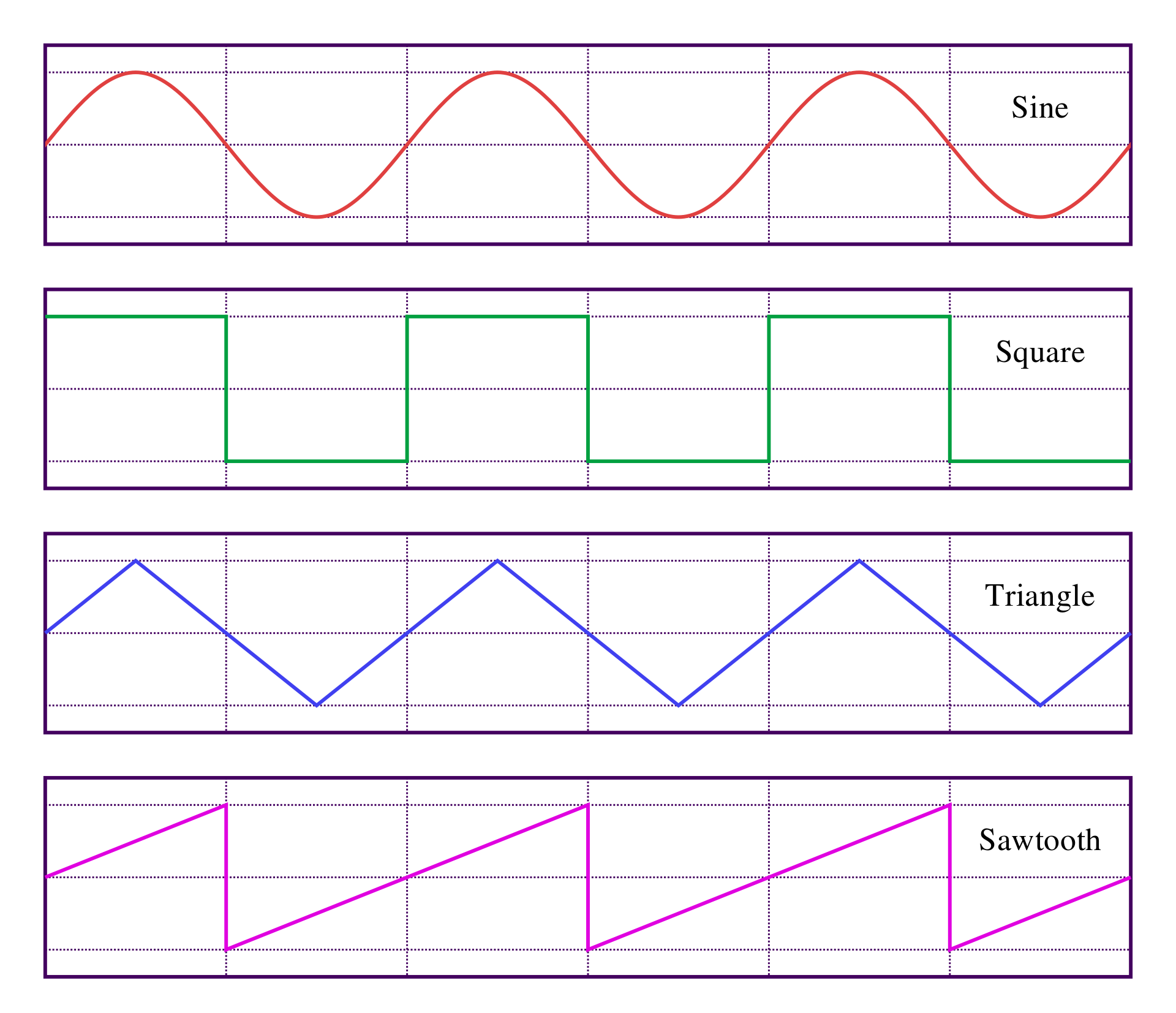
The Building Blocks of Synthesis
We will now explore each of the four basic waveforms in detail. For each one, we'll examine its shape, its unique harmonic "recipe," and its resulting sound. The WolfSound YouTube channel provides a fantastic, concise overview that we'll use as our guide.
Sine, Saw, Square, Triangle, Pulse: Basic Waveforms in Sound Synthesis Explained [Synth #005]
This video breaks down the essential properties of the basic synthesis waveforms, complete with mathematical context, spectral visualizations, and audio examples. It's a perfect technical summary.
We will watch this video in segments as we discuss each waveform. For now, you can get a sense of its structure. It covers the sine, triangle, square, saw, and pulse waves.
1. The Sine Wave
- Shape: A smooth, perfectly rounded oscillation. It represents a single, pure frequency.
- Harmonic Content: A sine wave has no harmonics. Its entire energy is concentrated at the fundamental frequency. It is the atom of the sonic world.
- Sound: Pure, mellow, and hollow. Because it lacks overtones, it can sound quite gentle and lacks "brightness" or "buzz." It's the sound of a tuning fork, a broadcast test tone, or the foundation of a deep sub-bass.
Let's confirm this with our video guide.
Sine, Saw, Square, Triangle, Pulse: Basic Waveforms in Sound Synthesis Explained [Synth #005]
Watch the segment on the sine wave.
The relevant section starts at the sine waveform. Notice the spectrum visualization shows only one spike: the fundamental.
2. The Sawtooth Wave (or Saw Wave)
- Shape: Looks like the teeth of a saw. It has a linear ramp (either up or down) followed by an instantaneous drop.
- Harmonic Content: The sawtooth is the most harmonically rich of the basic waveforms. It contains all integer harmonics (1st, 2nd, 3rd, 4th, etc.), including both even and odd multiples of the fundamental. The amplitude of these harmonics decreases as you go higher in frequency, proportional to , where is the harmonic number.
- Sound: Very bright, rich, and "buzzy." Its full harmonic spectrum makes it sound big and powerful. This is the absolute workhorse of analog-style subtractive synthesis. The classic detuned "supersaw" leads that are a hallmark of trance and progressive house (and a deadmau5 staple) are built from multiple sawtooth oscillators.
Sine, Saw, Square, Triangle, Pulse: Basic Waveforms in Sound Synthesis Explained [Synth #005]
Now, let's look at the sawtooth wave.
Watch the explanation starting at the sawtooth waveform. Observe how the spectrum contains a dense series of spikes representing all the harmonics.
3. The Square Wave
- Shape: Instantly jumps between a high and a low value, spending equal time at each.
- Harmonic Content: A square wave contains only odd-numbered harmonics (1st, 3rd, 5th, 7th, etc.). Like the sawtooth, the amplitude of these harmonics is proportional to . The absence of the even harmonics gives it a different character.
- Sound: "Hollow," "reedy," or "nasal" compared to the saw wave. It has a buzz, but it's less dense and more focused. It's often associated with classic video game sounds, but is also used for clarinet-like tones and aggressive, hollow-sounding basslines.
A close relative of the square wave is the pulse wave. A square wave has a 50% duty cycle (it's "on" 50% of the time and "off" 50%). A pulse wave is a generalization where this duty cycle can vary, which changes the harmonic content and timbre.
Sine, Saw, Square, Triangle, Pulse: Basic Waveforms in Sound Synthesis Explained [Synth #005]
Next up is the square wave and its generalization, the pulse wave.
First, watch the section on the square wave, noting the odd-only harmonic structure. Then, continue with the section on the pulse waveform to understand how the duty cycle affects the harmonics.
4. The Triangle Wave
- Shape: A linear ramp up followed by a linear ramp down, creating a triangular shape.
- Harmonic Content: Like the square wave, the triangle wave contains only odd-numbered harmonics. However, the key difference is that their amplitude falls off much more rapidly, proportional to . This means the higher harmonics are significantly quieter than in a square wave.
- Sound: Much softer and more mellow than a square or saw wave, closer to a sine wave but with a bit more "air" or brightness. It's often described as being flute-like or good for gentle pads and electric piano-style sounds.
Sine, Saw, Square, Triangle, Pulse: Basic Waveforms in Sound Synthesis Explained [Synth #005]
Finally, let's examine the triangle wave.
Watch the segment on the triangle wave. Pay attention to how quickly the harmonics in the spectrum visualization decrease in amplitude compared to the square and saw waves.
A Technical Summary
To consolidate this from a more formal perspective, we can look at a table summarizing the Fourier series coefficients for these common signals. Your engineering background will make this table particularly insightful. It's the mathematical expression of everything we've just heard and seen.

Look at rows 1, 2, and 3 for the Square, Sawtooth, and Triangular waves. The Cₖ column mathematically defines the harmonic content:
- Square Wave: The formula results in
Cₖ = 0for all even values ofk, confirming it has only odd harmonics. - Sawtooth Wave: The formula for
Cₖhas a value for everyk ≠ 0, confirming it has all harmonics. - Triangular Wave: Like the square wave,
Cₖ = 0for evenk. However, the denominator includesk², showing why its harmonics decay much faster than the square or saw wave's, which are proportional to1/k.
Ear Training Exercise
Theory is one thing, but training your ear is paramount. Open Ableton Live and load an instance of the Analog synthesizer. On the front panel, you'll see two oscillators (Osc 1 and Osc 2). Turn Osc 2 completely off for now by clicking its power button.
On Osc 1, you will see buttons for the four waveforms we've discussed. Play a note on your MIDI keyboard (or your computer keyboard) and cycle through the four shapes.
- Listen intently to the change in timbre.
- Try playing notes in different octaves. Notice how the character of the waveforms changes at higher and lower pitches.
- If you have a spectrum analyzer plugin (like Ableton's
Spectrum), place it after the synth and watch how the harmonic display changes as you switch waveforms. This will connect your eyes to your ears.
Conclusion
In this lesson, we have demystified the four foundational waveforms of synthesis. You are now equipped to identify them not only by their shape and sound but also by their specific harmonic recipes.
Here are the key takeaways:
- Timbre is determined by the presence and relative amplitude of harmonics above a fundamental frequency.
- Sine Wave: The fundamental building block. It contains no harmonics, resulting in a pure, clean tone.
- Triangle Wave: Contains odd harmonics that decay rapidly (), sounding soft and flute-like.
- Square Wave: Contains odd harmonics that decay slowly (), sounding hollow and reedy.
- Sawtooth Wave: Contains all integer harmonics that decay slowly (), making it the brightest and richest waveform—the primary source for classic synth leads and basses.
We've focused on what these waveforms are. In doing so, we've repeatedly touched on the idea of decomposing them into their constituent sine waves. In our next and final lesson of this module, we will formally explore the mathematical tool that makes this possible: the Fourier transform. We will see how it allows us to move between the time-domain (the waveform shape) and the frequency-domain (the harmonic spectrum), a concept that is central to nearly all modern audio processing.
Can't find a good explanation? Sign up and we'll make it for you
Sign up