
Hello! Welcome to your next lesson in our Fluid Mechanics module.
In the previous lesson, we established a crucial first step in analyzing fluid motion: distinguishing between laminar and turbulent flow using the Reynolds number. This allowed us to characterize the nature of the flow. Now, we will begin applying fundamental physical laws to predict the flow's behavior quantitatively.
Today's lesson focuses on one of the most fundamental principles in all of physics and engineering: the conservation of mass. In fluid mechanics, this principle is expressed through the continuity equation. Your learning outcome is to apply the continuity equation (conservation of mass) to incompressible flows. This powerful and intuitive tool allows you to relate fluid velocity to the geometry of the system, a common task in engineering design, from sizing fuel lines in an aircraft to designing wind tunnels.
1. The Core Idea: What Goes In Must Come Out
At its heart, the continuity equation is a mathematical statement of a simple idea: for a steady flow in a contained system (like a pipe), the mass of fluid entering a section per unit time must equal the mass leaving that section per unit time. Mass can't just appear or disappear.
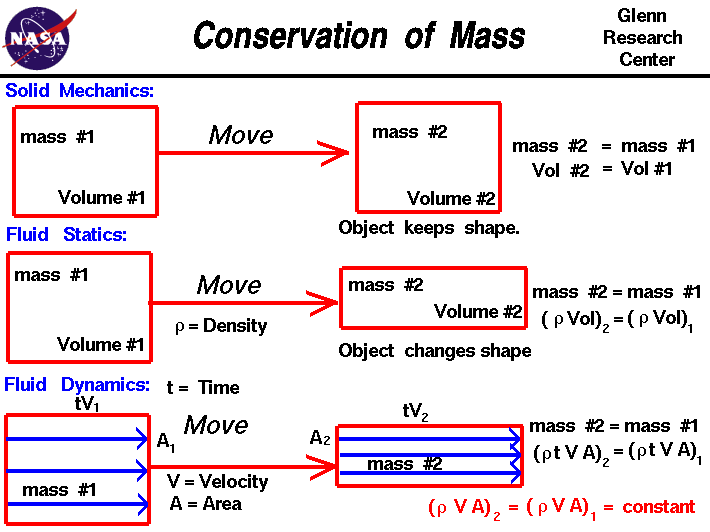
To apply this principle, we first need to define two key terms: volume flow rate and mass flow rate.
2. Defining Flow Rates
Volume Flow Rate ()
The volume flow rate, often denoted by , is the volume of fluid that passes through a given cross-section per unit of time. If a fluid is moving with an average velocity through a pipe with a cross-sectional area , the volume flow rate is:
The typical SI units for are cubic meters per second (m³/s).
Mass Flow Rate ()
The mass flow rate, denoted by (pronounced "m-dot"), is the mass of fluid passing through a cross-section per unit of time. It's related to the volume flow rate by the fluid's density :
The typical SI units for are kilograms per second (kg/s).
The following video provides a clear introduction to volume flow rate and mass flow rate and derives the continuity equation we will be using.
Continuity Equation, Volume Flow Rate & Mass Flow Rate Physics Problems
This video from The Organic Chemistry Tutor clearly defines volume and mass flow rates, derives the continuity equation from the principle of mass conservation, and provides several worked examples.
Please watch from the beginning to 06:28. The first two minutes define volume flow rate. The next section introduces mass flow rate and uses it to derive the continuity equation for incompressible flow, followed by a practical example.
3. The Continuity Equation for Incompressible Flow
As explained in the video, the principle of conservation of mass for a steady flow between two points (1 and 2) in a pipe means:
Substituting the formula for mass flow rate, we get the general form of the continuity equation:
This lesson focuses on incompressible flows. A fluid is considered incompressible if its density is constant throughout the flow. Most liquids, like water, are treated as incompressible. Gases, like air, can also be treated as incompressible if they are moving at relatively low speeds (as a rule of thumb, below about 30% of the speed of sound).
For an incompressible flow, , so the density term cancels out, leaving us with the simplified continuity equation:
This also means the volume flow rate is constant: . This is the key formula for this lesson. It tells us that for a given flow rate, if the pipe area decreases, the velocity must increase, and vice versa.
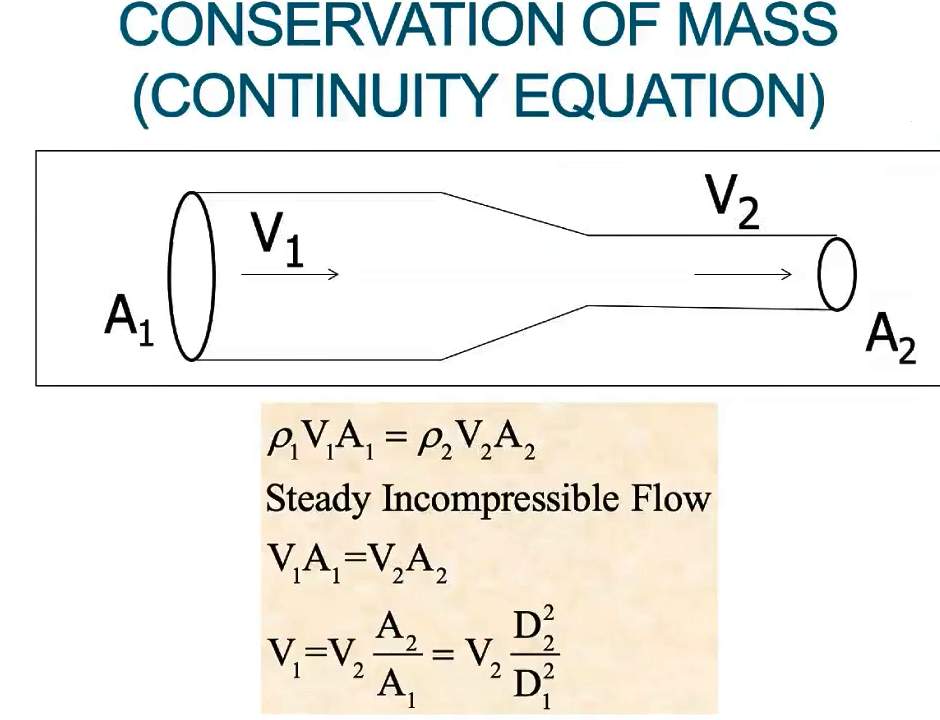
Let's watch another example to solidify this. This one uses the pipe radius, which is a common variation.
Continuity Equation, Volume Flow Rate & Mass Flow Rate Physics Problems
Let's continue with the same video from The Organic Chemistry Tutor, which now works through another example involving a change in pipe radius.
Watch the segment from 06:28 to 10:49. Notice how an increase in radius leads to a decrease in velocity, and pay attention to how the volume flow rate can be calculated at either section and gives the same result.
Test your understanding!
Air flows through a circular air-conditioning duct. The duct has a diameter of 40 cm at the inlet (point 1) and narrows to 20 cm at the outlet (point 2). The average velocity of the air at the inlet is 3 m/s. Assuming the air is incompressible, what is the velocity at the outlet?
Show answer
-
Identify the knowns and unknowns.
- Inlet diameter
- Outlet diameter
- Inlet velocity
- Unknown: Outlet velocity
-
Apply the continuity equation.
-
Calculate the areas. The area of a circular duct is .
(Note: You could also leave out, as it will cancel.)
-
Solve for .
As expected, since the diameter was halved, the area decreased by a factor of four, causing the velocity to increase by a factor of four.
4. Continuity for Branching Flows
The principle of mass conservation also applies to more complex systems, like pipes that split into multiple branches. For an incompressible fluid, the total volume flow rate entering a junction must equal the sum of the volume flow rates leaving the junction.
For a pipe that splits from one inlet (1) into two outlets (2 and 3), this becomes:
The following reading, from an aerospace-focused university textbook, explains and illustrates this concept with several clear examples.
Continuity Equation – Introduction to Aerospace Flight ...
This chapter from an Embry-Riddle Aeronautical University textbook, 'Introduction to Aerospace Flight Vehicles,' provides a formal but clear explanation of the continuity equation and its application to various flow scenarios, including branched pipes.
Please read the following sections: 'Simplifications of the Continuity Equation', 'Flow Through a Branched Pipe', and the 'Check Your Understanding #2' example. Focus on how the simple principle of 'mass in = mass out' leads directly to the equations for single and branched pipes. Don't worry about the integral symbols; the key is the resulting algebraic formulas.
Now, let's see this applied in a video problem that involves a branching pipe system.
Branching Pipe Flow - Bernoulli Equation and Continuity Equation Example Problem
This video from Brian Bernard tackles a problem with one inlet and multiple outlets. It's a great demonstration of applying the continuity equation in a more complex scenario.
Watch the segment from 08:56 to 11:24. The key part is where the presenter applies the continuity equation as Q_in = Q_out, which simplifies to Q1 = Q2 + Q3 + Q4. Please note: This video also uses the Bernoulli equation, which we will cover in the next lesson. For now, focus only on the application of the continuity equation to find the unknown flow rate Q4.
Conclusion
In this lesson, you've learned to apply the principle of mass conservation to incompressible fluid flows. This has given us the continuity equation, a fundamental tool for any fluid mechanics analysis.
Key Takeaways:
- Mass Flow Rate: is the mass of fluid passing a point per unit time.
- Volume Flow Rate: is the volume of fluid passing a point per unit time.
- Conservation of Mass: For steady flow, the mass entering a system must equal the mass leaving it.
- Continuity Equation (Incompressible): For a fluid with constant density, this simplifies to . This means velocity is inversely proportional to the cross-sectional area.
- Branching Flows: For a junction, the total flow rate entering must equal the sum of the flow rates exiting: .
Next Steps:
We have now covered the first fundamental law (conservation of mass). The next logical step is to introduce the conservation of energy. For fluid dynamics, this leads to the famous Bernoulli's equation, which will allow us to relate pressure, velocity, and elevation in a moving fluid. You've already had a sneak peek of it in the last video, and we will explore it in detail in our next lesson.
Can't find a good explanation? Sign up and we'll make it for you
Sign up