
Hello! Welcome to the ninth module of our course, where we shift our focus from fluids at rest (statics) to fluids in motion (dynamics).
In our last lesson, we concluded our study of fluid statics by exploring buoyancy and stability, applying Archimedes' principle to everything from submerged objects to the lighter-than-air vehicles central to your aerospace interests. Now, we begin our journey into the fascinating world of fluid dynamics.
Our first step is to learn how to describe the character of a fluid's motion. You've likely seen water flowing smoothly from a faucet, and also seen it splash chaotically. These two distinct behaviors are fundamental to fluid mechanics. Your learning outcome for this lesson is to distinguish between laminar and turbulent flow using the Reynolds number. Understanding this distinction is the first and most critical step in analyzing any problem involving fluid flow, from pipes to aircraft wings.
1. The Two Faces of Fluid Flow: Laminar and Turbulent
Fluid flow generally falls into one of two regimes:
- Laminar Flow: Characterized by smooth, orderly movement. The fluid flows in parallel layers (or laminas) with minimal mixing between them. It is highly predictable and easier to analyze mathematically. Think of honey slowly pouring from a jar.
- Turbulent Flow: Characterized by chaotic, irregular motion. The flow contains swirling regions of fluid called eddies, which lead to significant mixing. This regime is complex and stochastic. Think of a rapidly flowing river or smoke billowing from a chimney.
Between these two is a transitional flow regime, where the flow is neither fully laminar nor fully turbulent.
To get a clear visual and conceptual understanding of these flow types, the following video provides an excellent introduction.
Understanding Laminar and Turbulent Flow
This video from The Efficient Engineer provides a superb visual introduction to the concepts of laminar and turbulent flow, highlighting their key characteristics.
Please watch the video from the beginning to 01:54. Focus on the visual differences between the two flow regimes and the description of the velocity at a single point for each type.
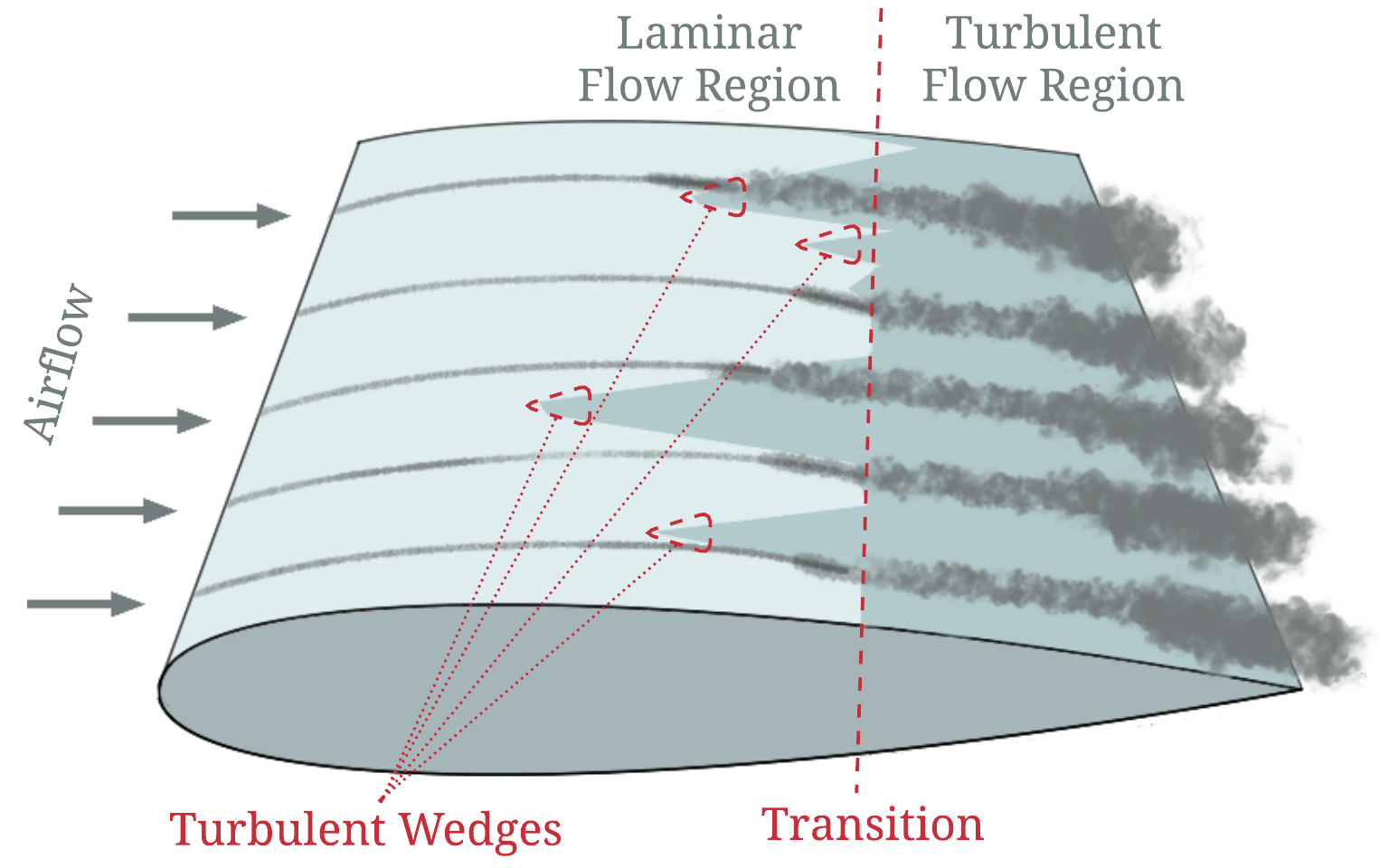
This distinction is not just academic; it has profound engineering consequences. For example, the flow of air over an aircraft's wing starts as laminar and transitions to turbulent. This transition point dramatically affects the drag on the wing, which is a key factor in aircraft performance and fuel efficiency.
2. The Reynolds Number: A Tool for Prediction
Observing a flow is one thing, but how can we predict whether a flow will be laminar or turbulent before we build the system? In the 1880s, the scientist Osborne Reynolds conducted a series of classic experiments by injecting dye into water flowing through a pipe. He found that the transition from laminar to turbulent flow depended on four key factors: the fluid's density, its viscosity, its velocity, and the size of the pipe.
Reynolds combined these into a single, powerful dimensionless number now named in his honor. The Reynolds number () represents the ratio of inertial forces to viscous forces within a fluid.
- Inertial Forces: These are related to the fluid's momentum and its tendency to continue moving. High inertial forces promote turbulence.
- Viscous Forces: These are the internal frictional forces within the fluid that resist motion and tend to damp out disturbances. High viscous forces promote laminar flow.
Therefore:
- Low Reynolds Number (): Viscous forces dominate → Laminar Flow
- High Reynolds Number (): Inertial forces dominate → Turbulent Flow
The following video does an excellent job of defining the Reynolds number, breaking down its formula, and explaining this crucial balance of forces.
Reynolds Number - Laminar vs. Turbulent Flow in 8 Minutes
This video from Less Boring Lectures provides a clear explanation of the Reynolds number, its formula, and its physical meaning.
Watch the segment from the beginning to 02:23. Pay close attention to the definition of the Reynolds number as the ratio of inertial to viscous forces and the breakdown of each variable in the formula.
3. The Reynolds Number Formula and Critical Values
As you've just seen, the formula for the Reynolds number is:
Where:
- (rho) is the density of the fluid (e.g., in kg/m³).
- is the characteristic velocity of the flow (e.g., in m/s).
- is the characteristic length of the geometry (e.g., in m).
- (mu) is the dynamic viscosity of the fluid (e.g., in N·s/m² or Pa·s).
- (nu) is the kinematic viscosity (), a property that combines density and viscosity (e.g., in m²/s).
The characteristic length () is a critical concept. Its definition depends on the situation:
- For flow inside a pipe (internal flow), is the pipe's inner diameter, .
- For flow over an airfoil (external flow), is typically the chord length of the airfoil.
- For flow over a flat plate, is the distance from the leading edge.
Critical Reynolds Numbers
The transition from laminar to turbulent flow occurs over a range of Reynolds numbers. However, for engineering purposes, we use approximate "critical" values. For flow inside a circular pipe, these are the standard values to know:

- : The flow is considered laminar.
- : The flow is transitional. It's unstable and may exhibit bursts of turbulence.
- : The flow is considered fully turbulent.
It's important to note that these values are specific to pipe flow. The critical Reynolds number for flow over an aircraft wing, for example, is much higher (often in the hundreds of thousands).
4. Calculation and Application
Let's now apply this knowledge to a practical problem. Your preference for a formula-based approach with worked examples will be well-served by this next segment.
Reynolds Number - Laminar vs. Turbulent Flow in 8 Minutes
The "Less Boring Lectures" video continues with an excellent, step-by-step worked example. It shows how to calculate the Reynolds number for oil in a pipe and then uses the result to determine the flow regime.
Please watch the rest of the video, from 02:35 to the end (around 07:32). The first part explains the critical Reynolds numbers, and the second part is the detailed example. Follow the calculations closely, especially how velocity is found from the volume flow rate, a very common task in fluid mechanics.
Now that you've seen a complete example, let's test your understanding.
Test your understanding!
Jet-A fuel at 40°C is being pumped through a 5 cm diameter pipe. You need to determine if the flow is laminar or turbulent.
Given:
- Average velocity, m/s
- Pipe diameter, cm m
- For Jet-A at 40°C:
- Density, kg/m³
- Dynamic viscosity, Pa·s
Calculate the Reynolds number and determine the flow regime.
Show answer
-
Identify the formula and variables.
We'll use .- kg/m³
- m/s
- m (This is our characteristic length, L)
- Pa·s (Remember that 1 Pa·s = 1 N·s/m²)
-
Calculate the Reynolds number.
-
Determine the flow regime.
Since , which is greater than 4000, the flow is turbulent.
Conclusion
In this lesson, we took our first step into fluid dynamics by learning to characterize the nature of fluid motion. This is a foundational concept that all subsequent analyses will build upon.
Key Takeaways:
- Fluid flow can be laminar (smooth, orderly) or turbulent (chaotic, mixing).
- The Reynolds number () is a dimensionless quantity that predicts the flow regime by comparing inertial forces to viscous forces.
- The formula is , where is a characteristic length (like pipe diameter or airfoil chord).
- For pipe flow, a Reynolds number below 2300 typically indicates laminar flow, while a value above 4000 indicates turbulent flow.
- The flow regime has major practical implications for drag, heat transfer, and mixing in engineering systems, which is especially important in aerospace design.
Next Steps:
Now that we can characterize a flow, our next step is to apply fundamental physical laws to it. In the upcoming lesson, we will introduce the first of these: the conservation of mass, which gives us the continuity equation. This powerful tool allows us to relate flow velocity to the cross-sectional area of a pipe or duct.
Can't find a good explanation? Sign up and we'll make it for you
Sign up