
Hello! Welcome to the next lesson in our fluid mechanics module.
In our last session, we explored how to calculate the total force that fluid pressure exerts on a flat, submerged surface and how to find the point where that force acts—the center of pressure. Today, we'll expand this concept from a flat surface to an entire three-dimensional body. We will investigate the net upward force from the fluid pressure, a phenomenon you've certainly experienced: buoyancy.
Your learning outcome for this lesson is to apply Archimedes' principle to solve problems of buoyancy and stability for submerged bodies. This principle is fundamental to the design of any object that operates in a fluid, from ships and submarines to the lighter-than-air vehicles that are a cornerstone of your interest in aerospace engineering.
1. Archimedes' Principle and the Buoyant Force
When a body is submerged in a fluid, the pressure on its bottom surface is greater than the pressure on its top surface, just as we saw in our previous lessons. The net effect of this pressure difference, integrated over the entire surface of the body, is an upward force called the buoyant force.
The ancient Greek mathematician Archimedes was the first to formalize this concept. Archimedes' principle states that the buoyant force on a submerged or floating object is equal to the weight of the fluid displaced by the object.
For a quick and intuitive introduction to this idea, please watch the beginning of the following video.
Archimedes Principle, Buoyant Force, Basic Introduction - Buoyancy & Density - Fluid Statics
This clip from The Organic Chemistry Tutor provides a simple, conceptual introduction to Archimedes' principle and buoyant force.
Watch the first 1 minute and 34 seconds of the video. It gives a great analogy about why it's easier to lift an object in water than in air.
The buoyant force, , can be calculated with a simple and powerful formula:
Where:
- is the density of the fluid.
- is the acceleration due to gravity.
- is the volume of the part of the object that is submerged in the fluid.
Note that the term is the mass of the displaced fluid, so is its weight. This formula directly represents Archimedes' principle.
An object's weight in a fluid, its apparent weight, is its true weight in a vacuum minus the buoyant force. Let's see how this is applied in a practical example.
Buoyancy and Archimedes’ Principle: Example Problems
The following video from Step by Step Science provides several worked examples. We'll start with the first one, which calculates the apparent weight of a copper cube in water.
Watch the segment from 00:38 to 03:36. Pay attention to how the free-body diagram is set up, with the object's weight acting down and the buoyant force (and the scale's tension) acting up.
Test your understanding!
A 10 kg solid block of aluminum () is completely submerged in sea water (). What is the buoyant force acting on the block? What is the tension in the cable holding it? (Use ).
Show answer
-
Find the volume of the block. Since it's completely submerged, this is also .
-
Calculate the buoyant force.
-
Calculate the tension. From a free-body diagram, the upward tension and the upward buoyant force must balance the downward weight of the block.
The tension in the cable is 60.85 N.
2. Floating, Sinking, and Neutral Buoyancy
The relationship between an object's weight () and the maximum buoyant force (when fully submerged, ) determines its behavior:
- Sinks: If , there is a net downward force, and the object sinks. This is equivalent to saying the object's average density is greater than the fluid's density ().
- Floats: If , the object will rise until it is only partially submerged. At equilibrium, it floats such that the buoyant force on the submerged part exactly equals its total weight. This occurs when .
- Neutrally Buoyant: If , the object will remain in equilibrium at any depth once fully submerged. This happens when . Submarines use ballast tanks to achieve this state.
A systematic approach is very helpful for solving buoyancy problems. The following resource outlines a clear, step-by-step procedure.
The textbook 'Applied Fluid Mechanics' provides an excellent procedure for solving buoyancy problems and defines the conditions for floating and sinking.
Read the section titled '5.2 Buoyancy'. Start from the statement of Archimedes' principle and read through the 4-step 'procedure for solving buoyancy problems', including the bullet points on sinking, floating, and neutral buoyancy. This provides a solid framework for analysis.
Now, let's apply this framework to an aerospace problem. The principles of buoyancy are exactly the same whether an object is in water or air—air is a fluid too!
Airships, Blimps, & Aerostats – Introduction to Aerospace ...
This chapter on Lighter-Than-Air vehicles from an Embry-Riddle Aeronautical University textbook directly applies Archimedes' principle to hot-air balloons. This is a great example of buoyancy in an aerospace context.
Read the section 'Principle of Buoyancy'. Pay close attention to the derivation for a hot-air balloon and the worked example 'Check Your Understanding #1'. Notice that the 'object' is the hot air inside the balloon, and the surrounding 'fluid' is the cooler ambient air.
3. Stability of Submerged and Floating Bodies
It's not enough for an object to float; it must also be stable. A stable object will return to its original orientation if it's tilted by a small amount (like by a wave or a gust of wind). An unstable object will capsize.
Stability depends on the relative locations of two key points:
- Center of Gravity (CG): The point where the object's total weight, , can be considered to act. This is the object's mass center.
- Center of Buoyancy (CB): The point where the buoyant force, , acts. This is the centroid of the displaced volume of fluid.
Stability of Completely Submerged Bodies
For an object that is completely submerged, the condition for stability is simple: the center of gravity (CG) must be below the center of buoyancy (CB).
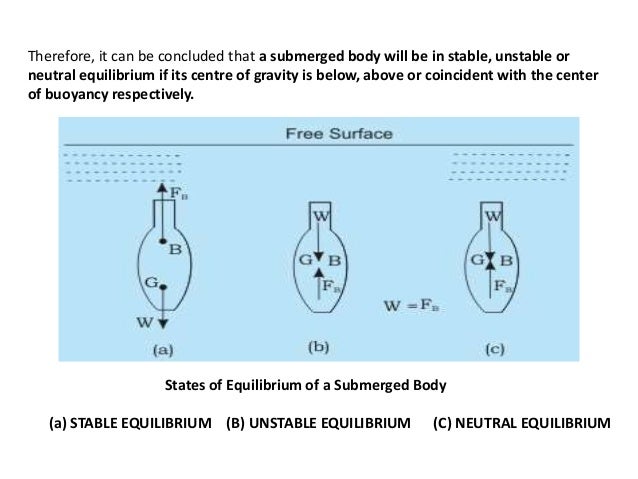
This principle is fundamental in the design of submarines and other underwater vehicles. They are designed with heavy components (like batteries and ballast) low in the hull to keep the CG well below the CB.
Let's return to the 'Applied Fluid Mechanics' text for a formal definition and examples of stability for submerged bodies.
Read the section '5.4 Stability of Completely Submerged Bodies'. This section explains the CG vs. CB rule and provides the excellent examples of the submersible 'Alvin' and a submarine to illustrate the concept.
Stability of Floating Bodies and the Aerospace Connection
For floating objects like ships or airships, the situation is a bit more complex. When a floating body tilts, the shape of the displaced fluid changes, causing the center of buoyancy (CB) to shift. This creates the possibility for the body to be stable even if its CG is above its CB.
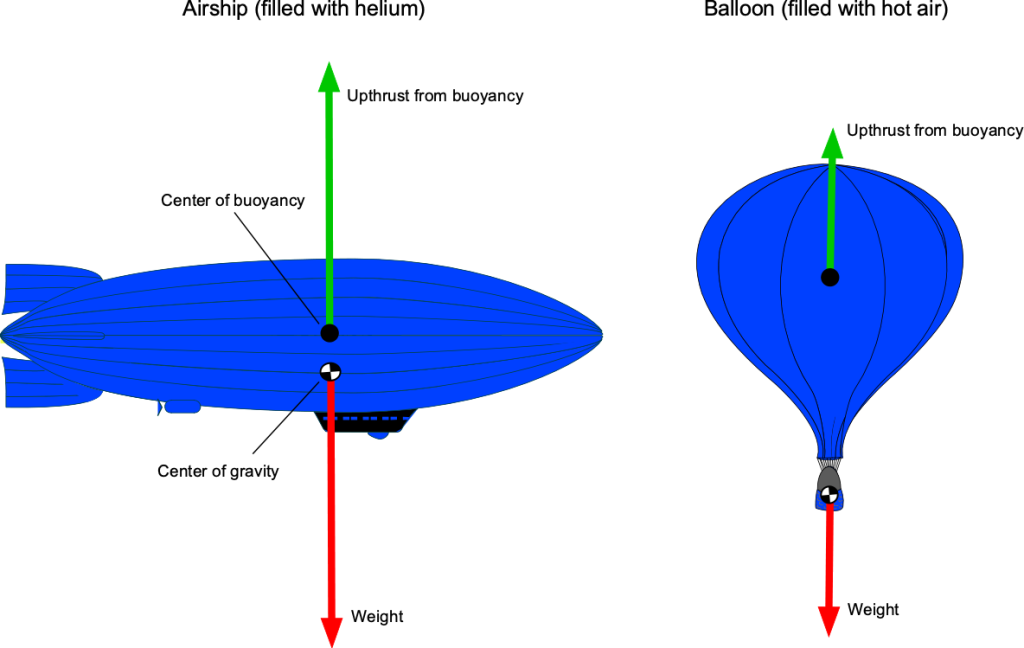
For floating bodies, stability is determined by a point called the metacenter (M). A floating body is stable if its center of gravity (CG) is below the metacenter (M). We won't go into the calculations for the metacenter in this lesson, but the concept is vital.
In aerospace, engineers use these principles to ensure the stability of airships and blimps. They can even actively manage buoyancy and stability during flight.
Airships, Blimps, & Aerostats – Introduction to Aerospace ...
The 'Airships, Blimps, & Aerostats' resource explains how these principles are applied in practice. This section connects directly to your aerospace engineering goals.
Please read two sections: 'Aerostatic Trim': This explains how the CG is kept below the CB for stability and how payload is calculated. 'Ballonets': This fascinating section describes how internal air bags are used to control an airship's buoyancy and trim (its pitch attitude) by effectively changing the volume and location of the displaced fluid. This is a real-world application of managing the CB.
Conclusion
In this lesson, you've learned to apply one of the most famous principles in physics and engineering to problems of buoyancy and stability.
Key Takeaways:
- Archimedes' Principle: The buoyant force on an object is equal to the weight of the fluid it displaces ().
- Equilibrium: An object's tendency to sink, float, or remain neutrally buoyant is determined by comparing its average density to the fluid's density.
- Stability (Submerged): A fully submerged object is stable if its center of gravity (CG) is located below its center of buoyancy (CB).
- Stability (Floating): A floating object (like a ship or airship) is stable if its center of gravity (CG) is located below its metacenter (M).
- Aerospace Application: Lighter-than-air vehicles like blimps rely on these principles for lift, and they use systems like ballast and ballonets to actively manage their buoyancy and stability.
Next Steps:
So far, our study of fluids has been entirely in statics—fluids at rest. In the next lesson, we will begin our journey into fluid dynamics by learning how to characterize fluid motion. We'll start by exploring the difference between smooth, orderly laminar flow and chaotic, swirling turbulent flow, using a key dimensionless number called the Reynolds number.
Can't find a good explanation? Sign up and we'll make it for you
Sign up