
Hello! Welcome back to our course on advanced performance marketing.
In the last lesson, we tackled the crucial challenge of analyzing conflicting signals from attribution reports and incrementality tests. The key takeaway was that these conflicts are not errors, but expected outcomes because the two methods answer different questions: attribution shows correlation ("who gets credit"), while incrementality proves causation ("who creates value"). We concluded by introducing calibration as a way to reconcile these differences.
Today, we'll build directly on that foundation. Your learning outcome is to develop a hybrid measurement framework that defines the roles for both attribution and incrementality. Instead of just analyzing conflicts, you will learn how to build a cohesive system where these tools work together. This is a vital skill for a marketing leader, as it allows you to guide your team's tactical efforts while maintaining a clear, strategic view of true business impact.
1. Beyond a Single Source of Truth
As a leader, it's tempting to search for a single, perfect metric—a "single source of truth." However, modern marketing is too complex for that. Relying solely on one measurement method creates significant blind spots.
- Attribution-Only World: If you only use attribution (like last-click or even data-driven models in Google Analytics), you risk over-optimizing for channels that are good at harvesting intent, not creating it. Your team might pour the budget into branded search and retargeting because they have a high reported ROAS, while starving the upper-funnel channels that actually generate new customers. This can look efficient in the short term but may lead to business stagnation.
- Incrementality-Only World: If you only use incrementality tests, you get a causal "gold standard" for big decisions, but it's too slow and expensive for daily tactical optimization. Your media buyers can't run a week-long geo-lift test every time they want to test a new ad creative or keyword.
The solution is not to choose one over the other, but to create a system where they complement each other.
2. The Three-Layer Hybrid Measurement Framework
A powerful way to structure this is through a layered framework organized by time horizon and the type of decision being made. This ensures that everyone, from the media buyer to the CEO, is using the right metric for their specific role.
Let's explore a practical model for this.
The Marketing Measurement Framework: How to ... - QRY
The article 'The Marketing Measurement Framework' from the agency QRY provides an excellent, clear structure for a modern hybrid framework. It directly addresses how to use different metrics for different purposes.
Please read the sections 'Attribution vs. Incrementality: The Core Distinction', 'A Modern Measurement Framework', and 'The Three-Layer Measurement Model'. Focus on how each layer serves a different user and a different time horizon.
As the article outlines, we can think of measurement in three distinct layers:
-
Layer 1: Optimization (Short-Term, Tactical)
- Purpose: Fast, directional feedback for in-channel optimization. This is about making campaigns work better on a daily or weekly basis.
- Primary Tool: Attribution Models (e.g., GA4 Data-Driven Attribution, platform-reported conversions in Google/Meta Ads).
- Key Questions: "Which ad creative is getting a better CPA?", "Should we bid more on this keyword?", "Is this audience performing better than that one?"
- Used By: Media buyers, channel specialists, and your social media marketing team.
-
Layer 2: Validation (Mid-Term, Strategic)
- Purpose: To measure the true, causal impact of marketing investments and to validate (or correct) the signals from the optimization layer.
- Primary Tool: Incrementality Testing (e.g., Geo-lift tests, conversion lift studies, holdout groups).
- Key Questions: "What is the true iROAS of our Facebook program?", "Is our investment in YouTube actually driving new sales?", "Should we shift the budget from Channel A to Channel B?"
- Used By: Marketing leadership, strategy teams, and analytics teams.
-
Layer 3: Business (Long-Term, Holistic)
- Purpose: To connect marketing performance to overall business health and financial outcomes.
- Primary Tools: Marketing Mix Modeling (MMM) and high-level business KPIs like Marketing Efficiency Ratio (MER) and LTV/CAC.
- Key Questions: "What is our total marketing ROI, including offline effects?", "How should we set our annual budget?", "Is our brand marketing driving long-term value?"
- Used By: C-Suite (CEO, CFO) and finance.
This layered structure gives each measurement tool a clear job, preventing the chaos that comes from using the wrong tool for the task.
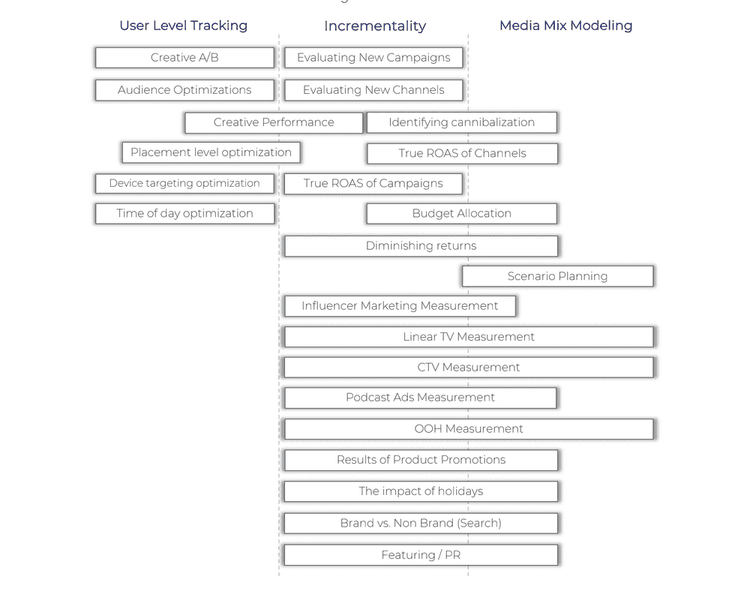
The following diagram illustrates which methodology is best suited for different types of marketing questions, reinforcing this layered concept.
3. Making the Framework Work: Cadence and Triangulation
A framework is only as good as the process that supports it. To make it actionable, you need two things: a regular cadence for review and a process for triangulation, where the layers inform each other.
Establishing a Measurement Cadence
You can't look at all the metrics all the time. A structured cadence ensures that teams are focusing on the right data at the right time.
The Marketing Measurement Framework: How to ... - QRY
The QRY article also provides a simple but effective template for a measurement cadence. This helps put the three-layer model into a practical weekly, monthly, and quarterly rhythm.
Now, please read the section 'Building a Measurement Cadence'.
A typical cadence looks like this:
- Weekly: Your media teams review Optimization Metrics (Layer 1). They are looking at attribution data within platforms to make tactical adjustments.
- Monthly/Quarterly: You and your strategy/analytics teams review Validation Metrics (Layer 2). You're analyzing the results of the latest incrementality tests to make bigger decisions about channel-level budgets.
- Quarterly/Annually: You present Business Metrics (Layer 3) to the executive team, showing how marketing is impacting MER and LTV, informed by insights from the other layers.
Triangulation: Making the Layers Talk to Each Other
This is the most critical part of a hybrid framework. The layers don't exist in silos; they must communicate. This process of using multiple methods to get a more accurate picture is often called triangulation.
Brand tracking, attribution, incrementality testing, Marketing ...
The article from Ekimetrics, a marketing measurement consultancy, explains this concept of 'triangulation' very well. It discusses why isolating methods is a common error and how combining them leads to a more robust strategy.
Please read the sections 'A frequent error: Isolating methods instead of blending them', 'The complementary nature of the approaches: Toward a 360° view of performance', and 'Result: A strategy that is guided, not simply tracked'. Note the example of how different methods can cross-calibrate.
Here’s how triangulation works in our framework:
Layer 2 Calibrates Layer 1: This is the concept we touched on in the last lesson. The causal insights from an incrementality test (Layer 2) are used to correct the correlational data from attribution (Layer 1).
- Practical Example: You run a geo-lift test on your YouTube campaigns and find the incremental ROAS is $2.0. Your GA4 attribution report claims the ROAS is $2.5. You calculate a calibration multiplier of 0.8 ($2.0 / $2.5). Now, your media team can use this multiplier on their weekly attribution reports to get a more realistic, "incrementality-adjusted" ROAS for ongoing optimization, without having to run a test every week.

Layer 2 Informs Layer 3: The validated, causal impact of individual channels (from Layer 2) serves as a crucial input for high-level Marketing Mix Models (Layer 3), making them more accurate.
Test your understanding!
Your Head of Finance is questioning your marketing budget. They point to your attribution dashboard (Layer 1) and say, "Your overall reported ROAS has been declining for three months. Why should we continue investing?"
Drawing on the hybrid framework, how would you structure your response to provide a more strategic perspective?
Show answer
A strong response would use the full framework:
-
Acknowledge the Layer 1 Data: "You're right, our short-term attribution ROAS in the platforms has seen a decline. My team is actively working on optimizing our campaigns to improve that tactical efficiency, looking at creative, bidding, and audience targeting."
-
Introduce the Layer 2 Context: "However, attribution data only tells part of the story—it measures correlation, not causation. We've been running a series of incrementality tests to understand the true causal impact of our channels. Our latest geo-test on our upper-funnel video campaign, which has a low attributed ROAS, showed a high incremental lift. This tells us it's effectively creating new demand that our attribution models are not fully capturing."
-
Connect to Layer 3 Business Impact: "This investment in demand creation is crucial for our long-term growth. While it might slightly lower the average attributed ROAS in the short term, it's filling the top of our funnel. We expect this to protect and grow our overall Marketing Efficiency Ratio (MER) and Customer Lifetime Value (LTV) in the coming quarters. Shifting budget away from it based only on the attribution signal would risk our future pipeline."
This response shows that you have a sophisticated understanding of measurement, moving the conversation from a reactive, tactical one to a strategic, forward-looking one.
Conclusion
Developing a hybrid measurement framework is about moving from a collection of conflicting reports to an orchestrated system of insight. By defining clear roles for both attribution and incrementality within a layered structure, you can empower your teams to optimize effectively in the short term while guiding the business with a causal, strategic view in the long term.
Key Takeaways:
- A hybrid measurement framework uses both attribution and incrementality, assigning them distinct roles to avoid blind spots.
- The Three-Layer Framework (Optimization, Validation, Business) organizes measurement by decision type and time horizon, giving clarity to different teams.
- Attribution (Layer 1) is for fast, tactical, in-channel optimization.
- Incrementality (Layer 2) is for strategic, causal validation of channel impact.
- An effective framework relies on a regular cadence for reviewing each layer and triangulation to ensure insights from one layer calibrate and inform the others.
Preview of the Next Lesson:
We've established that incrementality tests form the "validation" or "truth" layer of our framework. But how do we ensure that truth is reliable? The next module, Designing and Interpreting Experiments, will begin by addressing a critical first step: evaluating A/B test designs for validity and potential biases. This will equip you to ask the right questions of your analytics team and ensure your most important strategic decisions are based on sound evidence.