
Hello! Welcome to the final lesson in our module on Multi-Touch Attribution.
In our last session, we developed a powerful hybrid measurement framework. We established that attribution models are the fast, tactical "Optimization" layer, excellent for in-channel adjustments but ultimately correlational. We learned to use incrementality tests as the "Validation" layer to calibrate these models and uncover causal impact.
Today, we'll do a deep dive into that attribution layer. As a leader, you'll often be tasked with evaluating and selecting technology partners. Your learning outcome for this lesson is to critique a vendor's data-driven attribution (DDA) model based on its methodology and business fit. This is a capstone skill for this module, equipping you to look past the sales pitch and make a sound strategic investment. We'll build a framework of critical questions to ensure you choose a tool that is not only methodologically sound but also right for your business.
1. Deconstructing the "Data-Driven" Promise
First, what does a vendor mean by "data-driven attribution"? Unlike simpler heuristic models (e.g., last-click, linear) that follow pre-set rules, DDA models use algorithms to assign credit based on an analysis of historical conversion data. They analyze thousands of converting and non-converting customer paths to determine which touchpoints are most influential.
Many of these models are based on a concept from cooperative game theory called the Shapley Value. You don't need to be a data scientist to grasp the core idea, which is highly relevant to your role as a team lead.
Imagine your marketing channels are players on a team, and a conversion is a goal. The Shapley Value calculates a "fair" way to distribute credit for the goal among all the players who participated, based on their marginal contribution to every possible combination of plays.
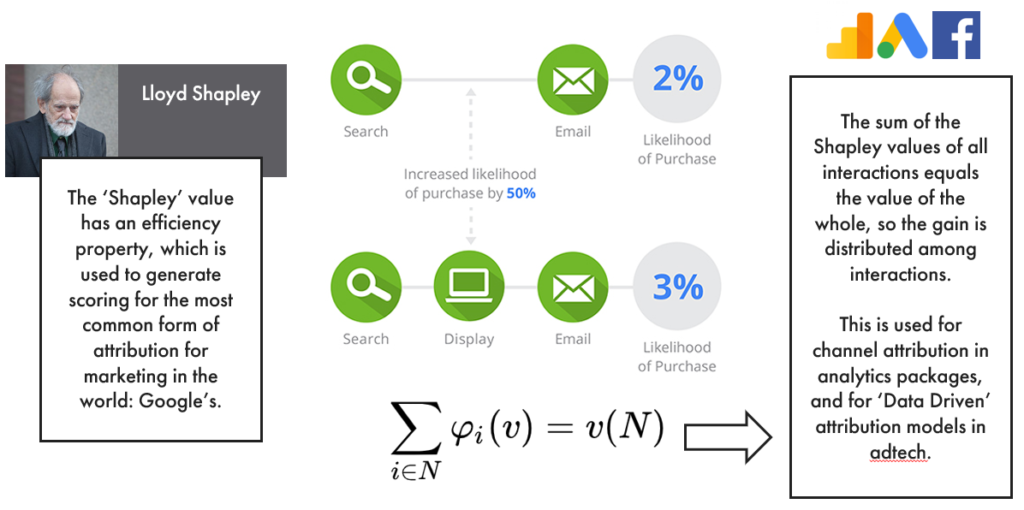
This is the vendor's promise: a mathematically rigorous and objective way to move beyond simple rules and understand the nuanced interplay between your marketing channels.
2. The Critical Lens: Where the Promise Meets Reality
While algorithmically sophisticated, DDA models are not a magic bullet. They have fundamental limitations that you, as a strategic leader, must understand. Believing the hype without acknowledging the pitfalls can lead to flawed budget decisions.
The following article provides a sharp, insightful critique of the common blind spots in these models.
Why data-driven marketing attribution models don't work as ...
The article 'Why data-driven marketing attribution models don't work as promised' from Statsig is an excellent counterpoint to vendor marketing materials. It clearly outlines the practical limitations you'll encounter.
Please read the section titled 'Where they fall short in reality'. Pay close attention to the six numbered points, as they form the basis of a strong methodological critique.
As you read, you'll see the recurring theme from our previous lessons: correlation is not causation. DDA models are exceptionally good at finding patterns and correlations in your data, but they cannot, by themselves, prove that a channel caused a conversion.
Here are the key limitations to internalize:
- Incomplete Data: The model is only as good as the data it sees. It can't account for cross-device journeys it can't connect, offline conversations, or the impact of a billboard your customer drove past.
- Correlation vs. Causation: A channel might get high credit simply because it's a common final step for users who were already going to convert (e.g., branded search). The model credits the harvesting of intent, not necessarily the creation of it.
- Oversimplified Journeys: The models reduce complex human decision-making into a neat sequence of trackable touchpoints, often missing the impact of brand perception built over months.
- Blindness to External Factors: A competitor's campaign failure or a positive news story could boost your sales. A DDA model will likely misattribute that lift to whichever marketing touchpoints it can see, simply because they were present.
- Instability: The credit assignments can sometimes change dramatically when you add a new channel or if the data changes slightly, making the model's recommendations feel erratic.
This doesn't mean DDA is useless. It means you must treat it as a powerful directional tool whose limitations you understand and actively mitigate—primarily through the incrementality testing we discussed in our last lesson.
3. An Evaluation Framework: Asking the Right Questions
Now, let's turn this understanding into an actionable framework for critiquing a vendor. Your evaluation should cover two distinct areas: Business Fit (is it right for us?) and Methodological Rigor (is the model sound?).
Ironically, one of the best sources for a structured evaluation checklist comes from a vendor's own guide. We will use it to build our set of critical questions.
The definitive guide to data-driven attribution
Google's 'definitive guide to data-driven attribution' provides a detailed chapter on how to select an attribution partner. We will use their criteria as our framework.
Please read 'Step 1: Define goals', 'Step 3: Be selective', and the section just before it, 'Would we benefit from data-driven attribution?'. Focus on the criteria listed for evaluating partners: data maturity, implementation, support, methodology, capabilities, and roadmap.
Based on this, here is a structured set of questions to guide your vendor conversations.
Part A: Assessing Business Fit
Before you even look at the model's math, you must assess if the solution fits your organization's reality.
-
1. Are we ready for this? (Data Maturity)
- Question to the vendor: "Here is an overview of our marketing mix and data sources. Based on your experience, do we have the volume and quality of data for your model to be effective?"
- Your goal: Be wary of any vendor who promises great results with "chaotic" or low-volume data. A good partner will be honest about the prerequisites.
-
2. Does this align with our goals? (Business Objectives)
- Question to your team (before meeting vendors): "What specific business decisions will this tool help us make? What is the single most important KPI we will use to define success (e.g., sales revenue, qualified leads, profit margin)?"
- Your goal: Avoid the "shiny new object syndrome." If you can't articulate the exact business problem you're solving, you're not ready to buy a tool.
-
3. Can we actually implement and use this? (Implementation & Support)
- Question to the vendor: "What is the typical onboarding process? What resources will we need from our engineering and analytics teams? What level of ongoing support and strategic consultation do you provide post-implementation?"
- Your goal: Assess the total cost of ownership, including the internal staff time required. A technologically superior model is useless if it's too complex for your team to use.
Part B: Assessing Methodological Rigor
This is where you probe the "black box." Your aim isn't to replicate their data science, but to ensure they have thoughtful answers to hard questions. The "Best-in-class methodology" subsection within the Google resource provides an excellent list.
-
4. How do you validate your model's recommendations?
- What you're listening for: The best answer involves lift analysis or comparisons against incrementality experiments. This shows they understand the difference between correlation and causation and have a process to check their model against a "ground truth." A vague answer about "backtesting" is a red flag.
-
5. Are you truly media-agnostic?
- What you're listening for: This is especially critical when the vendor also sells media (e.g., Google, Meta, Amazon). Ask them directly: "How do you prevent bias towards crediting your own platforms?" An honest vendor will acknowledge the potential conflict and explain the safeguards they have in place.
-
6. Do you use non-converting paths in your analysis?
- What you're listening for: The answer must be yes. A model that only looks at converting paths cannot understand what doesn't work. It's like trying to understand what makes a successful company by only studying successful companies.
-
7. How does your model handle data gaps like viewability, cross-device usage, and offline conversions?
- What you're listening for: No vendor has a perfect solution here. You are looking for transparency and sophistication. Do they dismiss the problem, or do they have methods to model and account for these gaps (e.g., integrating with viewability partners, offering cross-device identity solutions, allowing offline data ingestion)?
-
8. Does your model account for external factors like seasonality or promotions?
- What you're listening for: Advanced models should have the capability to incorporate these factors. If they don't, the model will likely misattribute seasonal sales lifts to your marketing campaigns, giving you an inflated sense of performance.
Test your understanding!
A vendor presents their new DDA model. They emphasize that it uses a cutting-edge machine learning algorithm and shows you a beautiful dashboard where credit is allocated down to the fourth decimal place.
Based on this lesson, what are three critical follow-up questions you would ask to cut through the hype?
Show answer
Here are three excellent questions that move beyond the surface-level pitch:
- "How do you validate the accuracy of these credit allocations against a causal baseline?" (This probes their understanding of correlation vs. causation and checks if they use methods like incrementality tests to ground their model in reality.)
- "Your model shows our branded search campaign gets 25% of the credit. But our concern is that this channel is mostly capturing users who would have converted anyway. How does your methodology distinguish between generating new demand versus harvesting existing demand?" (This directly challenges the model on a common attribution blind spot and tests its real-world strategic value.)
- "We have significant offline sales that are influenced by our digital marketing. What is your process for ingesting that offline data, and how does your model connect it to our online touchpoints?" (This assesses the model's ability to handle the "incomplete data" problem and adapt to your specific business context.)
Conclusion
Critiquing a data-driven attribution vendor is not about finding a perfect, flawless model—one does not exist. It's about a disciplined evaluation to find the best-fitting solution for your business, whose limitations you clearly understand and can mitigate.
Key Takeaways:
- Start with Business Fit: Before analyzing the algorithm, ensure the vendor's solution aligns with your company's data maturity, business goals, and operational capacity.
- Embrace Healthy Skepticism: Understand that all DDA models are sophisticated correlational tools, not perfect causal engines. They are subject to data gaps and blindness to external factors.
- Ask Tough Methodological Questions: Use the framework to probe how the vendor handles validation, bias, non-converting paths, and data gaps. Transparency and thoughtful answers are more important than a promise of perfection.
- The Goal is a Hybrid System: The best attribution tool is one that "knows what it doesn't know" and is designed to be calibrated and validated by the causal insights from your incrementality tests.
Preview of the Next Lesson:
We've spent this module focused on measuring and attributing value to customer journeys. We now pivot from valuing the path to valuing the person. In the next module, Customer Value and Segmentation Strategy, we will begin by learning how to interpret cohort retention curves and LTV calculations to assess business health. This will shift our perspective from short-term conversion events to long-term customer value and profitability.