
Good to continue. In the previous lesson, you mapped Exponent as a connected rate-markets architecture: Yield Markets create PT and YT instruments; the Rate Order Book and Rate CLMM provide execution and liquidity; Strategy Vaults delegate implementation; and risk tranching can redistribute defined downside risk.
This lesson changes perspective. Rather than asking, “What does this product do?”, ask the institutional-sales question: “What client outcome does this capability enable, under what conditions, and what risks remain?” The answer differs materially for an asset manager, a market maker, a treasury, and a family office.
From protocol features to institutional outcomes
A protocol feature is not yet a client proposition. “Rate CLMM,” “PT,” or “onchain guardrails” are product language. An institution decides based on mandate fit: return objective, risk budget, liquidity horizon, operating model, and governance requirements.
A disciplined translation has five parts:
| Step | Question |
|---|---|
| Capability | What does Exponent technically or economically enable? |
| Position | What exposure or activity does the client take on? |
| Outcome | What practical portfolio, execution, or operating result might it support? |
| Conditions | What must be true for that outcome to be useful? |
| Residual risk | What remains unprotected or uncertain? |
For example:
| Product capability | Position created | Relevant institutional outcome | Must not be overstated as |
|---|---|---|---|
| Buy a PT for a stated maturity | Fixed-maturity claim on the underlying asset | Greater predictability of return in underlying-asset units when held to maturity | Risk-free cash yield or dollar principal protection |
| Rate Order Book | Limit order at a chosen implied rate | More controlled entry, exit, or quoting | Guaranteed execution at that rate |
| Rate CLMM | Concentrated liquidity around an implied-APY range | Capital-efficient liquidity provision and potential fee capture | Passive yield with no inventory risk |
| Strategy Vault | Curated, policy-constrained multi-position strategy | Delegated access to specialist rate-market or cross-protocol strategies | A guaranteed strategy outcome |
| Risk tranche | Senior or junior exposure to a defined loss waterfall | Potentially tailored downside-risk transfer | Universal or unconditional insurance |
This framework is especially useful in an Exponent Institutional Sales Lead conversation. It keeps the discussion focused on a client’s decision rather than a product demonstration.
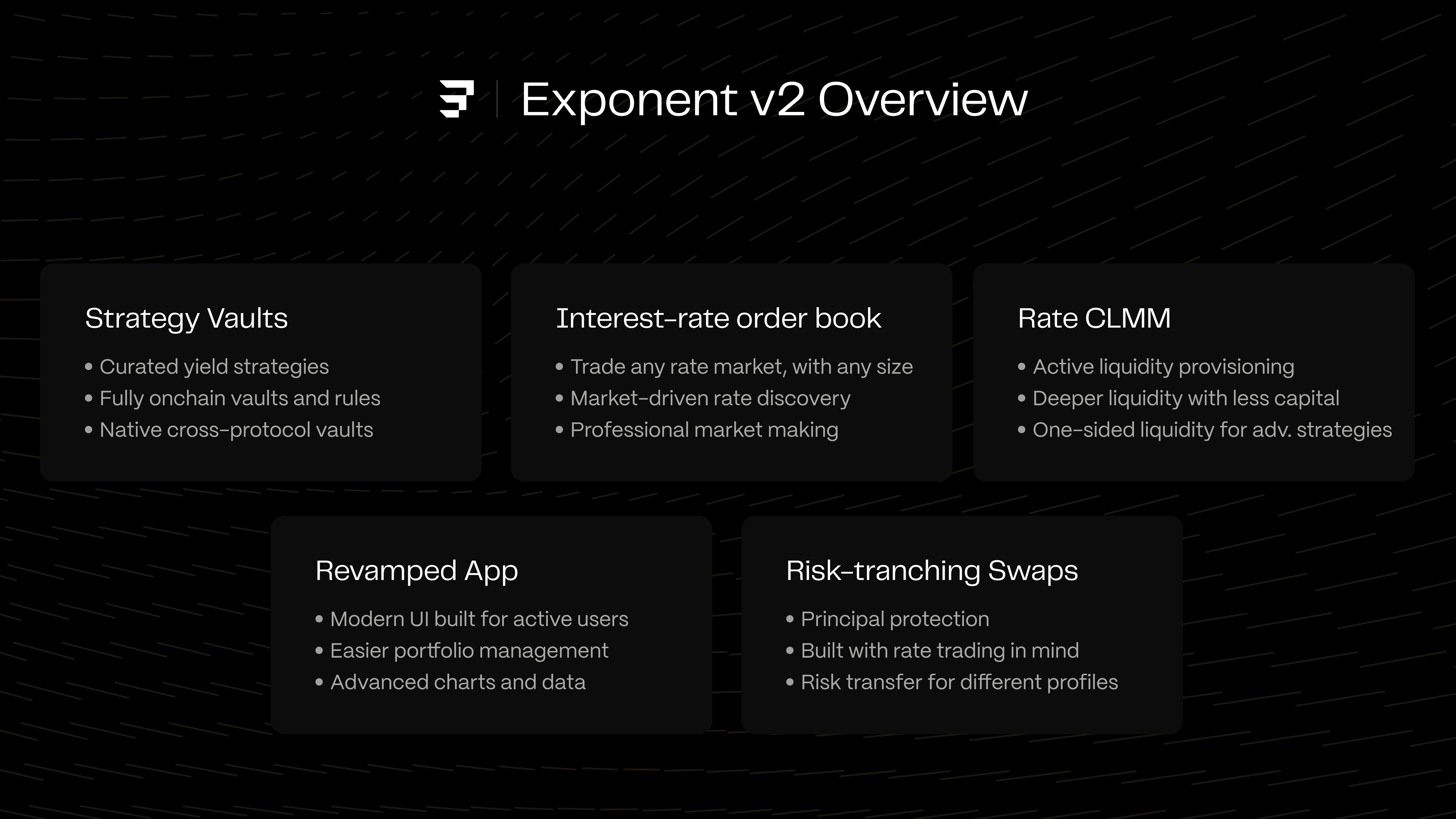
The execution and delegation toolkit
Before segmenting the client base, establish the underlying toolkit. Exponent’s v2 blog frames the protocol as a rate-trading and portfolio-construction venue with a hybrid liquidity model and managed strategies.
Exponent v2 is Live - Built For Those Who Outperform - Exponent Blog
Read Exponent’s v2 announcement to see how the team itself distinguishes rate execution for active participants from delegated access through Strategy Vaults. Treat terms such as “capital efficient” and “higher returns” as product claims to test through market data and diligence, rather than as return forecasts.
In the section “Institutional-grade Hybrid Liquidity for Interest Rate Trading,” read the hybrid-liquidity discussion. Focus on the contrast between rate-specific limit execution in the Order Book and actively managed range liquidity in the Rate CLMM. Then continue to “Strategy Vaults - Easy Access to Portfolio Construction in DeFi.” Read the vault overview, noting which activities are delegated to a curator: strategy selection, deployment, rebalancing, rollover, and position management.
The central commercial point is that Exponent supports three broad modes of participation:
- Directional rate positioning: buy PT to seek a fixed return through maturity, or buy and sell YT to express a view on future realized yield.
- Execution and liquidity provision: trade or quote rates using the Order Book, or make markets through the rCLMM.
- Delegated portfolio implementation: deposit into a Strategy Vault whose curator implements a stated mandate within defined policy constraints.
Risk tranching is a fourth, separate mode: downside-risk allocation. It may complement a yield position, but it does not create the yield and should not be assumed to cover every loss scenario.
Asset managers: mandate-aligned yield construction
For an asset manager, the relevant question is usually not whether DeFi yield exists. It is whether the return can be expressed in a form that fits a mandate, is executable at meaningful size, can be monitored, and can be explained to an investment committee.
Relevant Exponent outcomes
1. Maturity-aligned return construction
A manager that holds a yield-bearing Solana asset can use PTs to convert uncertain future yield into a maturity-specific, implied fixed return in units of that underlying asset. The manager selects:
- the reference asset;
- the maturity date;
- the executable implied rate;
- the desired position size;
- the preferred execution route.
This is closest to a fixed-income use case, but the analogy has limits. The client holds a tokenized claim that settles in the referenced underlying asset, not a conventional bond issued by a corporate or sovereign borrower. Underlying-protocol, smart-contract, custody, liquidity, and potentially token-price risk remain.
2. A tactical yield-view sleeve
YT allows a manager to isolate future variable yield. That may suit a more opportunistic mandate where the investment thesis is that realized yield, incentive emissions, or credit/staking conditions will exceed what the market currently implies.
The commercial translation is not “higher APY.” It is: a capital-efficient way to take a defined view on future yield without maintaining the full principal exposure of the yield-bearing asset. The trade-off is substantial time decay, pricing complexity, and potentially limited exit liquidity.
3. Delegated implementation with visible constraints
A Strategy Vault can suit a manager that wants exposure to specialist Solana rate strategies but does not want its own team continuously managing maturities, liquidity ranges, looping, or cross-protocol allocations. The institutional outcome is operational delegation, not elimination of investment responsibility.
For this client, a strong discovery conversation focuses on:
- Is the mandate permitted to use external curators?
- Is leverage permitted, including recursive borrowing or looping?
- Are the underlying assets and integrated protocols approved?
- What redemption terms are acceptable?
- How are valuation, exposures, fees, and policy changes reported?
4. Defined downside-risk transfer, where available and suitable
For a manager constrained by principal-risk limits, a risk-tranching structure may make an eligible yield allocation more usable. The manager needs to understand the precise covered risk, the protection amount, attachment point, duration, loss-calculation methodology, and identity or structure of junior first-loss capital.
A credible institutional statement is:
Exponent can help construct maturity-specific onchain yield exposures and provide execution or delegated implementation. Whether a position fits the mandate still depends on the underlying asset, liquidity, vault policy, legal structure, and the exact scope of any risk protection.
That statement is stronger than describing PTs as “risk-free yield” or Strategy Vaults as an outsourced fixed-income fund.
Market makers: rate-market inventory and monetizable flow
A market maker is fundamentally different from a yield allocator. The core objective is typically to price risk, intermediate flow, manage inventory, and earn compensation that exceeds adverse selection, hedging, technology, and capital costs.
Exponent’s two liquidity venues offer different ways to do that.
The Rate Order Book: proprietary quotes and intentional inventory
The Rate Order Book is most relevant to a market maker that wants to quote its own implied-rate levels, control order size, and manage the conditions under which inventory is accumulated or reduced.
Potential outcomes include:
- maintaining two-sided markets in PT or YT exposure;
- quoting different implied rates by maturity;
- working institutional client flow at pre-defined rate levels;
- accumulating PT or YT inventory only at economically acceptable prices;
- contributing to market-driven rate discovery.
The critical limitation is execution uncertainty. A resting order may not fill, may fill partially, or may fill when the market maker’s yield view is becoming stale. A serious market maker therefore needs a framework for quote refreshes, inventory limits, realized-yield monitoring, hedging routes where available, and operational controls.
The Rate CLMM: active liquidity provision around a rate view
The rCLMM is relevant when the market maker is comfortable providing liquidity around selected implied-APY ranges and actively managing inventory as rates move.
Its potential outcome is more concentrated deployment of capital in the rate range expected to attract trading, with potential fee income. One-sided liquidity can also be used to gradually enter or exit a PT position rather than placing a single large directional trade.
But the position is not equivalent to collecting a passive spread. The LP has exposure to:
- changes in implied rates;
- changing PT and YT inventory composition;
- active-range exit, after which intended fee capture may weaken;
- adverse selection when better-informed traders transact;
- rebalancing and transaction costs;
- the relationship between fees earned and the cost of holding inventory.
For a sophisticated market maker, the commercial message is:
Exponent provides both an order-driven venue for bespoke rate quotes and an active liquidity venue for range-based market making. The opportunity is to intermediate rate flow; the requirement is active inventory and risk management.
This is more accurate than promising “high capital efficiency” without asking how the firm models rate volatility, expected turnover, and fee capture.
Treasuries: predictability, liquidity planning, and concentration discipline
A DAO, foundation, operating company, or protocol treasury often has a different problem: it holds assets that may be idle, volatile, or exposed to variable yield, while also needing funds for grants, operations, incentives, redemptions, or runway.
The most natural use case: a maturity ladder of PTs
If the treasury already accepts the risk of holding a particular underlying asset, PTs may help it plan future value in that asset at selected maturities. Rather than keeping the entire allocation exposed to variable yield, it can split the allocation across maturities.
This can support:
- predictable token-denominated proceeds for expected expenditure dates;
- reduced uncertainty around a portion of portfolio yield;
- explicit comparison between available fixed rates and the treasury’s minimum return hurdle;
- avoidance of operational complexity associated with actively managing YT or LP positions.
The treasury still needs enough liquid assets outside fixed-maturity positions. A maturity match is not a liquidity match if the treasury may need to unwind early into a thin market.
When the Order Book matters
A treasury usually values execution discipline over constantly trading. The Order Book can be useful if it wants to specify the minimum implied rate at which it will lock yield or work a larger order rather than immediately crossing a pool.
The outcome is a defined execution condition, not a guarantee of deployment. If the limit does not fill, the treasury remains in its original position and needs an alternative plan.
When vaults may fit, and when they may not
A Strategy Vault may be appropriate for a treasury seeking delegated, diversified yield management while retaining onchain visibility. However, vaults can be a poor fit when:
- the treasury has rigid liquidity needs;
- the mandate prohibits leverage or multi-protocol exposure;
- the committee needs predictable composition at all times;
- strategy fees dilute a comparatively low risk-free hurdle;
- the team cannot adequately oversee the curator and policy controls.
For a treasury, the right sales conversation begins with cash-flow and liquidity calendars, not with the highest displayed yield.
| Treasury need | Potential Exponent approach | Key diligence question |
|---|---|---|
| Stable planning value in the accepted underlying asset | PT held to a matching maturity | Can the treasury hold through maturity without needing an early exit? |
| Defined target yield for a new allocation | Rate Order Book limit order | Is there sufficient liquidity and time for the order to fill? |
| Outsourced deployment into approved Solana strategies | Strategy Vault | Do permitted actions, leverage, fees, and redemption terms match policy? |
| Additional protection for an eligible allocation | Risk-tranching structure | Exactly which losses are covered, and to what amount? |
Family offices: tailored access, delegation, and capital-preservation boundaries
Family offices are heterogeneous. Some operate like active investment firms with dedicated digital-asset teams; others have lean teams, concentrated decision-making, and strong preferences for capital preservation, simplicity, and direct visibility.
The sales mistake is to treat “family office” as synonymous with retail wealth. The better segmentation variables are investment sophistication, delegated-manager tolerance, liquidity horizon, base currency, and appetite for direct onchain operations.
For an active family office
An active office may use Exponent much like a small asset manager:
- PTs for maturity-specific fixed-rate positions;
- YTs for tactical views on yield, emissions, or credit conditions;
- the Order Book for precise entry and exit levels;
- rCLMM positions where the office has market-making capability and a high tolerance for active risk management.
The important distinction is between a rate-investment strategy and a liquidity-provision business. A family office pursuing rCLMM returns should be equipped to treat it as the latter.
For a delegation-oriented family office
A Strategy Vault can offer access to a curated yield strategy without requiring the office to operate PT/YT positions, rebalance liquidity ranges, or manage rollovers internally. That is a meaningful operational benefit, particularly where the office wants transparent onchain positions but not a twenty-four-hour DeFi trading operation.
Read the Strategy Vault material with the same institutional lens: constraints are valuable because they bound curator discretion, but they do not remove asset, market, oracle, or integrated-protocol risk.
Exponent Strategy Vaults: A New Standard for Onchain Asset Management - Exponent Blog
Read this Exponent blog post for the operational and governance features behind Strategy Vaults. It is useful for translating “managed access” into concrete controls: curator permissions, whitelisted protocols, valuation, timelocks, and circuit breakers.
In “Introducing Exponent Strategy Vaults,” read the vault design and curator role. Focus on what is delegated and what is visibly constrained onchain. Then, in “Onchain Guardrails: Whitelisted Actions and Protocols,” read the transaction controls and circuit breaker discussion. Identify the difference between a control that limits actions and a guarantee against investment loss. Finally, in “What DeFi’s Future Look Like: Vault Strategies in Practice,” read the examples beginning with the live-strategy examples. Notice the distinct mandates: amplified fixed-rate exposure, multi-strategy yield allocation, and ecosystem support for a new asset.
For a preservation-oriented family office
Risk tranching can be relevant where the office’s hurdle is not simply maximizing return, but obtaining a specifically defined loss buffer for an eligible yield allocation. This proposition needs unusually careful language.
Exponent’s v2 announcement identifies principal protection as a key requirement for expanding institutional participation and specifically references asset managers and allocators above $5 million in connection with an initial OnRe-related rollout. Because product availability and terms can change, treat that article as evidence of the intended institutional direction, not evidence that a given tranche is currently live, available to a specific client, or suitable for its portfolio.
Exponent v2 is Live - Built For Those Who Outperform - Exponent Blog
Read the short section on risk tranching to understand Exponent’s stated strategic rationale for bringing principal-protection structures to onchain yield markets. The passage is also a reminder to verify current launch status, eligibility, and documentation before presenting any protection feature to a client.
Under “Risk-Tranching Swaps – Principal Protection on Rate Assets,” read the institutional-protection rationale. Focus on the reason protection may expand the addressable allocator base, while noting that the article describes an Alpha Phase and an upcoming rollout rather than universal availability.
A sound family-office message is:
Exponent can provide direct maturity-specific rate positions for an office with internal DeFi capability, or managed strategy access for one that prefers delegation. Where risk tranching is available, it may address a defined portion of downside risk, but the office must still underwrite the underlying asset, terms, liquidity, and operational model.
A practical positioning matrix
The following matrix is useful in a first-call preparation document. It prevents a generic pitch and makes the client’s required capabilities explicit.
| Client type | Primary problem | Most relevant Exponent capabilities | Desired outcome | Principal caveat |
|---|---|---|---|---|
| Asset manager | Implement a differentiated yield mandate with clear terms and reporting | PT/YT markets, Order Book, Strategy Vaults, potentially risk tranching | Maturity-specific return construction, tactical yield views, or delegated access | Fixed return is in underlying units; mandate, liquidity, and dependency risk remain |
| Market maker | Monetize rate-market flow while controlling inventory | Rate Order Book and Rate CLMM | Proprietary rate quoting, active liquidity provision, fee and spread opportunity | Inventory, adverse selection, active-range, and rebalancing risk can exceed fees |
| Treasury | Improve predictability without compromising operational liquidity | PTs, Order Book, selected Strategy Vaults | Maturity-aligned yield and more explicit execution discipline | Early-exit liquidity and underlying-asset exposure must fit runway needs |
| Family office | Access a tailored digital-asset yield allocation with appropriate governance | Direct PT/YT, Strategy Vaults, potentially risk tranching | Direct control or delegated implementation with visible policy constraints | Complexity, fees, manager discretion within policy, and capital-loss risk remain |
The same feature may be presented differently depending on the mandate. A PT is:
- a maturity-specific yield instrument for an asset manager;
- an inventory and hedging input for a market maker;
- a treasury-planning tool for an organization with known future obligations;
- a potentially simpler direct allocation building block for a family office.
Those are different outcomes generated by the same instrument. They should not be collapsed into a single claim such as “PT gives everyone safe fixed yield.”
A concise institutional conversation structure
When discussing Exponent with any of these segments, use this sequence:
-
Start with the existing exposure.
What assets, variable-yield positions, liquidity commitments, or operational obligations does the client already have? -
Identify the decision that is difficult today.
Is the client trying to lock a rate, express a yield view, execute size, provide liquidity, delegate management, or reduce specified downside? -
Match only the necessary product layer.
A treasury seeking a maturity-matched fixed return may need PT execution, not an rCLMM position. A market maker may need both liquidity venues but no vault. -
State the trade-off before the client asks.
A PT buyer gives up future variable yield; a YT buyer accepts time decay; an LP accepts inventory and active-management risk; a vault depositor accepts mandate and curator risk within policy constraints. -
Define evidence required before deployment.
This includes contract and custody arrangements, executable liquidity, fee schedule, vault terms, underlying-asset diligence, policy controls, and any protection documentation.
This structure reflects institutional credibility. It makes Exponent’s product breadth useful without presenting complexity as a benefit in itself.
Key takeaways
Exponent’s products create different outcomes for different institutional roles:
- Asset managers can construct maturity-specific yield positions, trade views on future yield, or delegate specialist implementation—but must retain mandate-level diligence.
- Market makers can quote and intermediate rate risk through the Order Book and rCLMM, in exchange for inventory, adverse-selection, and active-management exposure.
- Treasuries can use PT maturities and rate-specific execution to improve planning, provided liquidity needs and underlying-asset risk remain appropriate.
- Family offices may choose direct instruments or delegated vault strategies depending on internal capability, while treating any principal-protection feature as a precisely scoped risk-transfer arrangement rather than a blanket guarantee.
- The strongest institutional message is always conditional: identify the exposure, the outcome it may support, the operating requirements, and the risks that remain.
Next, you will turn this segmentation into a concise two-minute institutional positioning statement that distinguishes Exponent from a centralized exchange, a lending market, and a conventional yield vault.
Can't find a good explanation? Sign up and we'll make it for you
Sign up