
Welcome back. In the previous lesson, you translated Exponent’s capabilities into client outcomes for asset managers, market makers, treasuries, and family offices. The next step is to compress that analysis into language that is commercially clear without becoming promotional or imprecise.
A two-minute institutional positioning statement is not a product tour. Its purpose is to place Exponent in the buyer’s existing mental map: exchange, lending market, vault, custody stack, and portfolio-management workflow. This lesson gives you a defensible central message, the distinctions that make it credible, and a script you can rehearse for an interview or first institutional conversation.
Start with the category, not the feature list
“Order book,” “Rate CLMM,” and “Strategy Vault” are useful only after the listener understands the economic category.
The most accurate lead category is:
Exponent is an onchain yield exchange and yield-risk management platform for Solana.
Its core proposition is not simply that users can earn yield. Staking, lending, liquidity provision, and other DeFi activities already create yield. Exponent’s role is to help participants turn that variable yield exposure into maturity-specific, tradable rate exposure, then execute, manage, or delegate the resulting positions.
That distinction changes the sales conversation:
| Weak framing | Why it underperforms | Better framing |
|---|---|---|
| “Exponent offers high yield.” | Sounds like a generic earn product and makes an unstable APY the product. | “Exponent gives a portfolio tools to manage, lock, trade, or delegate yield exposure.” |
| “Exponent is Solana’s Pendle.” | May help a crypto-native listener initially, but does not explain the institutional use case or Solana-specific architecture. | “Exponent is a Solana rate market for maturity-specific yield positions and yield-risk management.” |
| “Exponent is a vault platform.” | Hides the underlying rate markets, price discovery, and execution infrastructure. | “Vaults are one access layer; rate markets and liquidity infrastructure are the foundation.” |
| “Fixed yield means safe yield.” | Confuses yield volatility with all sources of investment risk. | “A fixed-rate position can reduce uncertainty in yield, while underlying-asset, protocol, liquidity, and operational risks remain.” |
The homepage’s framing is worth absorbing because it contrasts ordinary variable-yield positions with fixed-duration rate positions.
Exponent: Outperform market rates with Solana's yield exchange
Read Exponent’s homepage to see its concise public positioning: predictable returns, yield-risk management, fixed durations, and a portfolio that can mix fixed and variable yield exposure.
At the top of the homepage, begin with the fixed versus variable framing. Read through the portfolio-construction panels that contrast fixed-rate positions with regular staking, credit, and liquidity positions. Focus on the problem Exponent is claiming to solve, rather than treating the displayed rates as performance evidence.
The three distinctions an institutional listener needs
A useful positioning statement does not argue that centralized exchanges, lending markets, or vaults are inferior. Each serves a different primary function. The point is to identify where Exponent fits and where it does not.
| Category | Primary economic function | Typical return or risk driver | Where Exponent differs |
|---|---|---|---|
| Centralized exchange | Trading venue, account infrastructure, and often custody | Market prices, exchange liquidity, and the exchange’s product terms | Exponent is designed around onchain rate exposure and yield-risk management, rather than broad spot trading or centralized account-based execution. |
| Lending market | Matches asset suppliers and borrowers | Borrow demand, utilization, collateral rules, liquidations, and bad-debt controls | Exponent makes yield exposure tradable and maturity-specific; a lending market may itself be an underlying source of yield. |
| Conventional vault | Packages or automates a strategy for depositors | Strategy performance, manager or smart-contract rules, fees, and withdrawal terms | Exponent has Strategy Vaults, but also provides the underlying rate markets, execution venues, and liquidity infrastructure. |
| Exponent | Yield exchange and portfolio-construction platform | Implied rates, realized yield, maturity, liquidity, and the underlying yield asset or protocol | Lets participants lock, trade, provide liquidity around, or delegate management of yield exposure. |
Exponent versus a centralized exchange
A centralized exchange is usually the place an institution uses for broad crypto liquidity, conversion, fiat rails, centralized account management, and sometimes custody. It may also distribute staking, earn, or structured-yield products.
Exponent should not be positioned as a replacement for those functions. Its distinction is that it is built around onchain rate markets: a participant can manage yield exposure through fixed-rate and yield positions at stated maturities, with market-driven execution mechanisms.
The institutional comparison is therefore:
- A CEX may help a client access or trade an asset.
- Exponent helps a client manage the yield and rate exposure associated with a yield-bearing asset.
Avoid implying that onchain execution eliminates all counterparty or operational risk. Instead, say that Exponent’s transactions and positions are implemented through onchain programs, while the institution must still diligence its wallet and custody model, contract risk, the referenced asset, and the applicable market liquidity.
Exponent versus a lending market
A lending protocol’s basic function is credit intermediation. Suppliers deposit assets; borrowers post collateral and borrow them. Rates commonly vary with pool utilization and borrower demand. For a lender, the major questions include credit design, collateral quality, liquidations, bad debt, and withdrawal liquidity.
Exponent does something different: it allows the market to separate and price yield exposure over a fixed period. A lender or holder of a yield-bearing asset may use Exponent to lock a maturity-specific rate, trade a view on future yield, or manage the rate risk created by the underlying lending position.
This makes the two products potentially complementary:
- A lending market can be the source of variable yield.
- Exponent can be the venue for managing the rate exposure created by that yield.
Do not say that Exponent “replaces lending.” It may sit on top of, or alongside, credit venues. The institutional value is the additional layer of rate management and price discovery.
Exponent versus a conventional vault
A conventional vault usually gives a depositor a simplified outcome: deposit one asset and receive exposure to an automated or manager-run strategy. The depositor may not actively decide when to rebalance, loop, lend, or move liquidity.
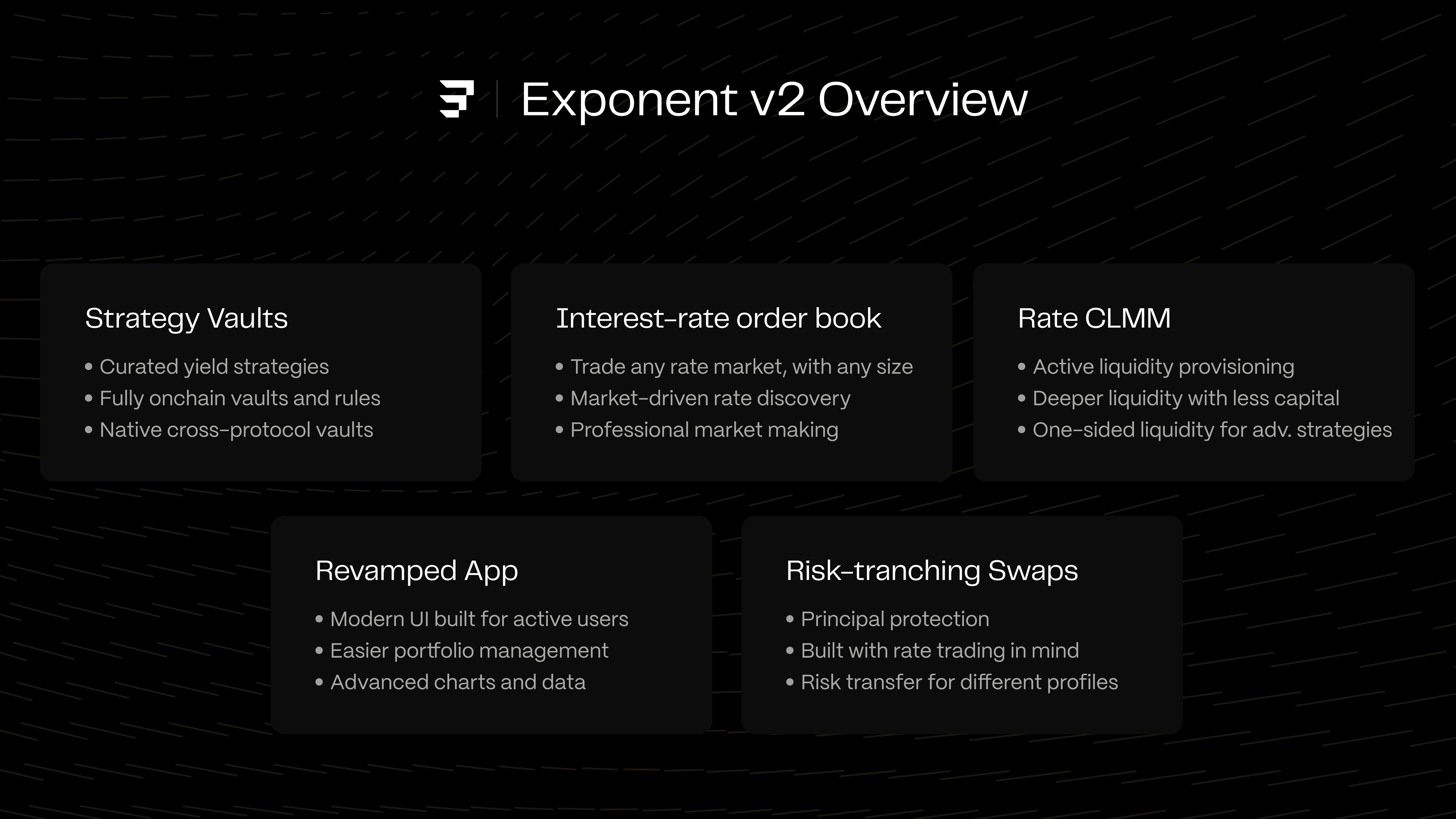
Exponent does offer Strategy Vaults. But calling Exponent “a vault” alone is incomplete. Its vaults are an implementation and delegation layer built around a broader rate-market architecture. For an institution that wants direct control, Exponent’s yield markets, Order Book, and Rate CLMM can be used directly. For one that prefers delegation, a Strategy Vault can provide managed exposure to a stated strategy subject to its policy constraints.
The distinction is important commercially:
A conventional vault begins with delegated strategy access. Exponent begins with rate markets and adds delegated strategy access when the client does not want to manage those instruments itself.
Support the pitch with product architecture
Exponent’s v2 materials provide the product language behind this positioning. The Order Book is designed for trading at explicitly quoted implied rates and for professional market making. The Rate CLMM is designed for active liquidity around selected rate ranges. Strategy Vaults allow a curator to implement a strategy without requiring each depositor to manage maturities and instrument positions directly.
Exponent v2 is Live - Built For Those Who Outperform - Exponent Blog
Read Exponent’s v2 announcement to connect the institutional positioning to the specific product architecture: rate markets, hybrid liquidity, and delegated strategy implementation.
First, in the opening section before “Institutional-grade Hybrid Liquidity for Interest Rate Trading,” read the platform framing. Then, under “Interest-rate Order Book,” read the order-book explanation to understand why implied-rate execution matters. Finally, under “Strategy Vaults - Easy Access to Portfolio Construction in DeFi,” read the vault overview. Focus on how vaults complement, rather than replace, the rate-market layer.
The practical conclusion is that Exponent can be described as a portfolio-construction venue for onchain yield, but only if you explain what that construction involves:
- Rate positioning: locking a rate for a chosen duration or taking a view on future yield.
- Execution: using an implied-rate order book or active liquidity venue rather than treating yield as a static displayed APY.
- Delegation: accessing a curator-managed strategy through a Strategy Vault when direct management is not appropriate.
- Risk transfer: where a specific risk-tranching product is available, reallocating defined downside risk under stated terms.
The last point requires particular discipline. “Principal protection” is never a blanket description of the whole platform or every position. It depends on the particular product, covered risk, limit, duration, attachment point, and legal and technical terms.
The two-minute institutional positioning statement
The following script is approximately 275 words, which is about two minutes at a deliberate institutional pace. It is designed for a general institutional audience, not just a crypto-native allocator.
Institutions with Solana yield exposure often face a basic problem: staking, credit, and liquidity positions can produce variable returns, while portfolios, liabilities, and risk limits often need clearer rate and maturity exposure. Exponent is an onchain yield exchange built to address that problem. It enables participants to trade and manage fixed-rate and yield exposure at defined maturities, using rate markets with both order-book execution and active concentrated liquidity.
Exponent is therefore different from a centralized exchange. A centralized exchange is principally a trading, account, and often custody venue. It may distribute yield products, but Exponent’s core proposition is onchain rate discovery, execution, and management of yield risk. It is not intended to replace fiat rails, broad spot liquidity, or a client’s custody and control framework.
It is also different from a lending market. A lending protocol primarily matches suppliers and borrowers, with rates typically driven by utilization and collateral mechanics. Exponent can work with yield-bearing assets originating in staking, credit, or other DeFi activity, but its purpose is to turn the resulting yield exposure into tradable, maturity-specific rate positions. The two can be complementary.
Finally, Exponent is more than a conventional vault. A conventional vault generally packages a strategy for depositors. Exponent offers Strategy Vaults for delegated implementation, but those sit alongside underlying rate markets, market-driven execution, and, where available, defined risk-transfer products.
For an institutional client, the question is not simply where to earn the highest APY. It is whether it needs to lock a rate, express a view on future yield, execute at a chosen implied rate, delegate a strategy, or manage a defined risk. Diligence remains essential: the referenced asset and protocol, smart contracts, custody and operations, liquidity before maturity, and the exact scope of any protection all matter.
This statement has a deliberate architecture:
| Segment | Purpose | Approximate time |
|---|---|---|
| Client problem | Establishes why variable yield alone is insufficient for an institutional portfolio | 20 seconds |
| Core category | Defines Exponent as a yield exchange, not an earn product | 20 seconds |
| CEX distinction | Clarifies what Exponent does not replace | 25 seconds |
| Lending distinction | Explains the rate-management layer | 25 seconds |
| Vault distinction | Positions vaults as optional delegation, not the whole proposition | 20 seconds |
| Diligence close | Demonstrates risk awareness and creates a natural transition into discovery | 25 seconds |
Deliver it like an institutional seller
The strongest delivery is measured and conditional. In a sales or interview context, confidence comes from making boundaries clear, not from claiming that every feature is appropriate for every allocator.
Use language such as:
- “can support a client seeking…”
- “is designed for participants managing…”
- “may complement an existing lending or staking allocation…”
- “subject to executable liquidity and the client’s approved custody model…”
- “where product terms and availability are appropriate…”
Avoid these formulations:
- “risk-free fixed yield”
- “guaranteed execution”
- “principal protected” without naming the specific product and protection terms
- “passive non-directional income” for active Rate CLMM liquidity
- “a replacement for centralized exchanges”
- “a vault with better APY”
For a live conversation, end the statement with one discovery-oriented bridge rather than another feature list:
“The useful starting point is whether your current constraint is yield volatility, maturity planning, execution at size, delegated implementation, or defined downside protection.”
That transition moves the conversation from generic protocol education to an actual institutional requirement.
A practical rehearsal routine is simple:
- Deliver the script once at a natural pace and time it.
- Remove any phrases you would not genuinely say in conversation.
- Replace only the opening client-problem sentence for each audience. For a treasury, emphasize liquidity planning and maturity matching; for a market maker, emphasize rate discovery, quoting, and inventory management.
- Keep the risk-and-diligence close unchanged. It is the part that signals institutional maturity.
Key takeaways
Exponent’s central institutional category is an onchain yield exchange for managing rate and yield exposure, not merely an earn product.
- Unlike a centralized exchange, Exponent focuses on onchain rate markets rather than broad centralized trading, account infrastructure, or fiat access.
- Unlike a lending market, it does not primarily intermediate borrower and supplier credit; it helps make yield exposure from underlying activities tradable and maturity-specific.
- Unlike a conventional vault, it offers direct rate-market access and execution infrastructure, while its Strategy Vaults provide an optional delegated-implementation layer.
- A credible pitch always states residual risks: referenced-asset and protocol risk, smart-contract risk, custody and operational risk, early-exit liquidity, and the specific terms of any protection.
Next, the course moves into fixed-maturity yield exchange mechanics. You will examine how principal tokens and yield tokens separate principal from future yield, which gives the positioning statement its precise economic foundation.
Can't find a good explanation? Sign up and we'll make it for you
Sign up