
Kia ora. In the previous lesson, you used inverse operations to rearrange formulas such as and . The reliable rule was: keep the equation balanced, and undo multiplication with division or undo division with multiplication.
This lesson adds one operation that appears often on electrical formula sheets: a square. You will learn to isolate an unsquared variable from formulas such as and . These are common power relationships, and the method is also useful wherever an electrical formula contains a squared quantity.
A square needs a square root
A squared term means a quantity multiplied by itself:
For example:
The inverse operation of squaring is taking a square root:
So, if an equation has:
and the question asks for , take the square root of both sides:
For the electrical formulas used in basic calculations, current, voltage, and resistance are usually treated as positive magnitudes. Therefore, use the positive square root unless the question specifically deals with a chosen polarity or direction convention.
This differs slightly from a pure algebra question, where can have two mathematical solutions, and . In a power formula such as , both positive and negative current directions produce the same heating power. When an exam asks for the current magnitude, report the positive value.
The key rule is:
To remove a square from the required variable, first isolate the squared term. Then take the square root of both sides.
The order matters: clear other operations first
Consider this power relationship:
Suppose you need to find current . It may be tempting to take the square root immediately, but is still multiplied by . First isolate .
Since multiplies , divide both sides by :
Now the squared term is alone. Take the square root of both sides:
This is the familiar current form of the power equation:
Notice that the square applies to current only in . It does not mean that both and are squared.
Electrical Formula Transposition
Watch “Electrical Formula Transposition” by Sparky Help for a direct electrical example of isolating voltage from a squared power formula. It reinforces the exact balancing method used in the previous lesson, then adds the square-root step.
In the section beginning with “resistance equals voltage squared divided by power,” watch isolating voltage. Follow the two distinct operations: first multiply by power to remove the denominator, then take a square root to remove the square on voltage. Pause just before the final formula and try to predict it from the working.
Pattern 1:
The formula
is used for the power dissipated in a resistor when current and resistance are known. You may also see it when power and resistance are known and you need current.
Rearranging for current
Start with:
Divide by :
Take the square root:
The square root must cover the whole fraction:
not
Those expressions are not generally equal.
Exam-style setup
A resistor dissipates power and has resistance . Write a formula for current.
A clear method-mark answer is:
Do the symbolic rearrangement before entering numbers into the calculator. That makes it easier to identify whether the square root should apply to a fraction, a product, or something else.
Rearranging the same formula for resistance
If the required quantity is , no square root is needed because is not squared:
Divide both sides by :
Be careful to square the current before dividing:
not
Pattern 2:
Another power relationship is:
This form is particularly useful when voltage and resistance are involved.
Rearranging for voltage
Suppose the question asks for voltage .
Start with:
The is a denominator, so multiply both sides by :
Now take the square root of both sides:
So the rearranged formula is:
The brackets are understood by the square-root bar, but when you use a calculator, enter the product as one complete expression:
Do not take the square root of and then multiply by .
Starting from a different arrangement
A formula sheet may instead show:
This is the same relationship, just rearranged. If you need , use the same method:
Multiply both sides by :
Take the square root:
The starting layout can look different, but the operations are identical:
- Remove the denominator.
- Isolate the squared term.
- Take the square root.
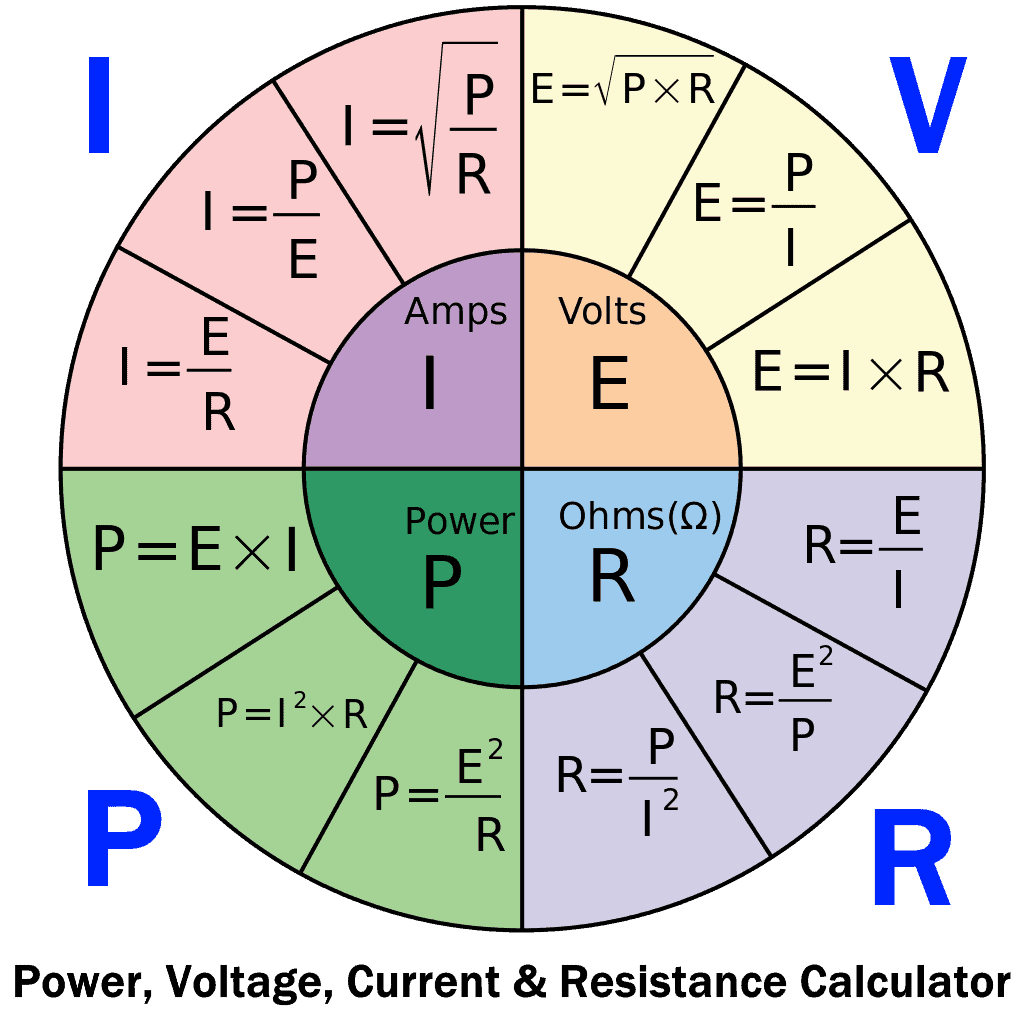
The formula wheel uses instead of for voltage. In many electrical texts, means electromotive force, but for these basic formula-sheet calculations it is treated as voltage:
Copy the symbol used in the exam question or supplied formula sheet, but recognise that the rearrangement method is unchanged.
A general squared-variable template
Many of these formulas fit a general pattern:
If the question asks for , proceed in two stages.
First, multiply both sides by :
Then take the square root:
Similarly, for the pattern:
first divide by :
then take the square root:
| Original pattern | Required variable | Rearranged form |
|---|---|---|
This table is useful for revision, but in an exam the safer approach is still to write the supplied formula and apply inverse operations one line at a time.
Use units as a quick formula check
Even before calculating, units can help you spot a misplaced square root.
For current:
Power has unit watts and resistance has unit ohms. Since:
taking the square root gives amperes:
For voltage:
The units become:
You do not need to show this unit algebra in every exam answer. But if you accidentally write:
the units will not simplify to volts, which is a warning that the rearrangement is wrong.
Common errors with squared terms
| Error | What goes wrong | Correct approach |
|---|---|---|
| Taking the square root before isolating the squared variable | The other factors remain mixed into the expression | Isolate or first, then take the root |
| From , writing | Resistance should reduce current for a fixed power, not increase it | |
| From , writing | The resistance was handled in the wrong direction | |
| Forgetting the square | Writing from | Preserve the exponent: |
| Rooting only one part of an expression | Calculator entry no longer matches the formula | Use brackets or the full root bar: or |
A useful physical reasonableness check is this:
- At fixed resistance, more power requires more current and more voltage.
- At fixed power, greater resistance gives less current but more voltage.
The correct formulas show that behaviour:
A short exam routine
When the required variable has a square on it, use this routine:
- Write the original formula from the formula sheet.
- Identify the required variable and confirm that it is squared.
- Clear any denominator first by multiplying both sides.
- Divide away any factor multiplying the squared term.
- Stop when the form is .
- Take the square root of both sides.
- Put the final formula in the form .
- Only then substitute values and use the calculator.
For example, if asked for voltage from , your symbolic working should end as:
That is enough structure to earn method marks and makes calculator use much safer.
Key takeaways
A square is undone by a square root, but only after the squared term has been isolated.
The two high-value electrical rearrangements are:
and
Keep the full product or fraction inside the square root, retain squared terms such as when rearranging for another variable, and use the expected unit or physical behaviour as a final check.
Next, you will combine formula rearrangement with careful substitution and calculator entry, including fractions, squares, and square roots.
Can't find a good explanation? Sign up and we'll make it for you
Sign up