
Kia ora. In the last lesson, you practised rearranging formulas before putting any numbers in them, including formulas with squares and square roots. This lesson is the next exam step: take the correctly rearranged formula, substitute the given values in the correct places, use your calculator accurately, and present an answer that earns method marks.
For Level 1 electrical calculations, the arithmetic is usually not difficult. Most lost marks come from entering numbers into the wrong part of a fraction, forgetting a square, mixing units such as kilohms and ohms, or rounding too early. The aim here is a repeatable written method you can use with your permitted formula sheet and calculator.
The calculation chain: formula first, numbers second
Use this sequence every time:
- Write the known values with units.
- State what you must find.
- Write the relevant formula from the formula sheet.
- Rearrange it symbolically if needed.
- Substitute values into the rearranged formula.
- Calculate, keeping extra digits on the calculator display.
- Write a final answer with the correct unit and sensible rounding.
The important boundary is between Steps 4 and 5:
- Before substitution: letters only.
- After substitution: numbers replace the matching letters.
For example, suppose a circuit has and , and you need current.
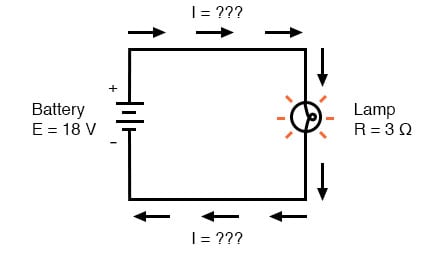
Start with Ohm's law:
Current is required, so use the rearranged form:
Now substitute for , and for :
On the calculator, enter . The final answer is:
Writing the symbols before the numbers helps prevent a common error such as dividing resistance by voltage. The formula tells you the order; the calculator simply evaluates that formula.
Watch the written method in action
The following short video reinforces the exact sequence: identify what is known, identify the required quantity, write or rearrange the formula, substitute, and calculate. It revises Ohm's law examples, but pay particular attention to how values are placed into the formula.
How to Calculate Current, Voltage, and Resistance? | Ohm's Law Practice Problems
Watch “How to Calculate Current, Voltage, and Resistance? | Ohm's Law Practice Problems” from Ms. Riaz Academy. It provides short worked examples of direct substitution and of substitution after rearranging Ohm's law.
Start with voltage calculation and notice that the known values and required unknown are written down before calculation. Then watch current calculation, where the formula is rearranged to I=V/R before the numbers are inserted. Finish with resistance calculation, focusing on the same structure for R=V/I.
A formula triangle can be a useful memory aid, but in an exam your written working should still show the formula you actually used. That working can earn marks even if you make a small calculator slip later.
Fractions: put each value in the correct place
Ohm's law has three common forms:
The letters in the final formula tell you where the values belong. For a fraction, make the numerator and denominator obvious on paper before using the calculator.
Worked example: current from voltage and resistance
A resistive load is connected to and has resistance . Calculate current.
Known:
Find:
Formula:
Substitute:
Calculate:
Rounded to three significant figures:
The calculator entry is simply:
Do not round the display to partway through a longer calculation unless the question specifically requires it. Keep the calculator value, then round once at the final answer.
Worked example: resistance from voltage and current
A circuit has a voltage of and a current of . Calculate resistance.
A useful warning: dividing by a decimal less than one makes the answer larger. Since is half an amp, producing is reasonable.
Unit readiness before substitution
Your calculator does not know whether you entered volts, amps, ohms, milliamps, or kilohms. You must make units compatible before the calculation.
For standard Ohm's law calculations:
- volts divided by ohms gives amps;
- volts divided by amps gives ohms;
- amps multiplied by ohms gives volts.
Worked example: kilohms must become ohms
A supply is connected to a resistor. Calculate current in milliamps.
First convert resistance:
Now use Ohm's law:
The question asks for milliamps, so convert the final answer:
Entering without converting would give , but that is not . It is a numerical trap caused by mixing volts with kilohms. Converting first makes the unit of the result unambiguous.
Calculator habits that prevent errors
When a formula has more than one operation, make the calculator display match the formula on your page.
Fractions and brackets
For a formula such as:
enter the numerator first, then divide by the denominator. If either part contains several operations, place that whole part in brackets.
For example:
is entered as .
But if the formula is:
the calculator must evaluate the full numerator:
Use brackets so the calculator treats as one quantity:
The expected answer is:
Without brackets, many calculators would calculate , which is , not .
Squares and square roots
The power relationships below involve squares and roots.
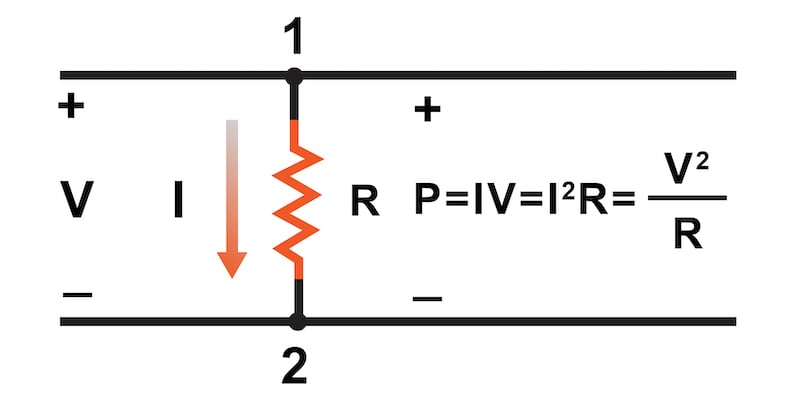
When a number is squared, square the entire value before continuing with the rest of the formula.
For and :
A clear calculator structure is:
The brackets around are not essential in this simple example, but they reinforce what is being squared: voltage only.
For a square root, ensure that the root covers the whole required expression. For example, if and , calculate current:
Enter the expression so the calculator applies the square root to , not to alone:
If your calculator makes this awkward, calculate the fraction first, check that is displayed, and then use the square-root key.
A method-mark layout to copy in the exam
For calculation questions, use enough lines that a marker can follow your decision-making. A strong answer often has this structure:
| Line | What to write |
|---|---|
| Given | , |
| Find | |
| Formula | |
| Substitute | |
| Answer |
You do not need to write a long explanation beside every line. The key is to make the formula, substitution, arithmetic, and unit visible.
Use the same pattern even if a formula was rearranged in the previous line:
This clearly shows that you understood both the rearrangement and the calculation.
Final accuracy checks before moving on
Before committing an answer, take a few seconds to check these four points:
- Correct formula: Does it calculate the quantity asked for?
- Correct substitution: Did every number replace the matching letter?
- Correct calculator structure: Are fractions, squares, roots, and brackets entered in the same structure as the written formula?
- Correct unit: Does the final answer use , , , or as required?
For instance, if you calculate current using:
your final unit should be amps, not volts or ohms. If you obtain an answer such as but the question asks for milliamps, make the final conversion and write .
Key takeaways
Accurate electrical calculations come from a disciplined sequence:
- Rearrange the formula with letters first.
- Convert units where necessary.
- Substitute each number into its correct symbol position.
- Enter the calculator expression with the same fraction, bracket, square, or root structure.
- Keep calculator precision until the final line.
- Round appropriately and always include the unit.
You have now combined formula rearrangement with calculation. Next, you will focus on checking answers using units, estimation, and physical reasonableness—quick methods for catching errors before handing in an exam paper.
Can't find a good explanation? Sign up and we'll make it for you
Sign up