
Kia ora. In the previous lesson, you practised choosing a formula by identifying the required quantity, the known quantities, and the expected unit. That prevents a common error: doing correct arithmetic with the wrong equation.
This lesson handles the next step. Sometimes the formula sheet gives the relationship you need, but the required quantity is not alone on the left-hand side. You will learn a reliable way to rearrange any three-variable multiplication or division formula before substituting numbers. The main electrical examples will be Ohm’s law and power, since these are frequent exam questions.
An equation is a balanced statement
Think of the equals sign as saying “the value on both sides is the same.” Rearranging does not mean a letter mysteriously “moves across” the equals sign. It means you perform the same operation to both sides so the equation remains balanced.
There are two rules:
- You may swap the left and right sides of an equation.
- You must do the same operation to both sides.
For example, begin with the power formula:
Suppose the question asks for voltage . The is multiplying , so divide both sides by :
On the right, divided by equals , leaving:
Swap the sides to put the required quantity first:
The key idea is simple:
- Multiplication attached to the quantity you want is undone by division.
- Division attached to the quantity you want is undone by multiplication.
Electrical Formula Transposition
Watch “Electrical Formula Transposition” by Sparky Help for a short visual explanation of why inverse operations are used when rearranging the power formula.
Watch core transposition. Focus on the idea that, when a variable is multiplied, dividing both sides by that variable cancels it. The triangle is a memory aid; the balanced-equation method is what lets you check that the result is correct.
The multiplication pattern
Many basic electrical formulas have this form:
Here, and are multiplied together.
| Required quantity | What you do to both sides | Rearranged formula |
|---|---|---|
| Nothing; it is already isolated | ||
| Divide by | ||
| Divide by |
Do not try to memorise the table as three unrelated formulas. Instead, inspect the original formula and ask:
“What operation is currently attached to the letter I need?”
If it is being multiplied by something, divide by that something.
Power formula:
The power formula is a direct example of the multiplication pattern:
Its three useful forms are:
Worked example: find voltage
A heater takes and uses . Find its supply voltage.
The question asks for voltage, so start with the original power relationship:
Divide both sides by :
Now substitute values:
Writing the rearranged formula before numbers is worthwhile in an exam. It shows the marker your method and gives you a place to spot an error before you calculate.
The division pattern
Now consider a formula written as a fraction:
This time, is divided by .
| Required quantity | What you do | Rearranged formula |
|---|---|---|
| Nothing; it is already isolated | ||
| Multiply both sides by | ||
| Multiply by , then divide by |
The most important point is that a denominator is removed by multiplying.
To isolate , start with:
Multiply both sides by :
The terms on the right cancel:
Then write the required quantity first:
9 Scientific models and mathematical equations
Read the density examples in this resource to see the same rearrangement method outside electrical work. The letters and context change, but the mathematical reasoning is exactly the same as for power and Ohm’s law.
In Chapter 9, Section 9.7, “Rearranging formulae involving multiplication and division” (pp. 96–97), read the worked method. Follow each operation performed on both sides, especially where multiplying cancels a denominator. Do not worry about the density context; concentrate on the cancellation steps and on putting the requested variable alone.
Ohm’s law: one relationship, three forms
For basic DC calculations, Ohm’s law is usually written:
Some formula sheets use rather than for voltage:
For the purposes of these basic calculations, treat and as voltage notation, but copy whichever notation the exam question or supplied formula sheet uses.
The three forms of Ohm’s law are:
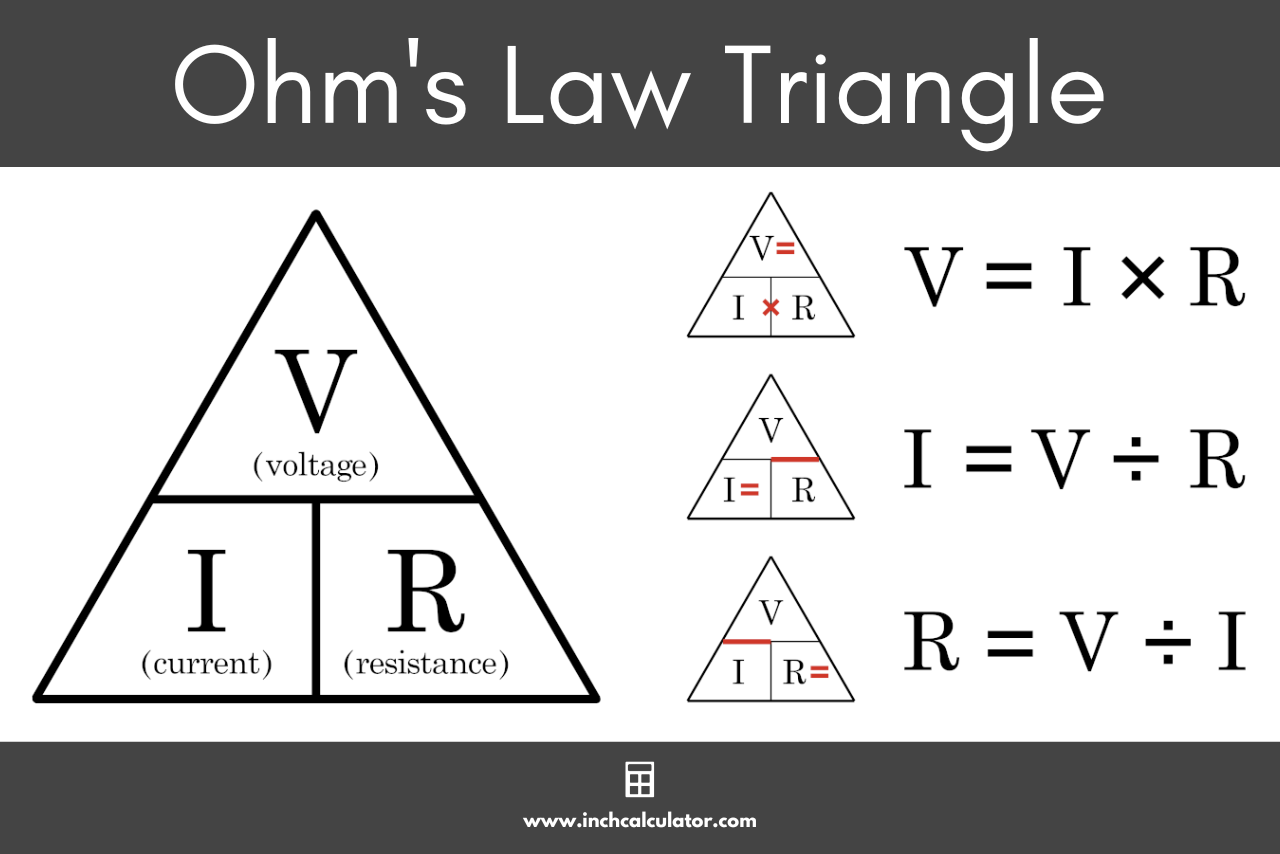
The triangle can be useful under time pressure, particularly for Ohm’s law. Cover the required letter:
- Cover : and are side by side, so multiply.
- Cover : is above , so divide by .
- Cover : is above , so divide by .
However, the triangle is only a mnemonic for this particular three-variable relationship. The balanced-equation method works even when a triangle does not.
Worked example: find current
A supply is connected across a resistor. Find the circuit current.
Start from Ohm’s law:
The required quantity is , which is multiplied by . Divide both sides by :
Substitute values:
Worked example: find resistance
A load has across it and draws . Find its resistance.
Start with:
The multiplies , so divide both sides by :
Then substitute:
A dependable exam routine
When the needed formula is not already arranged for the quantity asked, use this sequence:
- Write the original formula from the formula sheet.
- Circle the required variable in your written formula.
- Identify whether that variable is being multiplied or divided.
- Apply the inverse operation to both sides.
- Cancel only identical factors, such as or .
- Write the final rearranged formula with the required quantity on the left.
- Substitute values, including any required unit conversions.
For example, if a question asks for resistance, do not write numbers immediately. Your working should first establish:
Only then insert the voltage and current values.
Errors to watch for
| Error | Why it is wrong | Better approach |
|---|---|---|
| “Moving” a letter without changing the operation | It hides the balanced-equation step and often produces a wrong formula | State the inverse operation applied to both sides |
| From , writing | is multiplying , so it must be cancelled by division | |
| From , writing | is a denominator, so multiply by to remove it | |
| Substituting values before rearranging | It makes the method difficult to check and can lose method marks | Rearrange symbolically first |
| Relying on a triangle for every formula | Not every electrical formula fits that layout | Use inverse operations as the general method |
A quick sense check can help. In the formula
increasing resistance while voltage stays fixed should reduce current. The resistance therefore belongs in the denominator, not the numerator.
Key takeaways
A three-variable formula can be rearranged without guessing:
- An equation stays true when you perform the same operation on both sides.
- To undo multiplication, divide.
- To undo division, multiply.
- For , the alternative forms are and .
- For , the alternative forms are and .
- The Ohm’s law triangle can help recall these three forms, but the balanced-equation method is the more reliable exam skill.
Next, you will extend this method to formulas containing a squared variable. That requires one additional operation: taking a square root after isolating the squared term.
Can't find a good explanation? Sign up and we'll make it for you
Sign up