
Welcome back. In the last lesson, you practised the calculation chain: write the formula, rearrange it before substituting values, keep units compatible, use calculator brackets correctly, and include a final unit.
That gets you to an answer. This lesson adds the last exam habit: checking whether the answer deserves to be trusted. A quick check using units, a rough estimate, and what you know about how a circuit should behave can catch a wrong decimal point, a missed prefix, an incorrect formula, or values taken from the wrong part of a circuit.
By the end, you should be able to look at a result such as , , or and give a clear reason why it is plausible—or identify what needs to be checked again.
Three different checks, three different jobs
A good answer check is not just looking at the calculator display and thinking, “That seems okay.” Use three separate filters.
| Check | Main question | Errors it can catch |
|---|---|---|
| Units | Does the formula produce the unit requested? | Wrong formula, wrong conversion, incorrect final label |
| Estimate | Is the size of the number roughly right? | Decimal-point and prefix errors, calculator-entry errors |
| Physical reasonableness | Does the answer fit expected circuit behaviour? | Reversed relationships, mismatched circuit values, impossible results |
These checks complement each other. Correct units alone do not prove that the number is correct. For example, a result of has the correct unit for power, but it may still be numerically wrong.
The purpose is not to repeat every calculation from the beginning. In an exam, you usually need only 10–20 seconds to perform a useful check.
1.7 Solving Problems in Physics - University Physics Volume 1 | OpenStax
Read OpenStax’s short explanation of why solving the arithmetic is only part of a complete technical solution. It gives a clear framework for checking both units and reasonableness.
In Section 1.7, read the “Solution” and “Significance” material. Start with the units check, then continue with reasonableness checking. Focus on the distinction: units test the type of answer, while estimation tests its magnitude.
Units: let the formula tell you what the answer must be
Units behave like algebra. If you carry them through the formula, they should reduce to the unit of the quantity you were asked to find.
For Ohm’s law:
Voltage has units of volts, current has units of amps, and resistance has units of ohms:
Therefore, if you rearrange Ohm’s law to calculate current,
the units must become:
So an answer to must be in amps. If you finish with volts, ohms, or watts, something is wrong with the setup or final label.
The same idea works for the three common power formulas.
This does not require you to memorise a new set of formulas. It is simply a way to confirm that the formula you chose can produce the required type of answer.
A unit-and-prefix check
Suppose a supply is connected to a resistor.
First convert resistance:
A common incorrect answer is . The calculator may display the number if you enter , but that calculation used kilohms rather than ohms. The unit scale tells you the result is in milliamps, not amps.
A useful fast sense-check is:
- volts divided by ohms gives amps;
- volts divided by kilohms gives milliamps;
- milliamps multiplied by kilohms gives volts.
For exam working, the safest method remains converting to base units before calculating. The fast rule is mainly a way to spot a factor-of- mistake.
Unit Conversion the Easy Way (Dimensional Analysis)
Watch “Unit Conversion the Easy Way (Dimensional Analysis)” by ketzbook for a visual explanation of how units cancel during a conversion. Although its example is not electrical, the same unit logic applies to amps, volts, ohms, watts, and SI prefixes.
Watch the factor-label setup, where the units determine which way up to write a conversion fraction. Then watch why the factor equals one. In electrical calculations, use this idea to make sure unwanted units cancel and the requested unit remains.
Estimation: predict the rough size before trusting the exact number
An estimate is not a second full calculation. Round numbers to friendly values and work out what range you expect.
Consider a supply and an resistor. The calculated current is:
Before accepting that answer, estimate using :
The exact answer of is close to , so it passes the estimate check.
Compare these possible answers:
| Possible answer | Estimate check |
|---|---|
| Reasonable: close to | |
| Too large by about a factor of | |
| Too small by about a factor of | |
| Clearly impossible for this resistor and supply |
The estimate does not need to be exact. Its job is to tell you whether your calculator result is in the right neighbourhood.
Estimating power
For the same , resistor:
A quick estimate is:
The exact calculation gives:
If your calculator gave , the units would still be watts, so a unit check would not catch the error. The estimate of about would.
Physical reasonableness: does the circuit behaviour make sense?
Physical reasonableness means using what you know about a circuit to test the direction of a result.
For a simple resistive circuit, the relationships below are especially useful.
| Situation | What should happen |
|---|---|
| Supply voltage stays fixed and resistance increases | Current decreases |
| Supply voltage stays fixed and resistance increases | Power decreases |
| Resistance stays fixed and voltage increases | Current increases by the same factor |
| Resistance stays fixed and voltage doubles | Power becomes four times larger |
| Current is zero through an ordinary resistor | Voltage drop across that resistor is zero |
| A resistor is directly across a fixed voltage supply | It has the supply voltage across it |
For example, with a fixed supply:
A resistor takes more current than a resistor. If a calculation says the resistor has more current, check whether resistance was accidentally multiplied instead of divided.
For ordinary passive resistors in basic DC exam questions:
- resistance should not be negative;
- power dissipated by the resistor should not be negative;
- a very high resistance should not produce a very high current from the same supply;
- a very low resistance can produce high current, which should make you consider overload or short-circuit risk rather than treating the result as routine.
Check by calculating a related quantity
When enough information is given, calculate a related quantity using another form of the relationship. This is stronger than simply looking again at the same calculator entry.
Suppose a resistor circuit has .
First calculate current:
Now calculate power in two ways.
Using voltage and current:
Using current and resistance:
Both methods give , which supports the answer.
If someone wrote but then obtained , the unit would look correct. However, the related calculation reveals the problem:
A load at would draw , not . The current and power answers cannot both be true.
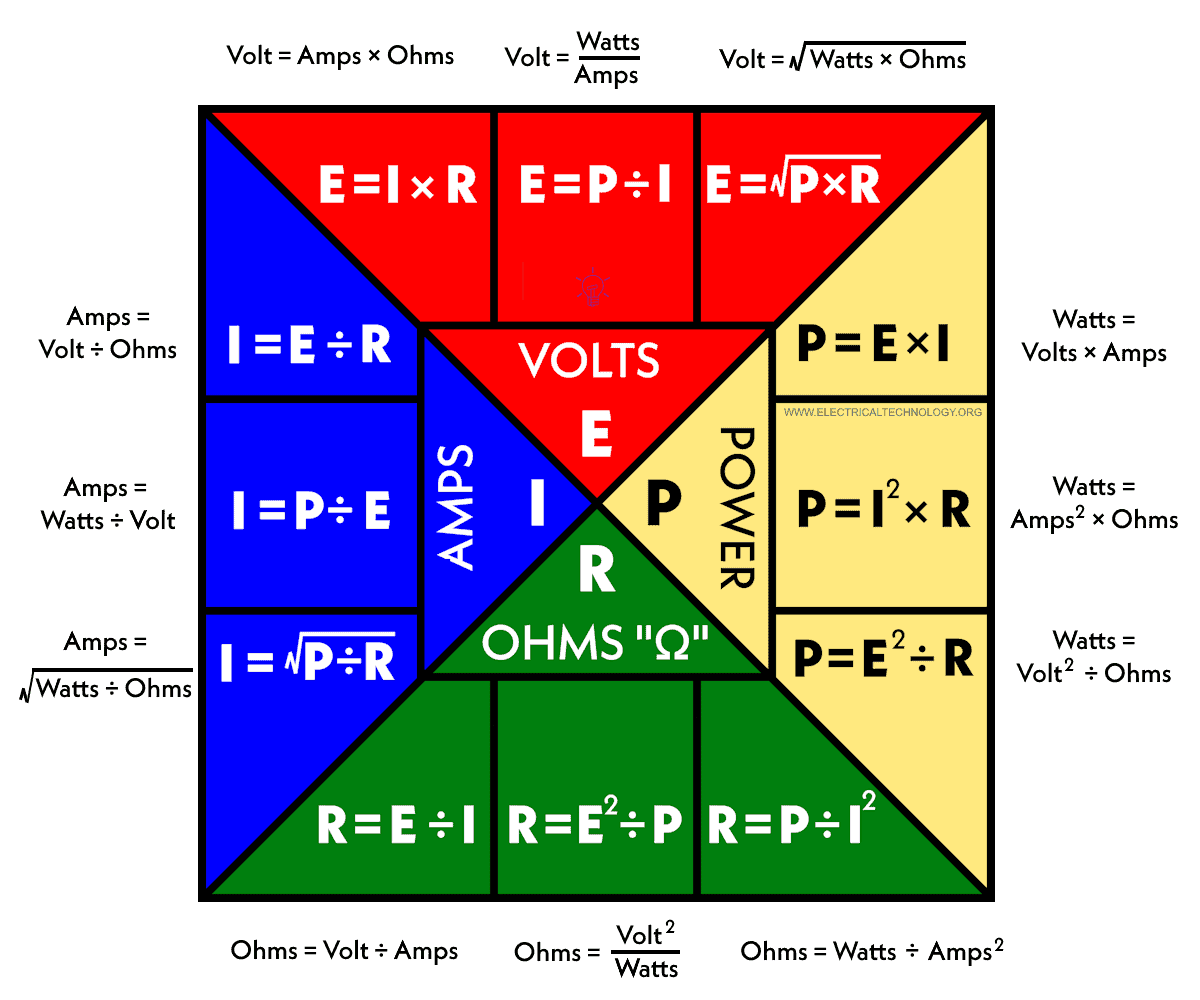
There is one more physical check that becomes important as you move into series and parallel circuits: values used in one Ohm’s law equation must describe the same component or same part of the circuit. You cannot use the current through one resistor and the voltage across a different resistor to calculate the first resistor’s resistance.
Lessons In Electric Circuits -- Volume I (DC) - Chapter 5
Read this short part of Chapter 5 to reinforce the rule that voltage, current, resistance, and power values must all refer to the same component or the same defined section of a circuit. This prevents a common mistake in later series-parallel questions.
In Chapter 5, subsection “Correct use of Ohm's Law,” begin with the same-context rule. Then find the later paragraph beginning “Not only does the table method” and read the cross-checking strategy. You do not need to master the table method yet; focus on the idea of checking results from more than one relationship.
A quick exam routine
Build these checks into the final lines of your calculation rather than leaving them until the end of the paper.
-
Read the requested quantity and unit. If the question asks for current in milliamps, your final answer needs milliamps.
-
Check formula units. For example, must give amps and must give watts.
-
Estimate with rounded numbers. Decide whether the result should be closer to , , , or before trusting the display.
-
Check the circuit relationship. Ask whether increasing resistance should have increased or decreased the current, whether a power result agrees with voltage and current, and whether all values belong to the same component.
-
Investigate failures rather than changing the answer randomly. Recheck:
- SI prefixes such as milli, kilo, and mega;
- the numerator and denominator of a fraction;
- brackets, squares, and square roots;
- the formula selected from the formula sheet;
- the final unit conversion.
A compact exam annotation can make your checking visible:
You would not normally need to write every check in full unless asked. But thinking through them gives you a reliable final defence against avoidable mistakes.
Key takeaways
A correct electrical answer needs more than correct calculator arithmetic.
- Units confirm that your formula produces the type of quantity requested.
- Estimation catches answers that are ten, one hundred, or one thousand times too large or small.
- Physical reasonableness checks whether the result matches expected behaviour, such as higher resistance causing lower current at a fixed voltage.
- Related-formula checks can reveal a mistake even when the final unit looks correct.
- In a circuit, use voltage, current, resistance, and power values that refer to the same component or defined circuit section.
You have now completed the core exam-mathematics skills: reading the question, converting units, using a formula sheet, rearranging formulas, calculating accurately, and checking the result. The next module starts the DC revision proper, beginning with the meanings, symbols, units, and measuring instruments for charge, current, voltage, resistance, power, and energy.
Can't find a good explanation? Sign up and we'll make it for you
Sign up