
Kia ora. In the previous lesson, you practised entering electrical expressions carefully: converting prefixes first, protecting fractions with brackets, and using squares and roots correctly on a calculator. Those skills matter only after you have chosen the right equation.
This lesson focuses on the decision that comes before calculation: reading an exam question, identifying what it asks for, and selecting the formula from a supplied sheet that matches the information given. We will use the common voltage, current, resistance, and power relationships as practice, but the same method applies to every formula on your exam sheet.
Treat formula selection as a matching task
Do not begin by looking for an equation that “looks familiar.” Start with the question.
For each calculation question, make a small information box in your working:
| Item | What to write |
|---|---|
| Find | The requested quantity, its symbol, and expected unit |
| Known | Every value supplied, with symbol and unit |
| Formula | An equation that has the target alone on one side and uses only known quantities on the other |
For the electrical quantities used in this lesson:
| Quantity | Symbol | Unit |
|---|---|---|
| Voltage | volt, | |
| Current | ampere, | |
| Resistance | ohm, | |
| Power | watt, |
A question may use ordinary trade wording rather than the symbol:
- “How much current does the load draw?” means find .
- “What is the voltage across the resistor?” means find .
- “Determine the resistance of the element” means find .
- “How much power is dissipated?” means find .
The unit requested is a useful second clue. If the answer must be in amperes, your selected equation must produce current, , not power or resistance.
The three selection checks
Before substituting numbers, check all three points:
-
The target is isolated.
If the question asks for current, select a formula beginning with . -
Every quantity on the other side is known.
If you have and , an equation containing is not the direct choice because is still unknown. -
The answer unit makes sense.
For example, produces watts because volts multiplied by amps gives watts.
This keeps formula selection separate from calculation. First choose; then substitute; then use the calculator.
Watch formula selection in worked electrical examples
Stop Struggling with Electrical Math – Ohm’s Law Made Simple!
Watch “Stop Struggling with Electrical Math – Ohm’s Law Made Simple!” by Electrician U for several practical examples of choosing voltage, current, resistance, or power equations from the known values.
Watch the worked examples. The presenter calls voltage E; on many formula sheets, the same quantity is written as V. For each example, pause briefly before the calculation and identify the requested quantity and the two known quantities yourself. Focus on why the selected equation contains exactly those knowns.
One detail from the video is especially important for exam work: a formula is selected from the target first, not from the first number you notice. A question containing does not automatically mean you should use an equation beginning with ; it may be giving voltage while asking you to find current, power, or resistance.
Use the formula wheel as a map, not as a guessing tool
The supplied formula sheet may list equations in rows, or it may show a formula wheel. The wheel below organises equivalent equations for the four core quantities.
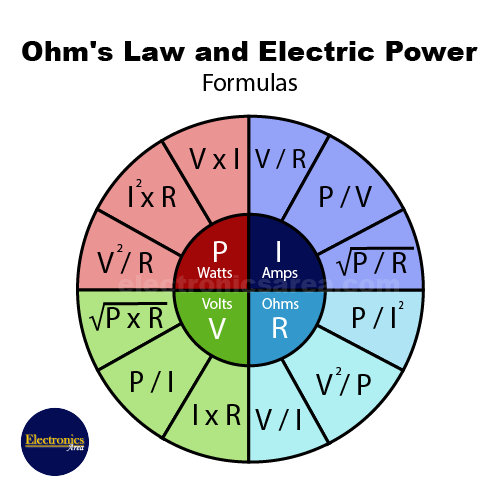
The wheel is useful because each centre section shows the quantity being found. For instance, the formulas in the power section all begin with , while the formulas in the current section all begin with .
Here is the same information in an exam-friendly table.
| If the question asks for… | If the known values are… | Select this equation |
|---|---|---|
| Power | Voltage and current | |
| Power | Current and resistance | |
| Power | Voltage and resistance | |
| Voltage | Current and resistance | |
| Voltage | Power and current | |
| Voltage | Power and resistance | |
| Current | Voltage and resistance | |
| Current | Power and voltage | |
| Current | Power and resistance | |
| Resistance | Voltage and current | |
| Resistance | Power and voltage | |
| Resistance | Power and current |
You do not need to memorise all twelve equations immediately if a formula sheet is provided. You do need to be able to scan the sheet and match:
- the letter you need to find; and
- the two letters you already know.
The square and square-root formulas are not “special power formulas to guess at.” They are simply the formulas on the sheet that connect the particular pair of known values to the required unknown.
Worked selection examples
The examples below deliberately stop after formula selection. In an exam, write the selected formula before doing the arithmetic. This earns method marks and makes it much easier to spot a wrong pathway.
Example 1: Find power from voltage and current
A heating element is supplied at and draws . Determine its power.
Write the information first:
The target is , and the known quantities are and . Select:
Do not select , because resistance has not been given. Do not select , for the same reason.
Example 2: Find current from power and voltage
A lamp operates from a supply. Find the current.
Look only at equations that begin with . The one containing the knowns and is:
It would be tempting to use Ohm’s law:
But is unknown, so it is not the direct equation for this question.
Example 3: Find resistance from power and current
A load dissipates when its current is . Determine the resistance.
Select the resistance equation containing and :
The square applies to the current, not to the power:
not
The formula sheet, not memory, is your authority. Copy its structure exactly.
Example 4: Find voltage from resistance and current
A resistor has a resistance of . Current through it is . Determine the voltage across it.
Select:
This is a direct Ohm’s law question because the known pair is current and resistance.
Example 5: Find voltage from power and resistance
A resistor dissipates . Find the voltage across it.
You need an equation beginning with that contains and :
The square root is a clue that this formula is designed for a power-and-resistance pair. It is different from:
because current has not been supplied.
Avoid the common formula-selection traps
| Trap | Why it fails | Better habit |
|---|---|---|
| Choosing the first formula containing a familiar number | A given voltage, current, or resistance can appear in several equations | Identify the required unknown first |
| Choosing an equation with another unknown on the right side | You cannot substitute a value you do not have | Use the equation that contains only known quantities |
| Ignoring the answer unit | You might calculate a valid number for the wrong quantity | Write the required symbol and unit before selecting |
| Using whenever power is mentioned | That formula requires both voltage and current | Match the formula to the pair actually given |
| Treating and as different in a basic DC formula sheet | Both may be used for voltage in different resources | Check the formula-sheet legend and use its notation consistently |
| Rearranging an equation in your head too early | It creates unnecessary errors and hides method marks | First look for a supplied equation that already has the target isolated |
A question may give more information than you need. For example, it might state that a heater is on a supply, has a resistance of , and draws , then ask for current. The direct calculation is not necessary because the current is already stated. Read the final sentence carefully before selecting any formula.
Likewise, an earlier part of a multi-part question may have produced a value. Once you have calculated and recorded that value, it becomes a known quantity for the next part.
A quick exam routine
Use this routine every time you see a calculation question:
- Underline the instruction word: calculate, determine, find, or state.
- Write the target as a symbol and unit, such as in .
- List the known values with symbols and units.
- Scan only formulas beginning with the target symbol.
- Choose the one containing only your known quantities.
- Copy the formula before substituting values.
- Convert prefixes where required, then calculate and check the final unit.
A compact piece of working might look like this:
This is clear to a marker even before the numerical calculation is completed.
Key takeaways
Formula selection is a process of matching, not memorising blindly:
- Start with the requested quantity and its expected unit.
- Record all known values using electrical symbols.
- Select a formula with the target isolated on the left-hand side.
- Check that every symbol on the right-hand side is a known value.
- Use the formula sheet or formula wheel as a map; do not choose based on what looks easiest.
- Copy the selected equation before using the calculator, so you retain method marks and can check your work.
Next, you will build on this by rearranging a three-variable multiplication or division formula when the formula sheet gives a useful relationship but not yet in the exact form you need.
Can't find a good explanation? Sign up and we'll make it for you
Sign up