
Kia ora. Last lesson established the calculation habit that comes before choosing a formula: record the known values with their units, identify the requested quantity, and flag any units that may need conversion.
This lesson develops that last step. Electrical questions regularly mix units such as , , , , , and . A prefix conversion does not change the physical quantity; it only changes how the same quantity is written. By the end, you should be able to convert confidently and show a clear, exam-mark-friendly calculation line.
Prefixes are powers of ten
A prefix tells you how large or small a unit is compared with its unprefixed form. For electrical calculations, think of , , , , , and as the no-prefix forms.
For example:
So a kilohm is a larger unit than an ohm, while a milliamp is a smaller unit than an ampere.
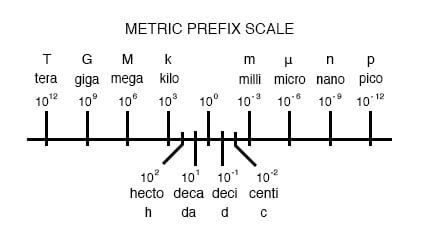
The most useful prefixes for pre-trade electrical work are below.
| Prefix | Symbol | Meaning | Power of ten | Typical electrical use |
|---|---|---|---|---|
| giga | billion times | |||
| mega | million times | , | ||
| kilo | thousand times | , , | ||
| no prefix | none | one unit | , , , | |
| milli | one thousandth | , | ||
| micro | one millionth | , | ||
| nano | one billionth | , | ||
| pico | one trillionth |
Two details matter particularly in an exam:
- Capital letters matter. is milliwatts, while is megawatts. They differ by a factor of .
- Kilo uses a lower-case . Write , not .
On meters and some displays, micro may be written as where the symbol is unavailable. Thus, commonly means .
Metric Prefixes and SI Units - SparkFun Learn
Read SparkFun Learn’s “Metric Prefixes and SI Units” to reinforce the size and symbols of the prefixes before using them in electrical calculations.
In “The Prefixes,” briefly review the standard table, then focus on the subsections “Describing the Large” and “Describing the Small.” Read the large-prefix explanation, then the small-prefix table and the warning about letter case, ending with the case distinction. Next, go to “Conversion” and read the conversion pattern. Focus on why a one-step change between the commonly used electrical prefixes changes the number by 1000.
The reliable method: expand, then rewrite
When you are unsure which way the decimal point should move, do not guess. Use the prefix power of ten.
The method has two parts:
- Write the starting value in the no-prefix unit.
- Rewrite that same amount in the requested prefix.
Example: convert to amperes
Milli means , so:
The current has not become smaller. It is still the same physical current. The number is smaller because one ampere is a larger unit than one milliampere.
Example: convert to watts
Kilo means :
Here the number becomes larger because watts are smaller units than kilowatts.
A useful sense check is:
- Converting to a larger unit gives a smaller number.
- Converting to a smaller unit gives a larger number.
For instance, is larger than , so must be less than . Likewise, is smaller than , so a capacitance written in nanofarads will have a larger number.
Prefixes used with the base units
Watch “Prefixes used with the base units” by Alom Shaha for a concise visual summary of the common prefix powers and a worked microamp conversion.
Watch the prefix map to hear the values for giga, mega, kilo, milli, micro, and nano. Then watch the microamp example. Notice that the prefix is replaced by its power of ten before the result is written in the no-prefix unit.
Converting directly between two prefixed units
You will often need to convert between two prefixed forms, such as and , or and .
The safest approach remains to pass through the no-prefix unit. After practice, you can use the exponents directly.
Suppose the starting prefix has exponent , and the target prefix has exponent . If the starting number is , the target number is:
You do not need to treat this as a new formula to memorise. It is simply a compact way to compare the two prefix powers.
Example: convert to
Mega is and kilo is .
Since:
the result is:
Using the direct exponent check:
Therefore:
Example: convert to
Micro is , and nano is .
To express that quantity in nanofarads:
Therefore:
A quick check confirms the direction: nanofarads are smaller than microfarads, so the numerical value should increase from to .
Calculator use and written working
For conversion questions, the calculator is useful, but your setup protects you from a wrong entry. Write the prefix factor before reaching for the calculator.
For example, to convert to :
On a scientific calculator, this is often entered as:
Many calculators also have an or key, which represents “multiply by ten to a power.” Check your own calculator before the exam so you can enter negative exponents confidently.
For written calculation marks, use a layout like this:
This shows the marker that you understood the prefix even if a calculator slip occurs on the final number.
Electrical examples you should recognise quickly
These are equivalent ways to write the same quantities:
| Quantity | Equivalent forms |
|---|---|
| Current | |
| Current | |
| Resistance | |
| Resistance | |
| Power | |
| Capacitance | |
| Frequency |
The key is always to convert the unit and number together. Do not change only the number or only the prefix.
For example, these statements are not equivalent:
But this statement is correct:
Later, when you substitute values into electrical formulas, it is usually safest to use no-prefix units unless the formula sheet or question explicitly tells you otherwise. Thus, convert to , to , and to before calculation. You can then convert the final answer into a more convenient prefix if required.
A short exam routine for prefixes
When you see a prefixed value in a question, use this routine:
- Copy the given value exactly, including its prefix. For example, write , not .
- Identify the required unit. The question might request , , , or .
- Write the prefix power of ten for the starting value and, if needed, the target value.
- Show one conversion line before entering the number in the calculator.
- Use the unit-size check. If changing to a smaller unit, the number should rise; if changing to a larger unit, it should fall.
- Put the requested unit on the final answer.
The most common mistakes are predictable:
- Treating and as the same prefix.
- Forgetting that micro is , not .
- Moving the decimal point in the wrong direction.
- Reporting a correct number with the wrong unit.
- Entering a prefixed value directly into a formula that expects no-prefix units.
Key takeaways
SI prefixes let you express the same electrical quantity at a convenient scale.
- means , means , and means .
- means , means , means , and means .
- Prefix symbols are case-sensitive: and are vastly different quantities.
- The physical quantity stays unchanged during a conversion; only its numerical representation changes.
- If uncertain, replace the prefix with its power of ten, convert through the no-prefix unit, and check whether the number should get larger or smaller.
Next, you will use these conversion skills while evaluating formula-sheet expressions involving fractions, percentages, powers of ten, squares, and roots.
Can't find a good explanation? Sign up and we'll make it for you
Sign up