
Hello, and welcome to the first lesson in your exam-revision course. This first module is about the calculation habits that earn marks before you even touch the calculator. The immediate skill is simple but essential: reading an electrical question accurately enough to identify what you know, what you must find, and which units belong to each quantity.
In an exam, many calculation errors begin before the formula is chosen. A learner may use the right equation but substitute the wrong value, miss a unit such as milliamps, or calculate voltage when the question actually asks for current. Your goal in this lesson is to make a short, reliable “data capture” from every question.
Treat every question as a data-extraction task
An electrical calculation question normally contains three kinds of information:
- Known quantities: values supplied in the words, a diagram, a table, or a label.
- Required unknown: the quantity the question asks you to determine.
- Context or conditions: information that may matter when choosing a formula later, such as “series circuit,” “single-phase,” “operating for 4 hours,” or “efficiency is 80%.”
For now, do not rush into a formula. First translate the question into electrical symbols and units.
A useful exam layout is:
For example, if a question says:
A resistor of carries a current of . Determine the voltage across it.
Your setup, before calculation, is:
Notice that the words “determine the voltage” tell you the unknown is voltage. You do not need to guess it from the numbers.
The core symbols to recognise quickly
| Quantity | Common symbol | Usual unit | Unit symbol |
|---|---|---|---|
| Voltage / potential difference | or | volt | |
| Current | ampere | ||
| Resistance | ohm | ||
| Power | watt | ||
| Charge | coulomb | ||
| Time | second | ||
| Energy | or , depending on the formula sheet | joule or kilowatt-hour | or |
There is one important notation issue: can mean the quantity voltage, while is the unit volt. In handwritten work, context makes the meaning clear:
The symbol on the left is the quantity; the unit on the right tells you what the number represents.
A four-step scan for exam questions
Use this same order every time. It slows you down by only a few seconds and prevents a great deal of rework.
-
Read the final instruction first. Look for words such as calculate, determine, find, state, or select. Write down the quantity requested and its expected unit.
-
Collect every stated numerical value. Values may be in the sentence, beside a circuit symbol, in a component label, or in a table.
-
Attach a symbol and unit to each value. Do not write only “12” or “3.” Write or .
-
Mark any units that may need conversion later. Keep the original value first. For example, write , rather than immediately changing it. The next lesson will cover converting prefixes such as milli, kilo, and mega accurately.
A short set of language clues can make the scan faster:
| Wording in a question | Usually tells you |
|---|---|
| “supplied at,” “across,” “potential difference” | Voltage, |
| “draws,” “carries,” “flows,” “load current” | Current, |
| “resistor of,” “has a resistance of” | Resistance, |
| “rated at,” “consumes,” “dissipates” | Power, |
| “for 30 minutes,” “operates for 5 hours” | Time, |
| “charge transferred” or “charge passes” | Charge, |
Treat these as clues, not replacements for reading. For example, “a heater” gives a power rating, but the question may ask for current, energy, or operating cost. The final instruction still decides the unknown.
Read diagrams as part of the question
Electrical diagrams often give the known values more clearly than the written question. Component labels are data.
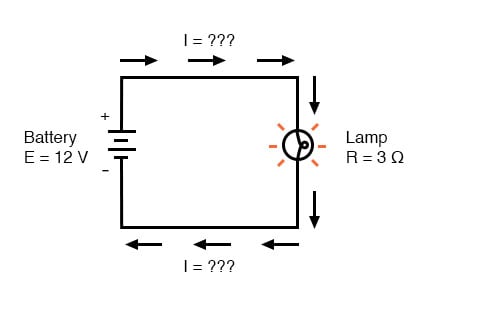
From this diagram, your extraction should be:
At this stage, you are not required to calculate the current. The important point is that the battery label supplies the voltage, the lamp label supplies the resistance, and the marking identifies the unknown.
Do not mistake every feature of a diagram for a numerical known:
- Current arrows show a direction convention, not a current value.
- A lamp, motor, or resistor symbol identifies the type of load; its resistance or power is known only if a value is labelled.
- A switch position, “series” arrangement, or “parallel” arrangement is context. It may control the method you use later, but it is not itself a number to substitute.
Watch the extraction method used in a calculation example
The following short example models the exact habit to build: list the supplied values first, name the required unknown second, and only then choose an equation.
How to Calculate Current, Voltage, and Resistance? | Ohm's Law Practice Problems
Watch “How to Calculate Current, Voltage, and Resistance? | Ohm's Law Practice Problems” from Ms. Riaz Academy. It shows a clean exam-ready sequence for separating known information from the target quantity.
Watch the first example. Focus on the four phases: recording the given current and resistance, identifying voltage as the unknown, stating the equation, and only then substituting values. For this lesson, concentrate especially on the written “knowns” and “unknown,” rather than the final calculation.
The process shown in the video is worth copying into your own working. In a written calculation question, a marker can often see that you understood the problem even before the arithmetic begins.
Worked extraction examples
The examples below are deliberately about identifying information, not solving it. Read each statement once for meaning, then a second time to collect symbols, values, and units.
Example 1: voltage and resistance given; current required
A supply is connected across a heating element. Calculate the current.
The phrase “calculate the current” is decisive. Although voltage appears first in the question, it is not the target.
Example 2: current and power given; voltage required
A motor consumes and draws . Determine its supply voltage.
Do not write . The prefix “milli” is part of the given unit and changes the size of the current substantially. Keeping the original unit visible is a good protection against a later calculator mistake.
Example 3: charge and time given; current required
A charge of passes through a conductor in . Find the current.
The expected answer unit is amperes, but the time is given in minutes. That does not make incorrect; it simply signals a conversion step before calculation.
Example 4: more information than you immediately need
A , lamp is connected to a DC supply for . Calculate the electrical energy used.
Voltage is a genuine stated value, so record it. But it may not be needed in the simplest energy calculation. Recording all data first is safer than trying to decide too early which values matter; formula selection comes after extraction.
Common extraction errors to avoid
Writing bare numbers
Writing “, , find ” is risky. In a multi-step question, you can forget which number was volts and which was ohms.
Write:
Solving for the wrong quantity
If the question asks for resistance, your “Find” line must begin with , even if the values given are voltage and current. Do not let the first quantity mentioned in the question decide your formula.
Losing prefixes
These are different quantities:
The first and third represent the same current; the middle one is much larger. For now, retain the unit exactly as supplied and add a conversion note where needed.
Confusing component ratings with the requested result
A lamp marked provides a known power rating:
It does not mean the answer must be power. If the question asks for current, then the unknown remains:
Ignoring the answer unit
Write the expected unit before you calculate. It provides a useful final check and makes your working easier for a marker to follow.
A compact exam routine
For every calculation question, aim to produce this “question translation” within about 20 seconds:
Use this even for multiple-choice questions. You may not need to show all the working on paper, but quickly identifying , , , , or another target makes it much easier to eliminate answer options with the wrong unit or an obviously unrelated quantity.
Key takeaways
You should now be able to separate an electrical question into known values, an unknown target, and correct units before attempting a calculation.
Remember:
- The final instruction tells you the unknown.
- Diagram labels are just as important as words in the question.
- Always write a value together with its symbol and unit.
- Preserve prefixed units such as , , and exactly as given, then mark them for conversion if necessary.
- Record all supplied values first; choose the formula only after the information is organised.
Next, you will build on this setup by converting between base units and common electrical prefixes such as milli, micro, kilo, and mega.
Can't find a good explanation? Sign up and we'll make it for you
Sign up