
Hello. In the previous lesson, you used corresponding sides and a scale factor to find unknown lengths in similar polygons, including cases where the requested length was only part of a full side.
This lesson reverses the viewpoint: instead of solving a problem, you will inspect someone else’s solution. Your goal is to locate the first thing that went wrong and classify it as a correspondence error, a setup error, or a calculation error. This is useful quiz practice because it turns “I got it wrong” into a specific correction for the next attempt.
Plan for about 35–40 minutes. Keep a sheet of paper nearby: copying each line of a proposed solution and checking it one line at a time is more effective than only looking at its final answer.
The rule that every correct solution must protect
For similar polygons:
- corresponding angles are congruent;
- corresponding sides have proportional lengths;
- one single scale factor applies to every pair of corresponding sides.
The order in a similarity statement tells you the correspondence. If:
then the matching vertices are with , with , with , and with . Therefore the matching sides are:
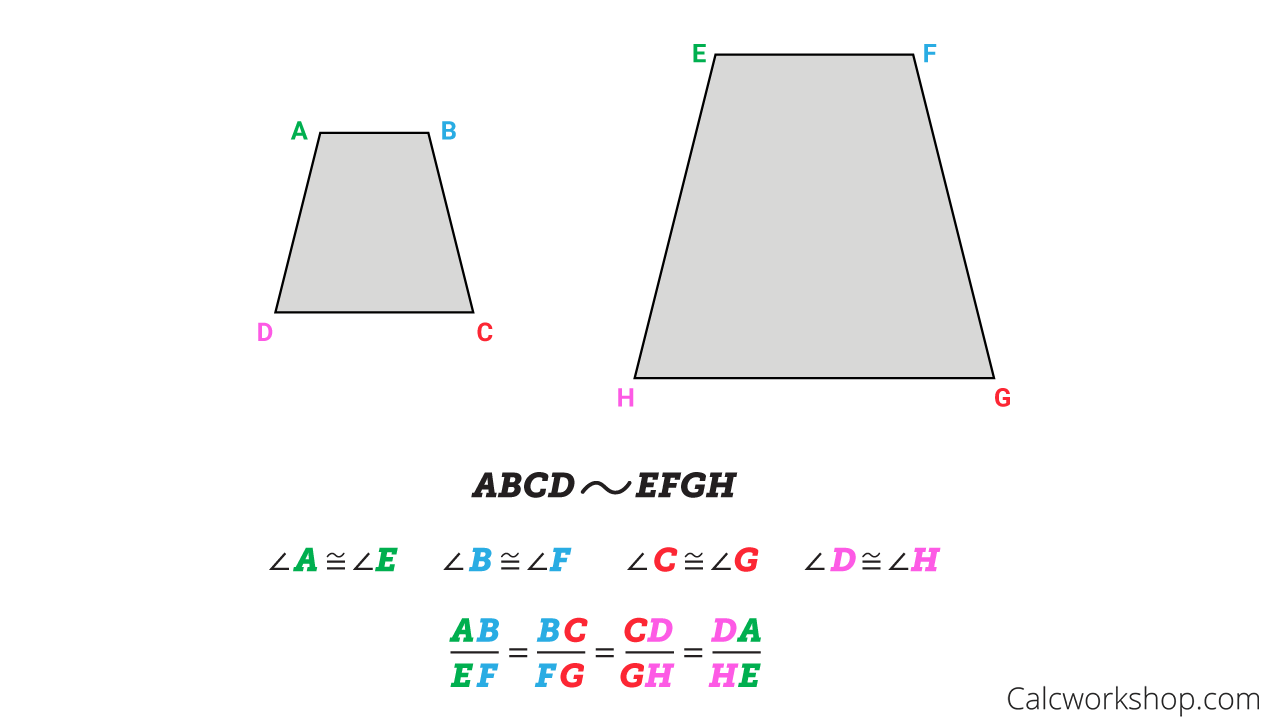
A diagram can be rotated, flipped, or drawn at an odd angle. That does not change which sides correspond. Use the vertex order, angle markings, or matching endpoints—not a side’s position on the page.
Before diagnosing arithmetic, make one quick check: is the claim of similarity justified? Two figures must have matching corresponding angles and a common scale factor for corresponding side lengths. If someone applies proportions to figures that have not been shown to be similar, treat that as a setup/justification error.
Similar Triangles - GCSE Maths
Watch “Similar Triangles - GCSE Maths” from 1st Class Maths to see why a triangle’s position can be misleading and why matching angles must come before choosing side pairs.
In the section on joined triangles, watch the matching process. Focus especially on how the presenter identifies corresponding angles before pairing sides, and on the two fractions used to keep the same large-to-small direction.
The three error types
A wrong answer may include more than one mistake, but diagnose the earliest error. Later work may be wrong simply because it was built on that first incorrect line.
| Error type | What has gone wrong? | Fastest check |
|---|---|---|
| Correspondence error | Sides or vertices that do not match have been paired. | Return to the similarity statement and list the side pairs. |
| Setup error | The matching sides are correct, but the proportion, scale-factor direction, or whole-side relationship is written incorrectly. | Check that both fractions use the same direction. |
| Calculation error | The correspondence and equation are correct, but arithmetic or algebra is wrong. | Recalculate from the correct equation. |
A useful distinction:
- A correspondence error answers, “Did they choose the right two sides to compare?”
- A setup error answers, “Did they organize those correct sides correctly?”
- A calculation error answers, “Did they perform the arithmetic correctly after writing a valid equation?”
Here is a visual reminder of what a consistent scale-factor check looks like.
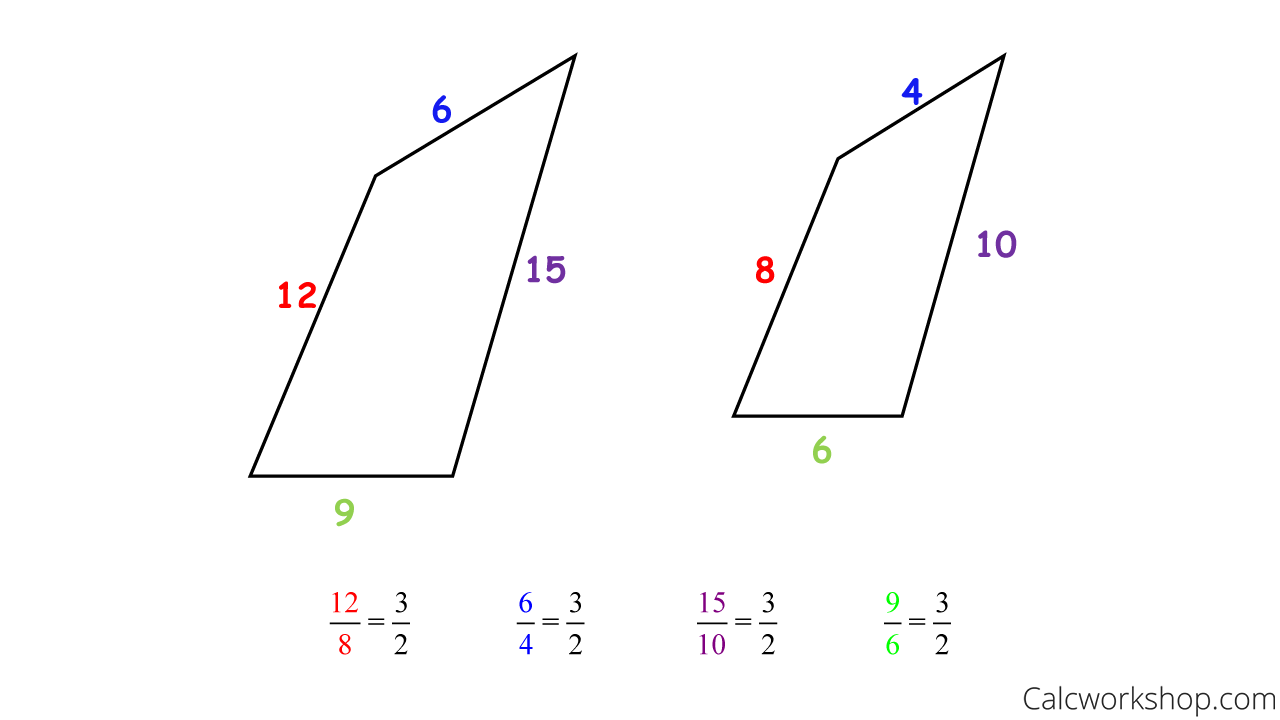
Notice that each ratio in the image is written in the same direction:
Writing the reciprocal consistently would also be correct:
A reciprocal is not automatically an error. It becomes a setup error only when a student switches directions halfway through or uses the factor in the wrong direction.
similar figures worksheets for 8th grade | Worksheetzone
Read the “Mistakes Students Make That These Worksheets Surface Early” section from Worksheetzone. It gives a short account of the exact checking habits that prevent correspondence mistakes and reversed-scale-factor setups.
In the section “Mistakes Students Make That These Worksheets Surface Early,” begin at the sentence “Three errors appear consistently in 8th grade student work” and read the three error types. Pay particular attention to the difference between pairing sides geometrically and merely matching labels or appearances.
Case file 1: A correspondence error
Suppose:
The given lengths are:
Find .
Because the similarity statement is:
the correct side pairs are:
Now inspect this student work:
The student’s first equation is already wrong. corresponds to , not . The student has selected a side from the correct triangle but paired it with the wrong side of the other triangle.
This is a correspondence error.
A correct setup, keeping large sides over small sides, is:
The key lesson is that correct numbers cannot rescue an incorrect side pairing.
Case file 2: A setup error
Use the same pair of similar triangles. The student correctly knows that corresponds to , but writes:
All the side pairs are correct:
- matches ;
- matches .
But the fractions point in opposite directions:
That inconsistency is a setup error.
To correct it, choose one direction and maintain it. For large divided by small:
Or, for small divided by large:
Both valid setups give:
A setup check you can do in seconds
Put words above the fractions before inserting numbers:
Then substitute side names:
Finally, substitute numbers:
If the words above the fractions do not match, stop and fix the setup before doing any arithmetic.
A related setup error occurs when a student uses a part of a side instead of the full side that corresponds to another full side. For example, if similarity relates to the entire side , then placing , only part of , directly into that proportion is a setup error. Find the whole corresponding side first, then subtract to obtain the requested part.
Case file 3: A calculation error
Again, the triangles are similar, and the student writes:
This setup is correct:
- corresponds to ;
- corresponds to ;
- both fractions are written as large divided by small.
The student cross-multiplies:
This is also correct. But then the student concludes:
That final step is wrong because:
So this is a calculation error:
The correction does not require rebuilding the proportion. You simply keep the valid setup and repair the arithmetic.
This is why diagnosis should be done in order. If you immediately see that is not right and call the whole solution “wrong,” you miss the useful fact that the student understood the geometry and the proportion. Their next review should focus on arithmetic accuracy, not on relearning correspondence.
A reliable error-detection routine
When you see an incorrect similar-polygon solution, use this audit in order.
-
Read the similarity statement.
Write the matching vertices and matching side pairs. Do not rely on the picture’s orientation. -
Check every side pair in the proportion.
If even one pair does not correspond, label the first mistake a correspondence error. -
Check fraction direction and full lengths.
Are both fractions small-over-large or large-over-small? Did the solution use a whole side where a whole side is required? If not, it is a setup error. -
Verify the arithmetic.
Cross-multiply again, simplify fractions, and divide carefully. If the equation is valid but the numbers are mishandled, it is a calculation error. -
Use a size check.
If the target figure is an enlargement, the matching target side should be longer. If it is a reduction, it should be shorter. This check may reveal a problem, but use the earlier steps to name the exact error type.
For your next practice problem, try an error log rather than simply writing the corrected answer:
| What to record | Example |
|---|---|
| First incorrect line | |
| Error type | Setup |
| Why it is wrong | The left ratio is large over small, but the right ratio is small over large. |
| Corrected line | |
| Prevention rule | Write “large/small” above both fractions first. |
That turns a missed problem into a short retrieval prompt for your final review.
Key takeaways
To locate an error in a similar-polygon solution, check the work in this order:
- Correspondence: Are the sides genuinely matching sides?
- Setup: Are those matching sides arranged in a consistent ratio, with the correct whole lengths?
- Calculation: Does the arithmetic correctly follow from the valid proportion?
Remember: a reversed ratio can be correct if it is reversed everywhere. The real setup problem is mixing directions. And when several lines are wrong, classify the first incorrect line, because that is the error that caused the rest.
Next, you will complete a timed mixed practice set without notes and use this error-detection system to identify one skill that needs final review before the quiz.
Can't find a good explanation? Sign up and we'll make it for you
Sign up