
Hello. You have now practiced the full chain for similar polygons: writing equivalent ratios, solving proportions, matching corresponding sides, finding scale factors and unknown lengths, and diagnosing whether an error came from correspondence, setup, or calculation.
This final lesson in the module uses a different study method: a short closed-note quiz simulation. The goal is not just to get a score. You will use the results to choose one specific weak skill for a final review, rather than trying to review everything at once.
Plan for about 40 minutes: 4 minutes to set up, 20 minutes of no-notes practice, 8 minutes to check, and 8 minutes for focused review.
Set up the quiz simulation
Before viewing the practice set closely, gather:
- blank paper and a pencil;
- a timer set for 20 minutes;
- no class notes, textbook, calculator, or prior lesson pages.
Write this target at the top of your paper:
I will solve a mixed set of similar-polygon problems without notes, then use my errors to select one skill to review.
For items 5 and 6, use this convention:
That direction matters only because it keeps your answers consistent. A reciprocal can also be valid if you explicitly choose the reverse direction, but for this timed set use left figure to right figure.
Use a simple response list on your paper:
| Item | Answer | Work checked? | If incorrect, first error type |
|---|---|---|---|
| 1 | |||
| 2 | |||
| 3 | |||
| 4a | |||
| 4b | |||
| 5 | |||
| 6 | |||
| 7 | |||
| 8 |
For every length problem, briefly show your proportion or scale-factor calculation. That work will help you diagnose an error accurately afterward.
Timed mixed practice: no notes
Start your 20-minute timer now. Work through all eight items in order. If you are stuck for more than about 90 seconds, circle the item, write what you know, and move on. Returning later is better than spending most of the quiz on one problem.
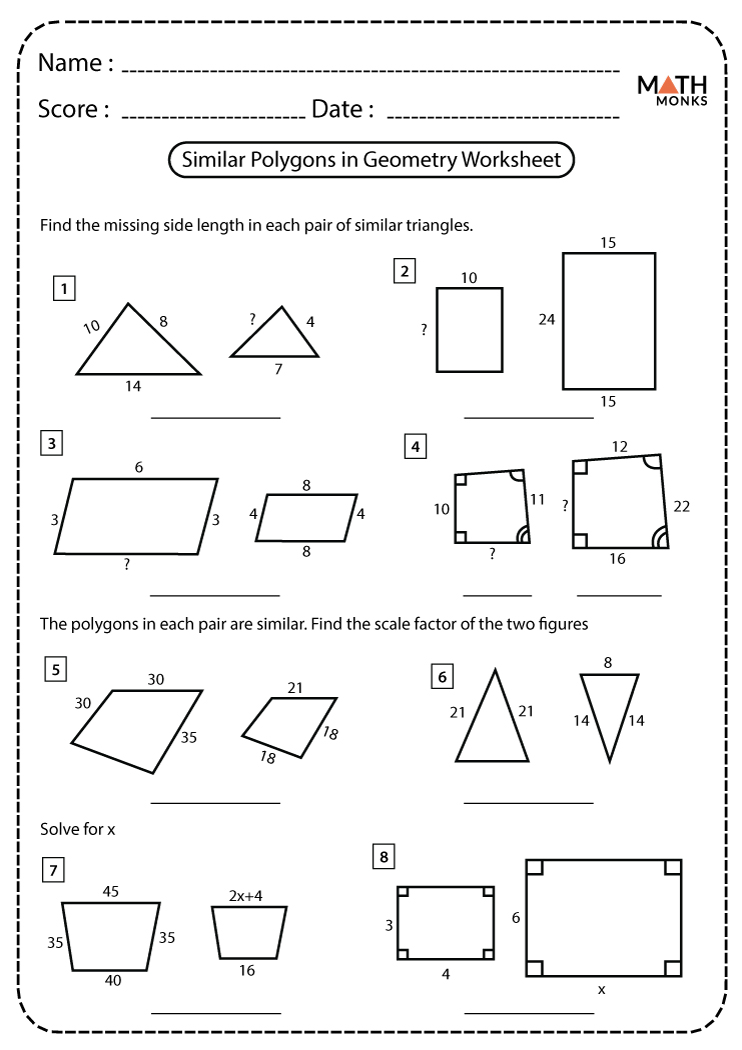
While working, use these quiet checkpoints rather than looking anything up:
- Find matching sides before calculating. Rotation or flipping does not change correspondence.
- Keep ratio direction consistent. If one fraction is right figure over left figure, every fraction should use that same direction.
- Use a size check. A side in an enlargement should be longer; a side in a reduction should be shorter.
- For items 7 and 8, solve the equation only after you have made a valid proportion.
When the timer ends, stop writing. Do not immediately redo uncertain problems. Mark each unanswered item with a dash; an unanswered item is useful evidence about what to review.
Check the work after the timer
Only now compare your answers with the key below. There are nine answer parts because item 4 has two missing lengths.
Answer key
| Item | Correct answer | Quick check |
|---|---|---|
| 1 | The small triangle is a reduction by . | |
| 2 | The larger rectangle is times the smaller one. | |
| 3 | The left parallelogram is of the right one. | |
| 4a | The large quadrilateral is twice the size of the small one. | |
| 4b | and | The small top and bottom sides are half of and . |
| 5 | Moving from the left polygon to the right polygon is a reduction. | |
| 6 | The corresponding sides change from to . | |
| 7 | The right trapezoid is of the left one. | |
| 8 | The rectangle’s height doubles from to . |
For item 4, award yourself one point for finding the missing side of the large figure and one point for finding the two missing sides of the smaller figure. Your score is therefore out of 9.
A wrong reciprocal on items 5 or 6 needs a careful judgment:
- If you wrote the reciprocal but clearly stated and used the reverse scale-factor direction, count the mathematical idea as correct, but note that you did not follow the stated left-to-right convention.
- If you switched directions partway through your work, record a setup error.
Do not just write the correct answer over a wrong one. For every missed part, identify the first point where your work broke down:
| What happened in your work? | Error label |
|---|---|
| You paired sides that do not actually match. | Correspondence |
| You paired the correct sides but reversed only one ratio, used an inconsistent scale factor, or used a part when a whole side was needed. | Setup |
| Your proportion was valid, but multiplication, division, or algebra was incorrect. | Calculation |
| You did not know how to begin or left it blank. | Skill gap |
This is the key difference between checking and learning from a quiz: an answer tells you whether you were right; the first incorrect step tells you what to do next.
Select one weak skill for final review
Choose one skill, not a vague goal such as “similar polygons.” Use the evidence from your work.
| If your misses mainly involved… | Select this weak skill |
|---|---|
| Matching the wrong sides, especially when a figure was turned or flipped | Corresponding sides and vertices |
| Getting the reciprocal of the intended factor or mixing fraction directions | Scale-factor direction and proportion setup |
| Knowing the factor but not finding a missing side | Using a scale factor to find an unknown length |
| Correct geometry but mistakes when cross-multiplying, dividing, or solving for | Solving proportions accurately |
| Several kinds of misses | Choose the skill that caused the earliest error most often. |
Write one sentence to finish your error log:
My final-review skill is __________________ because __________________.
For example:
My final-review skill is scale-factor direction and proportion setup because I matched the sides correctly on items 5 and 7 but used opposite ratio directions.
Now spend your final 5–8 minutes correcting one representative missed problem from that skill. Cover the answer key, rewrite the problem’s proportion, solve it again, then compare. The goal is a corrected method you can retrieve tomorrow, not merely a corrected number.
If your weak skill was solving proportions accurately, choose this short review from OpenStax:
8.7 Solve Proportion and Similar Figure Applications - Elementary Algebra 2e | OpenStax
Read the “Solve Proportions” opening in OpenStax Elementary Algebra 2e to reset the idea that a proportion compares like quantities in corresponding positions.
In the “Solve Proportions” section, read from the definition through the setup guidance. Focus on why equivalent fractions must keep their quantities in matching positions before you clear fractions and solve.
If your weak skill was correspondence, scale factor, or unknown side length, choose this instead:
8.7 Solve Proportion and Similar Figure Applications - Elementary Algebra 2e | OpenStax
Read the “Solve Similar Figure Applications” introduction in OpenStax Elementary Algebra 2e to reinforce the two facts every valid similar-figure solution needs: equal corresponding angles and one common side-length ratio.
In the “Solve Similar Figure Applications” section, read the similarity explanation. Then look at the seven-step “Solve geometry applications” strategy immediately below it, especially the steps to label the figure, choose the unknown, and check whether the answer’s size makes sense.
Key takeaways
A timed set is most useful when it follows this sequence:
- Attempt every problem without notes.
- Check only after the timer ends.
- Locate the first mistake, rather than only noting the final wrong answer.
- Select one narrow weak skill for final review.
- Redo one representative problem using the corrected method.
You have completed the math-quiz preparation cycle: retrieve, check, correct, and target the next review. In the next module, you will turn ideas like these into digital flashcards designed to make closed-book recall easier and more reliable.
Can't find a good explanation? Sign up and we'll make it for you
Sign up