
Hello. In the previous lesson, you found the scale factor between similar polygons by dividing a target side length by its corresponding starting side length. Now we use that multiplier for the practical goal: finding a missing side length.
By the end of this lesson, you should be able to look at two similar polygons, match the correct sides, choose a known corresponding pair, and calculate an unknown length. You will also handle a common quiz variation: when similarity gives you a whole side, but the question asks for just one piece of it.
Plan for about 35–40 minutes: read and work through the examples carefully, watch the short worked example, then finish with the closed-note routine.
From a scale factor to a missing length
Similar polygons keep the same shape, so every corresponding side is changed by the same multiplier.
Suppose side in the starting polygon corresponds to side in the target polygon. If the scale factor from starting to target is , then:
To find an unknown side length, use this reliable routine:
- Identify the two similar polygons or triangles.
- Match corresponding vertices and sides. Use a similarity statement, angle markings, parallel lines, or matching endpoints—not how long a side looks.
- Choose a known pair of corresponding sides and calculate the scale factor in the direction you need.
- Multiply the known corresponding side by that factor to find the unknown.
- Check whether the answer’s size makes sense. A reduction should produce a shorter length; an enlargement should produce a longer one.
You can also solve with a proportion. These are the same idea written differently:
The main rule is: keep the order consistent across both fractions.
For example, if a small triangle has a side of , its corresponding side in a larger triangle is , and another small side is , then the scale factor from small to large is:
The corresponding unknown large side is:
Equivalently:
The scale-factor method is usually faster when you have already identified the direction. The proportion method can be useful when you prefer to see both corresponding pairs lined up.
Solving for a Missing Side Length in a Pair of Similar Figures
Watch “Solving for a Missing Side Length in a Pair of Similar Figures” by Mike Buboltz for a clear demonstration of this exact process: obtain a scale factor from one corresponding pair, then apply it to another.
Watch the proportion setup to see how the matching short and medium sides are kept in the same order. Then watch the scale factor, focusing on why the factor is 0.8 and how it changes the side of length 9 into 7.2. Notice the quick reasonableness check: because the second triangle is smaller, its missing side must be less than 9.
Example 1: Find a corresponding missing side
The first diagram below contains two triangles formed by intersecting lines. The arrow markings show that is parallel to .
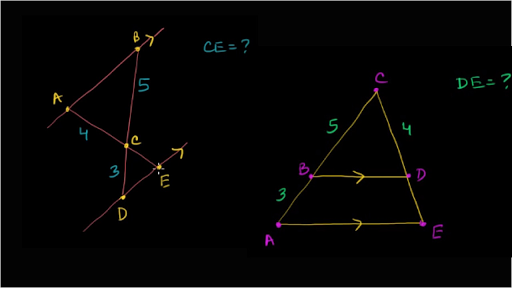
In the left diagram, consider:
and
The matching vertices are:
So the corresponding sides include:
and
This matching step is more important than the arithmetic. In particular, corresponds to , because both run from the intersection point to the vertex on the parallel line.
We know:
The scale factor from to is:
Since corresponds to , multiply by the same reduction factor:
A proportion gives the same result:
The answer is less than , which fits the diagram’s relationships: is a reduced version of .
Keep correspondence visible
When writing a proportion, write the side labels before replacing them with numbers:
Only then substitute:
This small habit prevents a frequent error: using correct numbers from the diagram but pairing sides that do not correspond.
Example 2: When the unknown is only part of a side
The right-hand triangle diagram adds one extra step. Since is parallel to , the smaller triangle and larger triangle are similar:
Their corresponding vertices are:
Therefore:
Notice the second pair carefully:
The side in the small triangle corresponds to the entire side in the large triangle. It does not correspond to , which is only one part of that larger side.
First find the full length . The diagram gives:
Since lies between and :
Now calculate the scale factor from small triangle to large triangle :
Use it on the corresponding side :
At this stage, do not stop. The question asks for , not .
The complete side is made of the two pieces and :
So:
Rewrite with denominator :
or:
This kind of question tests two skills together:
- use similar triangles to find a missing whole corresponding side;
- use segment addition or subtraction to find the requested part.
Choose the method that matches the question
Here is a quick decision guide for similar-polygon side problems.
| What you know | Best first move |
|---|---|
| A known corresponding pair and an unknown corresponding side | Find the scale factor, then multiply. |
| An unknown side in the starting figure but a known side in the target figure | Use the reciprocal scale factor, or divide by the scale factor. |
| The unknown is a piece of a larger side | Use similarity to find the whole corresponding side first, then add or subtract segments. |
| The diagram is confusing | Write the matching vertices and side pairs before using numbers. |
For a missing side in the starting figure, division may be more natural. Suppose the factor from small to large is , and the large corresponding side is . Then the small side satisfies:
You can divide by :
Or reverse the scale factor first. From large to small, it is :
Both approaches work because reversing a scale factor gives its reciprocal.
A quiz-ready solution format
On a quiz, avoid jumping immediately to a calculation. A clear solution can be only a few lines:
This format makes your reasoning visible. It also makes mistakes easier to locate:
- If the side labels do not match, it is a correspondence error.
- If matching sides are correct but the fraction has the wrong direction, it is a setup error.
- If the setup is correct but multiplication or simplification is wrong, it is a calculation error.
- If you find an entire side when the problem asks for a segment, it is a whole-versus-part error.
For a short new way to study this skill, use a retrieve-check-correct cycle:
- Cover the worked examples and leave only the diagram visible.
- Write the two triangles that are similar and list their matching side pairs.
- Choose a scale factor direction and calculate the unknown.
- Reveal the worked solution and compare each line, not just your final answer.
- Record the type of any mismatch so your next review targets the real issue.
Key takeaways
To calculate an unknown side length in similar polygons:
- Match corresponding vertices and sides.
- Find the scale factor using a known corresponding pair.
- Multiply or divide to obtain the unknown corresponding side.
- If the question asks for part of a side, find the whole side first and then use segment addition or subtraction.
- Check that the answer has a sensible size for an enlargement or reduction.
In the diagram examples:
Next, you will learn how to inspect an incorrect similar-polygon solution and decide whether the mistake came from correspondence, setup, or calculation.
Can't find a good explanation? Sign up and we'll make it for you
Sign up