
Welcome back. Last lesson focused on the setup step for similar polygons: use the similarity statement, angle markings, and matching endpoints to identify corresponding sides. That work comes first because a scale factor is only meaningful when you compare lengths that truly match.
Now you will determine the scale factor between similar polygons. The main idea is simple: a scale factor is the single number by which every side length is multiplied to change one figure into the other. The important detail is to state the direction of the change.
Scale factor is a multiplier
Suppose one polygon is a smaller version of another. If every side of the smaller polygon must be multiplied by to produce the matching side of the larger polygon, then the scale factor from small to large is:
A scale factor can be:
| Scale factor | Meaning |
|---|---|
| Greater than | Enlargement: the target figure is larger |
| Equal to | No size change: the figures are congruent |
| Between and | Reduction: the target figure is smaller |
For similar polygons, every pair of corresponding sides gives the same scale factor.
If polygon is the starting figure and polygon is the target figure, use:
A useful way to remember this is:
new length divided by old length
The “new” figure is the one you are changing to, not necessarily the one drawn on the right side of a page.
How to Find Scale Factor with Similar Figures
Watch “How to Find Scale Factor with Similar Figures” by Mario’s Math Tutoring for a short explanation of why direction changes the fraction you use.
Watch the direction warning first: deciding which figure is the starting figure prevents reversed ratios. Then watch the enlargement example, focusing on “new divided by old” and why a factor greater than 1 enlarges a figure. Finish with reduction and reciprocals to see why reversing the direction reverses the fraction.
Find the factor using corresponding sides
Use the correspondence routine from the previous lesson before using any lengths. For example, if:
then the matching vertices are with , with , with , and with . Therefore:
To find a scale factor reliably:
- Name the direction. Write “from smaller to larger,” “from to ,” or whatever the problem asks.
- Choose one known pair of corresponding sides.
- Put the target length on top and the starting length on the bottom.
- Simplify the fraction.
- Check a second corresponding pair when one is available.
Do not compare two sides merely because both are at the top of their figures, both look longest, or happen to have the same color. Correspondence determines the ratio.
A full example: small quadrilateral to large quadrilateral
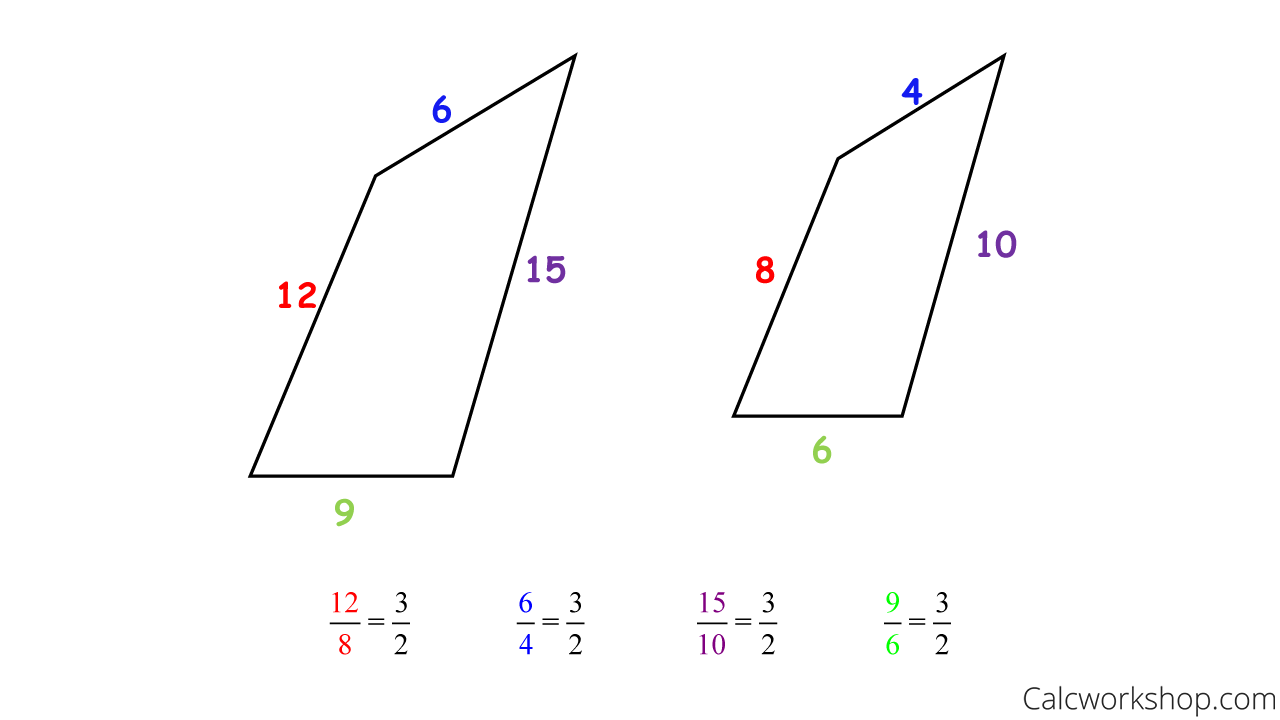
In the quadrilateral comparison image, first decide the direction:
Find the scale factor from the smaller quadrilateral to the larger quadrilateral.
Choose the corresponding sides of lengths and . The new, larger length is , and the old, smaller length is :
Simplify:
So the scale factor from the smaller quadrilateral to the larger quadrilateral is:
This says every side in the small figure is multiplied by to make the corresponding side in the large figure. Check it using the other pairs:
All four ratios agree, which confirms the scale factor.
Notice that is not “three halves” of in a vague sense. It is exactly:
The fraction is a multiplication instruction: divide by , then multiply by .
Reversing direction reverses the scale factor
Now use the same image, but change the question:
Find the scale factor from the larger quadrilateral to the smaller quadrilateral.
The target length is now , while the starting length is :
Simplify:
Thus, the scale factor from large to small is:
The two factors are reciprocals:
That makes sense. Multiplying a small side by enlarges it; multiplying the result by returns it to its original size.
For instance:
When a problem says only “find the scale factor between the polygons,” look carefully for wording such as “from triangle to triangle .” If no direction is given, make your answer precise by writing a phrase such as:
or
A second example with a similarity statement
Suppose:
and the diagram gives:
Because the similarity statement tells you that corresponds to , find the factor from to :
If another pair is given, such as:
use it as a verification:
Both ratios match, so the scale factor is confirmed.
A scale-factor check has two parts:
- Numerical check: all ratios of corresponding sides simplify to the same value.
- Size check: if the target is larger, the factor should be greater than ; if it is smaller, the factor should be less than .
The size check is useful, but it is only a backup. A diagram may not be drawn accurately, so the side ratios are the real evidence.
A short retrieve-check-correct routine
Use the quadrilateral comparison image for a five-minute closed-note review.
- Cover the explanation in this lesson, but leave the image visible.
- On paper, write the two scale factors: one from small to large and one from large to small.
- Write at least two ratios of corresponding sides that justify your result.
- Uncover the lesson and check your work.
- If you reversed a fraction, label the issue direction error. If you compared nonmatching sides, label it correspondence error. If your unsimplified ratio was right but the final fraction was wrong, label it calculation error.
Naming the type of mistake makes your next review much more useful than simply replacing an answer.
Key takeaways
A scale factor is the constant multiplier relating corresponding side lengths of similar polygons.
To find it, identify corresponding sides, state the direction, and use:
For the quadrilaterals in this lesson:
Reversing direction produces the reciprocal scale factor. In the next lesson, you will use a known scale factor to calculate an unknown side length in similar polygons.
Can't find a good explanation? Sign up and we'll make it for you
Sign up