
Hello. In the previous lesson, you solved proportions by keeping matching quantities in the same order, then checking your answer by substitution. Similar polygons use that same discipline: before you can compare lengths, you must know which parts match.
In this lesson, you will identify corresponding vertices and sides in similar polygons, even when one shape is rotated, flipped, or drawn in a different position. This is the essential setup skill for finding scale factors and missing side lengths in the next lessons.
Similar means same shape, not necessarily same size
Similar polygons have the same shape, though one can be a larger or smaller version of the other. Two conditions make polygons similar:
- Corresponding angles have equal measures.
- Corresponding side lengths have the same ratio.
For today, focus on the word corresponding. It means “matching part”: the corner in one polygon that plays the same role as a particular corner in the other, or the side joining matching corners.
Similar polygons and triangles defined - Math Open Reference
Read the introduction from Math Open Reference to establish the two features of similar polygons: matching angles and proportional sides.
In the opening section, “Similar Triangles and Polygons,” read from the definition and example. Focus on the phrases “corresponding sides” and “corresponding interior angles.” You do not need to calculate any ratios yet; identify what must be matched before ratios can be written.
A vertex is a corner of a polygon. For example, is a vertex of quadrilateral . An angle is located at a vertex, so is the angle at vertex . A side is the segment between two neighboring vertices, such as .
Let the similarity statement do the matching
The most reliable clue is the order of the letters in a similarity statement.
If you see
read the names position by position:
| First polygon | Matching part in second polygon |
|---|---|
So the corresponding vertices are:
- and
- and
- and
- and
Because matching angles sit at matching vertices:
The similarity symbol, , does not mean the polygons are equal in size. It means they have the same shape, with their corresponding sides proportional and their corresponding angles congruent.
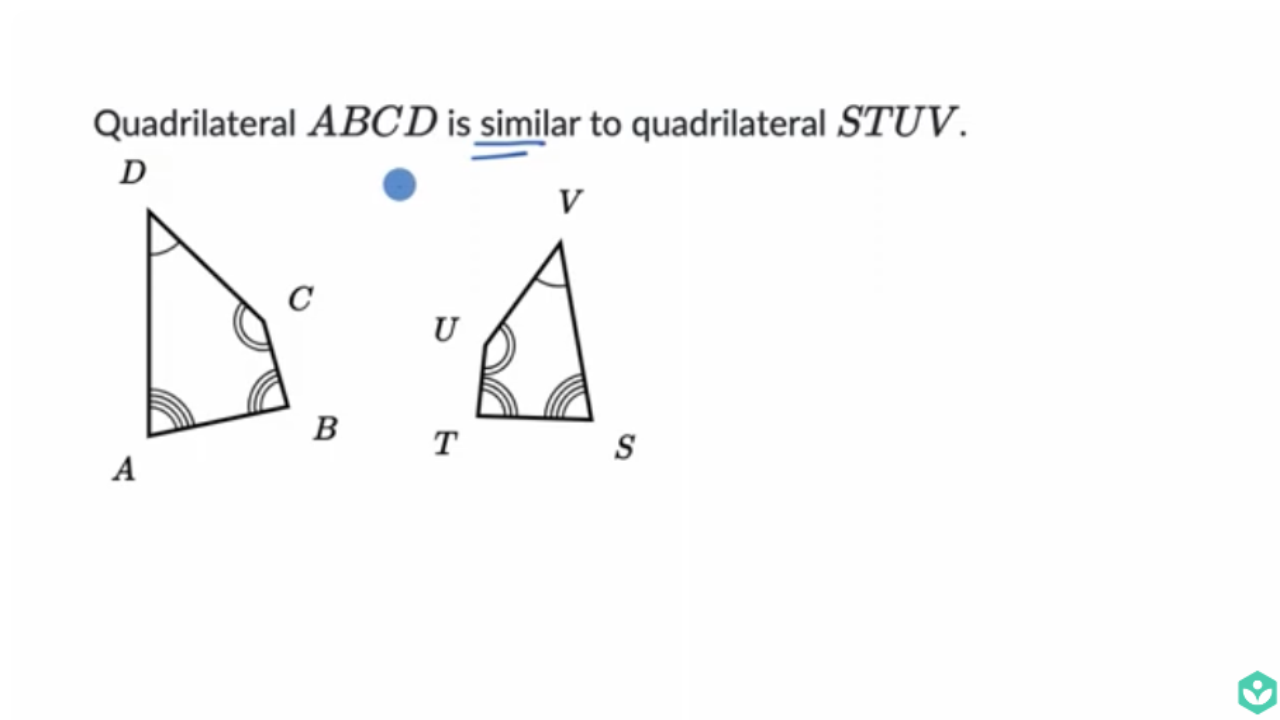
Notice that the corresponding corners are not necessarily in the same location on the page. In the image, is at the lower left of the larger quadrilateral, while is at the lower right of the smaller one. Page position is not a rule. Letter order and matching angle marks are the reliable evidence.
Similar Triangles and Figures, Enlargement Ratios & Proportions Geometry Word Problems
Watch “Similar Triangles and Figures, Enlargement Ratios & Proportions” from The Organic Chemistry Tutor for a concise demonstration of how the letter order in a similarity statement identifies matching vertices, angles, and sides.
Watch letter order. Pause after the presenter matches A with D, B with E, and C with F. The key idea is that the first letters match, then the second letters match, and so on.
Match sides by matching their endpoints
Once you know the matching vertices, corresponding sides follow automatically.
Return to:
Side has endpoints and . Since matches and matches , side matches side .
Use this same endpoint method for every side:
| Side of | Why it matches | Corresponding side of |
|---|---|---|
| matches , matches | ||
| matches , matches | ||
| matches , matches | ||
| matches , matches |
This method is safer than trying to match “top side to top side” or “long side to long side.” Drawings may be rotated, reflected, or not drawn to scale. Endpoints do not change.
A quick written format for a quiz is:
That setup will later tell you exactly which side lengths belong together in a proportion.
When no similarity statement is given
Sometimes a diagram gives angle markings or angle measures but does not clearly state the correspondence. Then use the polygon’s features to establish it.
Start with the strongest clues:
- Angle markings or angle measures. A right angle matches a right angle; a one-arc angle matches another one-arc angle; an angle measuring matches another angle.
- Distinctive vertex shape. A very sharp corner, a wide corner, or a vertex between a long and short side can help confirm a match.
- Neighboring sides. Once one vertex is matched, trace around the boundary. Each side must match a side joining the corresponding neighboring vertices.
- The similarity statement, if supplied. It should agree with the angle marks and the side connections.
For example, suppose quadrilateral and quadrilateral have these marked angles:
Then the correct similarity statement is:
and the sides match as follows:
The final side is easy to overlook: after reaching the last letter, the polygon closes back to its first vertex.
Rotation and reflection do not change correspondence
A polygon remains similar if it is turned or flipped. This is a common source of quiz mistakes because students try to match sides by where they appear on the page.
Imagine cutting one polygon out of paper. You could rotate it, or turn it over like a card. Its shape stays the same. What matters is the order of the connected corners and the matching angles, not whether the two figures “face” the same direction.
Similar polygons and triangles defined - Math Open Reference
Read this short section to see why rotation and reflection do not destroy similarity, and how to keep identifying the correct corresponding parts.
In the “Rotation and reflection” section, read from rotation and reflection. Then read the cardboard comparison immediately afterward. Focus on the idea that a turned or flipped figure still has matching corners and sides; only its position has changed.
A useful check is adjacency. If corresponds to , then the sides next to , namely and , should correspond to the sides next to , namely and . A proposed match that pairs neighboring sides with non-neighboring sides is probably wrong.
A fast matching routine for quiz questions
Before using any lengths, complete this routine:
- Read the similarity statement, if one is provided.
- Write the vertex pairs in matching positions.
- Use the endpoint rule to write the side pairs.
- Check angle markings or measures to make sure the correspondence makes sense.
- Ignore the figures’ page positions and apparent sizes.
For a short retrieval practice session, cover the table from this lesson. On blank paper, write the vertex and side matches for
Then uncover the table and correct your work. If you mismatched a side, do not merely replace the answer: identify whether the problem was reading letter order, overlooking endpoints, or trusting the picture’s position.
Key takeaways
Similar polygons have corresponding angles that are congruent and corresponding sides that are proportional. A similarity statement lists matching vertices in the same order:
means matches , matches , matches , and matches . Match each side by matching its two endpoints, rather than by its position in the drawing.
Next, you will use these correctly matched sides to determine the scale factor between similar polygons.
Can't find a good explanation? Sign up and we'll make it for you
Sign up