
Hello! Welcome to your fifth lesson in the Strategic Measurement Frameworks module.
In our last lesson, we explored the crucial difference between attribution and incrementality. We learned that to understand the true impact of our marketing, we must move beyond correlation and seek to prove causation. This helps us answer, "Is this channel actually driving sales?"
Today, we take that thinking a step further. Once we have confidence in how we measure, we must decide what to measure to keep the entire organization focused and moving in the same direction. In a world of endless data, a leader's most important job is to provide clarity and focus. This is where the North Star Metric comes in.
This lesson is designed to help you formulate a North Star Metric framework to align team activities with strategic business goals. As a leader, this framework will be one of your most powerful tools for translating high-level company vision into concrete, measurable actions for your teams.
1. What is a North Star Metric?
You've likely heard the term "North Star Metric" (NSM). At its core, it's the one metric that best captures the core value your product or service delivers to its customers. It's not a vanity metric like "page views," and it's not a lagging business result like "quarterly revenue." It sits in a crucial middle ground.
To get a clear definition, let's start with a short article from Mixpanel that outlines the concept.
What is a North Star metric? | Signals & Stories
This article, 'What is a North Star metric?', clearly defines the concept and its three essential criteria.
Please read the first two paragraphs, starting from 'A North Star metric is the one measurement...' and ending with '...the company will grow sustainably—or so the theory goes.' Focus on the three key qualifications of an NSM.
As the article states, a true North Star Metric must do three things:
- Lead to revenue: It should be a leading indicator of future business success.
- Reflect customer value: It must measure the "aha!" moment when customers get real value from your product.
- Measure progress: It must be something your teams can actually influence and track.
The distinction between a leading indicator (the NSM) and a lagging indicator (revenue) is critical. Focusing only on revenue is like driving while looking in the rearview mirror. The NSM helps you look ahead.
Master The North Star Metric with THIS Workshop
This video from Miro explains this distinction very well. It highlights why revenue, while essential, is not an effective North Star for guiding product and marketing teams.
Watch the segment from 07:28 to 09:00. Pay close attention to the explanation of why revenue is a 'lagging indicator' and how it can hide underlying problems with product usage and health.
2. The North Star Framework: From Metric to Action
A single metric, no matter how well-chosen, isn't enough to guide your team's daily work. The real power comes from the North Star Framework, which breaks the high-level NSM down into a set of actionable input metrics. These inputs are the levers your marketing and product teams can pull every day.
Imagine your NSM is the final score of a game. The input metrics are the key stats that drive that score: shots on goal, pass completion rate, time of possession, etc. Your teams don't focus on the final score during the game; they focus on executing the actions that influence these key stats.
This is often visualized as a "metric tree."
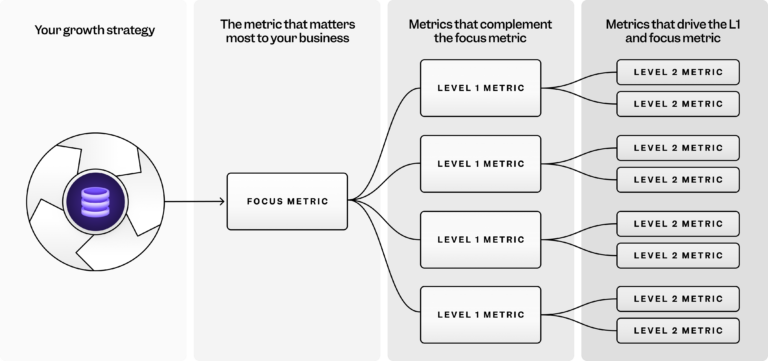
The Amplitude North Star Playbook provides an excellent, in-depth guide to this entire concept. We will refer to it throughout this lesson.
The guide to discovering your product's North Star
Let's read the introduction to the Amplitude North Star Playbook. It defines the framework and the role of input metrics.
Please read Chapter 1, 'About the North Star Framework' (pages 6-13). Focus on the definitions of the NSM and 'Inputs', and the Burger King example on page 12, which shows how different team 'squads' focus on different inputs to drive the single NSM.
As the playbook explains, your teams should never try to influence the North Star Metric directly. Their goals and initiatives should be aimed at moving the input metrics. This is how you connect the day-to-day work of your social media marketing team, for example, to the overarching strategic goal of the company.
3. How to Formulate Your North Star Framework
Now for the practical part. As a leader, you will be central to the process of defining and championing this framework. Here’s a strategic, step-by-step approach.
Step 1: Identify the "Game" You're Playing
Different business models create value in different ways. A simple way to start is to identify which of these three "games" your business is in. This will dramatically narrow down the type of metric you're looking for.
- The Attention Game: Value is created by maximizing the time users spend in the product (e.g., Netflix, Facebook, media sites).
- The Transaction Game: Value is created when a user makes a purchase with confidence (e.g., Amazon, Shopify, e-commerce stores).
- The Productivity Game: Value is created by helping a user complete a task efficiently (e.g., Slack, Salesforce, B2B SaaS tools).
Given your interest in e-commerce, your focus would typically be on the transaction game.
Step 2: Use a Checklist to Evaluate Potential Metrics
Once you have a few candidate NSMs, you need a way to vet them. The Amplitude Playbook provides a fantastic checklist for this. A good NSM is:
- Expressive of customer value: Does it measure a moment of success for the customer?
- Representative of your strategy: Does it reflect your unique vision and differentiation?
- A leading indicator of revenue: Does it predict future business success? (Not revenue itself!)
- Actionable: Can your teams actually influence it?
- Understandable: Can you explain it in plain language to the whole company?
- Measurable: Can you track it? (Don't let current tooling limit you too much here initially).
- Not a vanity metric: It should be a true signal of health, not just a big number that feels good (e.g., avoid "registered users" or "app downloads").
This checklist is a powerful tool for facilitating strategic discussions with your leadership peers and your team.
The guide to discovering your product's North Star
To see this checklist in detail, let's go back to the Amplitude Playbook.
Please read Chapter 2, 'The North Star checklist and statement exercise' (pages 14-22). This chapter walks through each item on the checklist with examples and explains why vanity metrics are so dangerous.
Step 3: Define the Metric and Its Inputs
With a strong candidate NSM, the next step is to break it down into its core inputs. A useful model for this is the Breadth, Depth, Frequency, and Efficiency formula.
- Breadth: How many users are getting value? (e.g., # of subscribers)
- Depth: How much value are they getting? (e.g., hours of content streamed per subscriber)
- Frequency: How often are they getting value? (e.g., # of sessions per week)
- Efficiency: How quickly do they get to the value? (e.g., time to first purchase)
Let's see this applied to a real example.
Master The North Star Metric with THIS Workshop
The Miro video provides a great breakdown of this 'product formula' using Spotify as an example.
Watch from 16:25 to 19:49. This section first explains the difference between output (the NSM) and input metrics, then shows how Spotify's NSM could be broken down using this model.
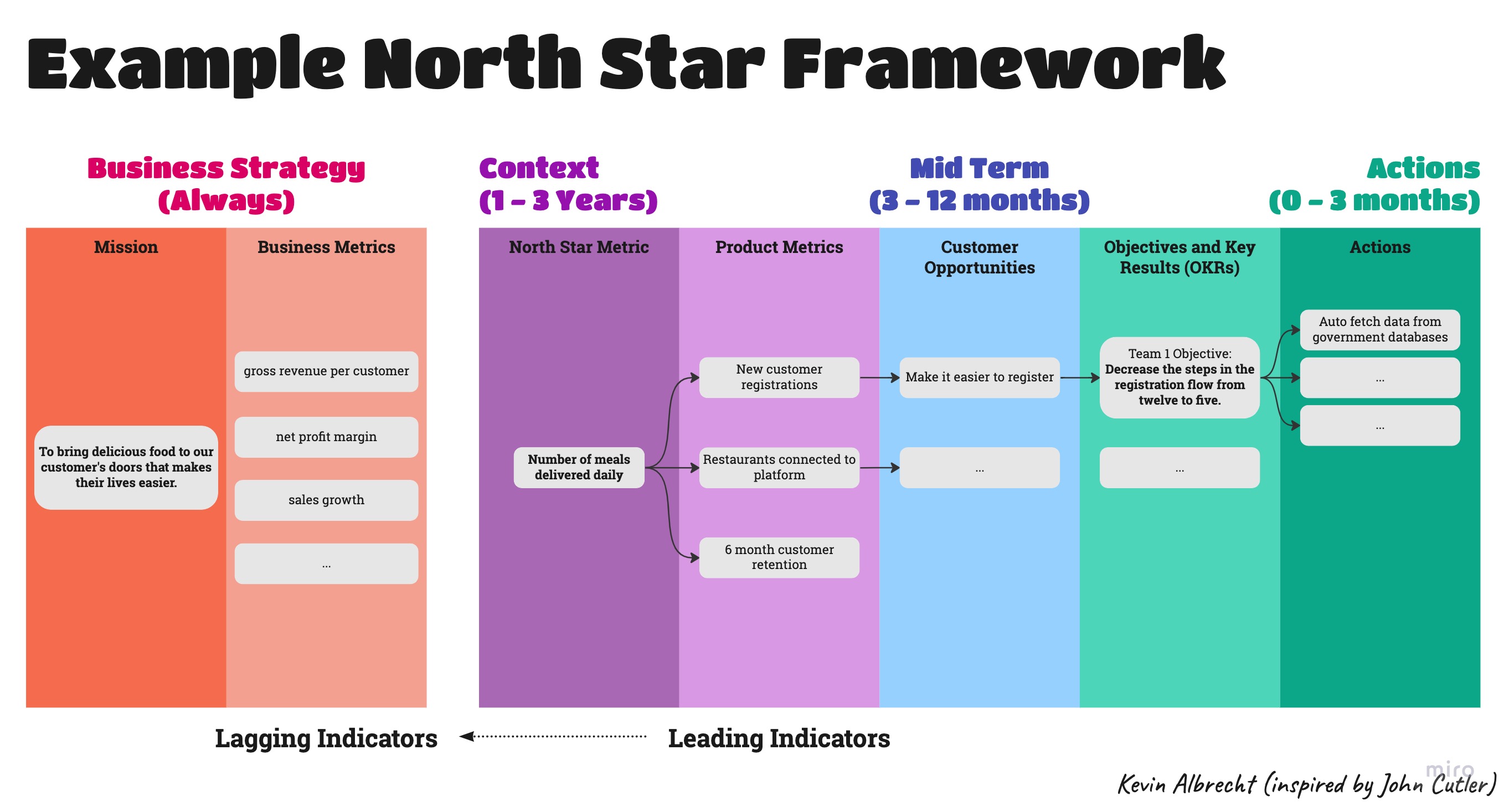
The image below shows how this all comes together in a complete framework, connecting the highest-level mission all the way down to specific actions and OKRs for teams.
Test your understanding!
You are the new Head of Performance Marketing for an e-commerce company that sells DIY project kits. The leadership team has proposed "Monthly Active Users (MAU)" as their North Star Metric.
Based on what you've learned, how would you critique this choice? What better alternative could you propose, and what might be some of its input metrics?
Show answer
This is a great opportunity to apply the checklist and framework thinking.
Critique of "Monthly Active Users (MAU)" as an NSM:
Using the checklist, you could argue that MAU is a poor choice for an e-commerce business:
- It doesn't express customer value: A user could be "active" by browsing aimlessly, dealing with a customer service issue, or just opening the app by accident. It doesn't capture the moment they successfully find, buy, or complete a project. It's a classic vanity metric.
- It's a weak leading indicator of revenue: While more users might lead to more revenue, it's not a direct or strong predictor. A small number of highly engaged buyers is more valuable than a large number of inactive "active" users.
Proposed Alternative:
A much stronger NSM would be tied to the transaction game and the customer's "aha" moment.
- Proposed NSM: "Weekly First-Time Projects Purchased"
Justification:
- Expresses Customer Value: It measures the moment a new customer finds a project they're excited about and commits to it.
- Leading Indicator of Revenue: Growth in new customers making their first purchase is a strong predictor of future repeat purchases and long-term revenue growth.
- Actionable & Measurable: It's a clear, quantifiable metric that marketing and product teams can directly influence.
Potential Input Metrics (The Framework):
- Breadth: # of new user sign-ups per week.
- Depth: % of new users who add an item to their cart in their first session.
- Frequency: (This is less relevant for a "first-time purchase" metric, but for a repeat business NSM, it would be key).
- Efficiency: Average time from sign-up to first purchase.
Your marketing team could own the "Breadth" input (driving sign-ups), while the product/UX team could own the "Depth" and "Efficiency" inputs (improving the onboarding and checkout funnel). This framework creates clear alignment and accountability.
Conclusion
Mastering the North Star Framework is a fundamental leadership skill. It provides the clarity, focus, and alignment needed to drive sustainable growth. It forces difficult but essential conversations about what "value" truly means for your customers and how that connects to the health of the business.
Key Takeaways:
- A North Star Metric (NSM) is a single metric that measures customer value and acts as a leading indicator of revenue.
- The NSM Framework is more powerful than the metric alone. It breaks the NSM down into actionable input metrics that teams can own and influence.
- To formulate an NSM, identify the "game" your business plays (Attention, Transaction, Productivity) and use a checklist to ensure your metric is meaningful, actionable, and not a vanity metric.
- As a leader, your role is to use this framework to align teams, prioritize work, and connect daily activities to strategic business goals.
Preview of the Next Lesson:
The North Star Framework gives us our ultimate destination and the main roads (inputs) to get there. In our next lesson, "Translate high-level business objectives into a hierarchy of marketing KPIs," we will zoom in on the marketing team's role. We'll learn how to take an input metric from the NSM framework and break it down even further into a detailed hierarchy of KPIs that can guide your campaign strategy, budget allocation, and team performance management.