
Hello! Welcome to your fourth lesson in the Strategic Measurement Frameworks module.
In our last lesson, we established the financial guardrails for your marketing strategy by interpreting LTV/CAC ratios and payback periods. We answered the question, "Are we acquiring customers efficiently and profitably?" This was about measuring the value of an acquisition.
Today, we address a more fundamental question: "Which of our marketing efforts are actually causing these acquisitions?" This is the critical leap from correlation to causation. As you move into a strategic leadership role, your ability to distinguish between channels that are merely present during a conversion and those that are truly driving it will be paramount for effective budget allocation.
Our goal for this lesson is to evaluate the trade-offs between different measurement methodologies, particularly attribution and incrementality. You're very familiar with platform-reported metrics from your extensive experience with Google and Meta Ads. This lesson will equip you to critically assess those metrics and understand when a more rigorous, causal approach is necessary to uncover the true impact of your marketing spend.
1. The Limits of Attribution: Correlation vs. Causation
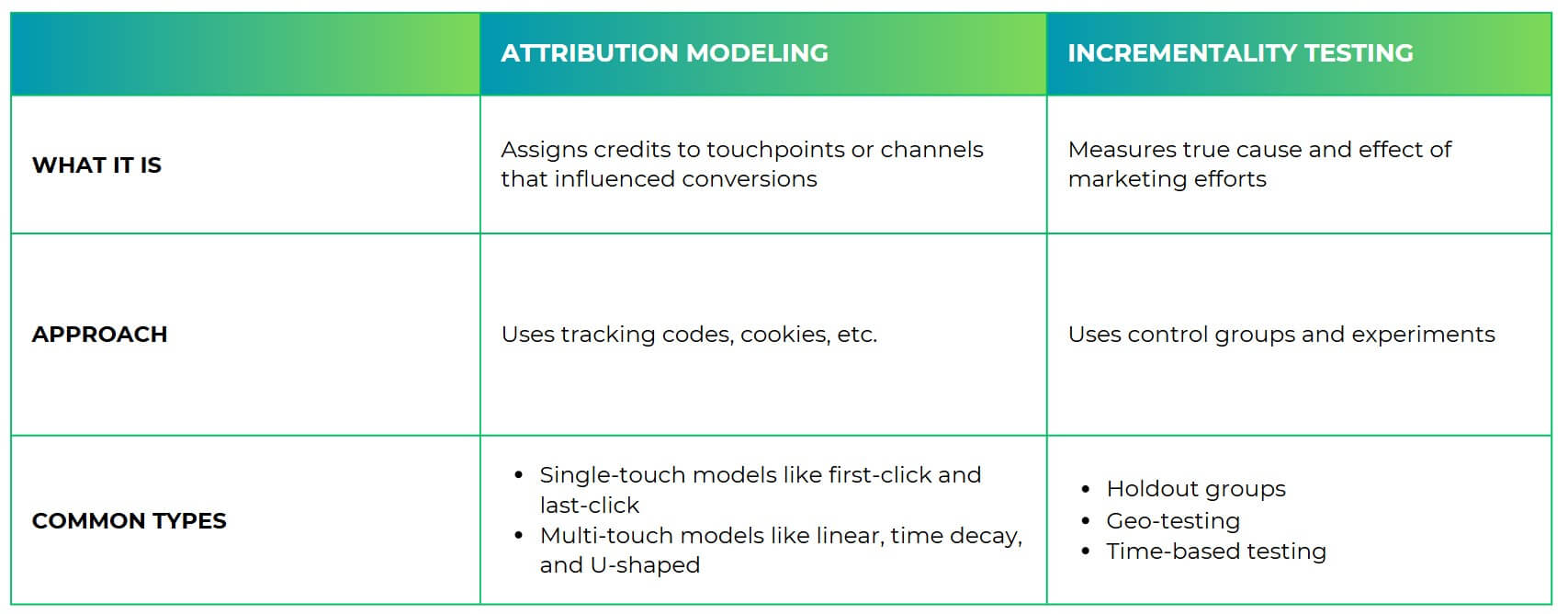
For years, marketing measurement has been dominated by attribution. Attribution models, from simple last-click to complex data-driven ones, aim to assign credit for a conversion to the various touchpoints a user interacts with. While useful, they share a fundamental flaw.
The Incrementality Imperative: A Comparative Analysis of ...
To understand this flaw, let's start with a foundational reading from Appier's analysis on measurement. This section clearly articulates why the industry is moving beyond traditional attribution.
Please read the section 'The Shift from Correlation to Causality in Marketing Measurement,' focusing on the part titled 'Beyond Attribution: The Fundamental Flaw of Correlation.' Pay close attention to the critical counterfactual question it poses: 'Would this conversion have happened anyway?'
As the article highlights, attribution is excellent at showing correlation but falls short of proving causation. Think about a branded search campaign. A last-click attribution model will credit that campaign for every sale from a user who searched your brand name and clicked the ad. But how many of those were loyal customers who were going to buy from you anyway? The attribution model can't tell you. It only sees that the ad was the last touchpoint.
This is where the concept of incrementality comes in. It doesn't ask "Who gets credit?" but rather "What happened only because of this marketing activity?"

2. A Comparative Framework: Attribution vs. Incrementality vs. MMM
To make sound strategic decisions, you need to understand the distinct roles of the three primary measurement frameworks: Attribution, Incrementality, and Marketing Mix Modeling (MMM). They are not mutually exclusive; a sophisticated marketing organization uses all three, but for different purposes.
Marketing Incrementality: The Ultimate Guide to ...
The following guide from Improvado provides an excellent, concise comparison of these three frameworks. The table in this section is a perfect reference for understanding their unique roles.
Please read the section 'Incrementality vs. Attribution vs. Marketing Mix Modeling (MMM)'. Focus on the comparative table that breaks down each framework by its core question, methodology, granularity, and primary use case.
Let's summarize the key distinctions you, as a leader, need to internalize:
-
Attribution:
- Question: Which touchpoints get credit for this conversion?
- Use Case: Understanding the customer journey, tactical intra-channel optimization (e.g., which ad creative in a Google Ads campaign is performing best).
- Limitation: Answers "what happened," not "why it happened."
-
Incrementality:
- Question: Did my marketing cause this outcome?
- Use Case: Validating the true value of a channel or campaign, justifying budget, calculating true incremental ROAS (iROAS).
- Methodology: Based on controlled experiments (test vs. control groups).
-
Marketing Mix Modeling (MMM):
- Question: How does my total marketing mix (including offline channels, seasonality, etc.) impact business outcomes?
- Use Case: High-level strategic budget allocation across broad categories (e.g., TV vs. Digital), long-term forecasting.
- Limitation: Not granular enough for tactical, campaign-level decisions.
3. How Incrementality Testing Works
The core principle of incrementality is the scientific method: comparing a test group (exposed to marketing) against a statistically identical control group (withheld from marketing). Any difference in outcomes between the two is the incremental lift.
Incrementality Testing in Digital Marketing & testing architecture
To see this in action, let's watch a short video that explains the concept using a very practical example from a Meta Ads campaign. This will make the theory of test and control groups tangible.
Please watch the video from the beginning until 3:20. Pay attention to how the audience is split, how incremental leads are calculated, and how this leads to a more accurate, 'actual CPA'.
As the video demonstrates, the platform-reported CPA of $10 was misleading. The true, incremental CPA was $16.67. This is the kind of insight that prevents you from scaling a campaign that looks efficient but is actually far less profitable than you believe.
4. Evaluating the Strategic Trade-offs
Now for the central task of this lesson: evaluating the trade-offs. As a leader, you won't always need a full-blown incrementality test. Sometimes, an attribution report is sufficient. Knowing when to use which is a key strategic skill. The choice often comes down to a trade-off between experimental rigor and operational convenience.
The Incrementality Imperative: A Comparative Analysis of ...
Let's return to the Appier analysis. The final sections provide an excellent framework for making these strategic choices.
Please read the sections 'Comparative Analysis and Strategic Framework' and 'Choosing Your Measurement Approach: A Decision Framework.' These sections directly compare the pros and cons of different methodologies and provide a guide on when to use each.
Based on this reading, here is a decision framework you can use:
1. For High-Stakes Validation & Major Budget Decisions:
- Methodology: Use Experimental approaches (Randomized Controlled Trials like Google or Meta's Conversion Lift studies, or Geo-Lift tests).
- Why: You need the most scientifically defensible, unambiguous proof of causal impact to justify multi-million dollar budgets or to decide whether to keep a major channel running.
- Trade-off: You accept the opportunity cost of a holdout group and the time it takes to get results in exchange for high confidence in the outcome.
2. For Continuous Optimization & Rapid Feedback:
- Methodology: Use Model-Based approaches or rely on Attribution metrics.
- Why: You need quick, directional feedback on day-to-day tactical changes (e.g., new ad copy, small budget shifts). The cost and time of a full experiment are not justified.
- Trade-off: You accept that the results are correlational or based on a statistical model's assumptions in exchange for speed and operational convenience.
Your role is to match the measurement methodology to the gravity of the decision at hand.
Test your understanding!
Your team manages a $5M annual budget for Meta ads. The platform consistently reports a 4x ROAS. However, the CFO is skeptical, arguing that many of these customers would have converted anyway. She asks for your recommendation on how to prove the true value of the Meta spend.
Your analytics team presents two options:
- A four-week Meta Conversion Lift study, which will require holding out 10% of the audience from seeing ads during that period.
- A subscription to a third-party analytics platform that uses causal modeling on your historical data to provide "always-on" incremental insights without disrupting campaigns.
Which option do you recommend to the CFO, and how do you explain the trade-offs?
Show answer
The most appropriate recommendation for this high-stakes situation is Option 1: The Meta Conversion Lift study.
Here’s how you would explain it to the CFO:
"I recommend we proceed with the Meta Conversion Lift study. The core of your skepticism is whether these ads are truly causing sales, which is exactly the question this experiment is designed to answer.
-
Why it's the right choice: This is a Randomized Controlled Trial—the gold standard for proving causality. By comparing a group that sees our ads to an identical group that doesn't, we will get a scientifically defensible measure of the incremental revenue directly generated by our Meta spend. This will give us a true, incremental ROAS to answer your question with high confidence.
-
Acknowledging the trade-offs: The primary trade-off is a short-term opportunity cost. For four weeks, we will not be showing ads to 10% of our audience, and we may miss some potential sales from that group. However, I believe this is a small, calculated investment to validate a $5M annual budget. The long-term strategic clarity we will gain is well worth the short-term cost.
-
Why the other option is less suitable for this question: The causal modeling platform is a valuable tool for ongoing, tactical optimization. However, when facing a foundational, high-stakes budget challenge from finance, presenting the results of a direct experiment is far more powerful and less 'black box' than the output of a third-party model. We should use the most rigorous method available to make this cornerstone decision."
Conclusion
Today we've moved beyond simply measuring efficiency to questioning the very source of our results. This is a vital step in your transition to a strategic marketing leader.
Key Takeaways:
- Attribution shows correlation; Incrementality proves causation. Platform-reported ROAS is an attribution metric and can be misleadingly high.
- Incrementality measurement uses controlled experiments (test vs. control) to isolate the true, causal lift of a marketing activity. The result is a more accurate incremental ROAS (iROAS).
- The choice between methodologies involves a strategic trade-off. Use rigorous experiments for high-stakes budget validation and rely on attribution or models for faster, day-to-day tactical optimization.
- As a leader, your job is to ask the critical question: "Is this metric showing a correlation, or have we proven causation?"
Preview of the Next Lesson:
We've now explored frameworks for assessing data quality, business efficiency (LTV/CAC), and causal impact (Incrementality). But with so many things to measure, how does a team maintain focus? In our next lesson, we will learn how to formulate a North Star Metric framework to align all team activities and measurement efforts with the single most important strategic business goal.