
Hello! Welcome to the sixth lesson in our module on self-supervised speech representation.
In our last lesson, we took a deep dive into the practical side of transfer learning. You learned how to take a pre-trained wav2vec 2.0 model and fine-tune it for automatic speech recognition (ASR) on a specific dataset. We saw compelling evidence that even with just minutes of labeled data, this approach vastly outperforms training a model from scratch.
That entire exercise was a case of transfer learning for a single task (ASR) in a single language. Today, we will broaden our perspective significantly to address the learning outcome: Explain how self-supervised speech models enable transfer learning across different languages and downstream tasks.
We will explore the true power of these models: the fact that their learned representations are not just specific to one language or one problem, but are fundamental, general-purpose features of speech. This universality is what allows a single pre-trained model to be a foundation for a huge variety of applications.
By the end of this lesson, you will understand:
- How pre-trained models facilitate cross-lingual transfer, enabling ASR and other tasks in low-resource languages.
- The strategy and benefits of multilingual pre-training, using models like XLSR as a case study.
- How the same core model can be adapted for diverse downstream tasks beyond ASR, such as speaker identification, emotion recognition, and even generative modeling.
1. The Foundation: Universal and Hierarchical Representations
The magic behind the broad applicability of self-supervised models lies in the nature of the representations they learn. During pre-training on thousands of hours of raw audio, the model isn't just memorizing sounds; it's discovering the underlying structure of speech.
This process is a form of transfer learning, where knowledge from a general, unsupervised task is transferred to specific, supervised tasks.
[PDF] Self-Supervised Speech Representation Learning: A Review
To formalize this, let's turn to a comprehensive review paper on self-supervised speech representation learning. This section explicitly connects self-supervised learning (SSL) to the broader concept of transfer learning (TL).
Read the short subsection 'Transfer Learning' found within Section II.D, 'Other related work'. It begins with 'Transfer learning (TL) is another closely related area...'. This will confirm the framing of SSL as a type of transfer learning.
A key insight is that the representations are hierarchical. As mentioned in the same review paper (LINK, Section I), the model learns features at multiple levels:
- Low-level acoustic features: Capturing information about speaker identity, prosody, emotion, background noise, and channel effects.
- Mid-level phonetic features: Representing the basic sound units of speech (phonemes).
- High-level lexical/semantic features: Encoding word-like and contextual information.
Different downstream tasks can tap into the most relevant level of this hierarchy. A speaker identification system might rely on the low-level acoustic features, while an ASR system will focus on the phonetic and lexical features. This is the core principle that enables transfer learning to so many different tasks.
2. Part 1: Transfer Learning Across Languages
One of the most impactful applications of self-supervised learning is in breaking language barriers. Supervised ASR requires thousands of hours of transcribed audio, a resource that simply doesn't exist for the vast majority of the world's languages. SSL provides a powerful solution.
2.1. From Monolingual to Multilingual
A surprising and powerful result is that a model pre-trained only on one language (like English) can still significantly boost performance on another language.
The "Self-Supervised Speech Representation Learning: A Review" paper (LINK) discusses this in Section V.D, "Robustness and transferability." It cites a study finding that representations pre-trained on English successfully enabled phone discrimination in 10 other languages. This works because many fundamental phonetic characteristics are shared across human languages. The model learns universal features of human speech, not just English speech.
2.2. Case Study: Multilingual Pre-training with XLSR
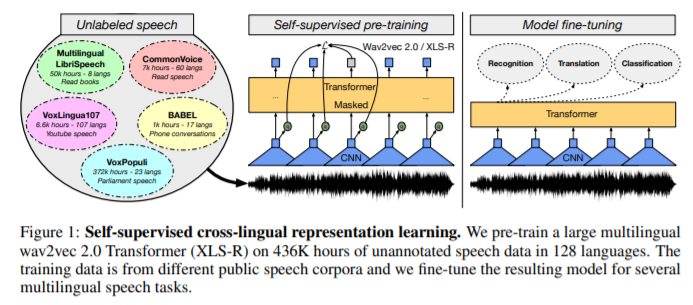
The next logical step is to pre-train a model on many languages simultaneously. This is the idea behind models like XLS-R (Cross-lingual Speech Representation), which is a version of wav2vec 2.0 pre-trained on a massive multilingual dataset.
Let's explore the details of how this works.
XLSR-53: Crosslingual Wav2vec 2.0 Model - Emergent Mind
This document from Emergent Mind provides a concise summary of the XLSR-53 model, a landmark in cross-lingual speech processing. It explains the data, methodology, and results of multilingual pre-training.
Read Sections 1-3 and 5. Pay close attention to: The sheer scale and diversity of the pre-training data (Section 2). The fine-tuning protocol for adapting the model to new languages (Section 3). The analysis of what makes cross-lingual transfer effective (Section 5), especially the point about language diversity being more important than just data quantity.
As you read, the key takeaways are:
- Shared Phonetic Space: By being exposed to over 50 languages, the model learns a more robust and generalized phonetic representation. It discovers that the phoneme /b/ in English, German, and Spanish, for example, shares common acoustic properties.
- Positive Transfer: When fine-tuning for a new language, the model can leverage what it learned from genealogically similar languages in the pre-training mix. Fine-tuning for Portuguese benefits from the model having already seen Spanish and Italian.
- Data Diversity > Data Quantity: The analysis shows that pre-training on a diverse set of languages is more effective for cross-lingual transfer than pre-training on a larger amount of data from just one or a few languages.
The results are striking. On a language identification task, XLSR-53 fine-tuned on just 10 minutes of data per language achieves 89.2% accuracy, whereas an English-only pre-trained wav2vec 2.0 model gets only 74.2% (LINK, Section 4). This demonstrates that the multilingual pre-training created far more generalizable representations.
3. Part 2: Transfer Learning Across Downstream Tasks
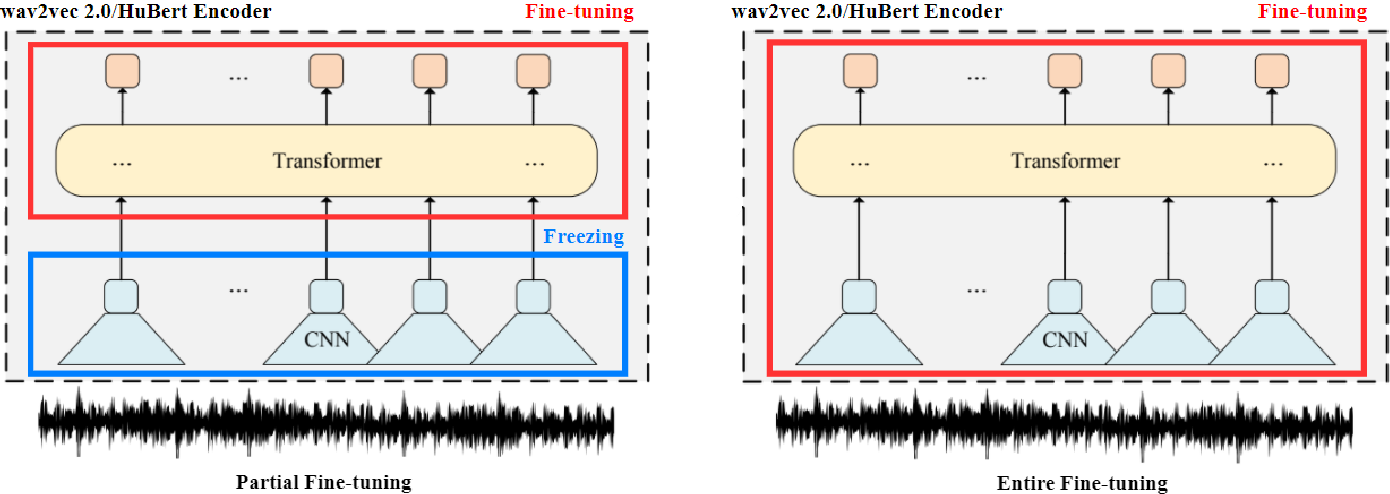
The same pre-trained encoder that is so powerful for ASR can be repurposed for a wide range of other speech tasks. The general strategy is always the same:
- Pass the audio through the frozen or partially-frozen pre-trained model to get a sequence of hidden-state representations.
- Pool these representations into a fixed-size vector (e.g., by taking the mean across the time dimension).
- Feed this vector into a small, simple classification or regression head.
- Fine-tune this new head (and optionally, the Transformer) on a small labeled dataset for the new task.
Let's explore some examples. The following video discusses the HuBERT model, but the principles of applying it to downstream tasks are identical to wav2vec 2.0.
ML4Audio - HuBERT paper discussion
In this paper discussion from Hugging Face, the presenters talk about fine-tuning HuBERT for various tasks and the quality of its learned representations, which makes it suitable for applications beyond ASR.
Watch the following two clips: 00:42:13 - 00:43:22: This part explains the general fine-tuning setup for downstream tasks like classification and regression. 01:00:55 - 01:02:44: Here, a participant shares personal findings that HuBERT's representations perform particularly well on tasks like speaker clustering and speech separation compared to wav2vec 2.0, even if their ASR performance is similar.
Here are some of the key downstream tasks enabled by these universal representations:
-
Speaker Identification (SID) / Verification (ASV):
- Task: Identifying who is speaking or verifying if two utterances are from the same person.
- How it works: This task relies on low-level acoustic features like timbre and pitch, which are richly captured in the model's representations. After pooling the representations to an utterance-level vector, a simple classifier can be trained to recognize speakers. The video highlights that some models are better at this than others, suggesting the representations capture different nuances.
-
Emotion Recognition & Sentiment Analysis:
- Task: Classifying the emotion (e.g., happy, sad, angry) or sentiment of an utterance.
- How it works: Similar to SID, this task uses prosodic information encoded in the representations. An utterance-level embedding is created and fed to a classification head.
-
Generative Tasks & "Textless NLP":
- Task: Generating novel speech in the style of a prompt, without relying on any text. This is a step towards the Audio-LLMs you are interested in.
- How it works: This is a more advanced application. Models like HuBERT (and wav2vec 2.0 with its quantization module) learn to discretize audio into a series of "acoustic units." We can then train a language model (like a GPT) not on text tokens, but on these acoustic tokens. The language model learns to predict the next acoustic unit, and a decoder can turn this sequence of units back into a waveform.
This fascinating idea is discussed in the video and the review paper.
ML4Audio - HuBERT paper discussion
Let's return to the HuBERT discussion, where they touch upon this exciting generative capability.
Watch from 01:03:02 to 01:05:10, and then the summary from 01:07:16 to 01:07:38. The speaker explains how the high-quality learned units from HuBERT pave the way for generative models and 'textless NLP'.
This ability to model language directly from audio, bypassing text entirely, opens up possibilities for languages without a writing system and for modeling the rich, non-lexical aspects of speech like hesitation, emotion, and prosody.
Conclusion
Today, we've expanded our understanding of transfer learning in speech AI, moving beyond a single task and language to see the true "universal" nature of self-supervised models.
Key Takeaways:
- Universal Representations: Self-supervised models learn hierarchical representations of speech that capture acoustic, phonetic, and lexical information, making them applicable to a wide array of problems.
- Cross-Lingual Transfer: These models can be fine-tuned for languages not seen during pre-training. This effect is amplified by multilingual pre-training (e.g., XLSR), where data diversity proves more critical than sheer quantity.
- Downstream Task Flexibility: The same pre-trained encoder serves as a powerful feature extractor for diverse tasks like speaker identification, emotion recognition, and ASR, simply by swapping out the final "head" and fine-tuning on task-specific data.
- Towards Generative Audio: The high-quality discrete representations learned by these models are a foundational component for "textless" generative spoken language models, a key area of modern audio research.
Preview of the Next Lesson:
We've established that these models learn powerful, generalizable features, and we've seen the results. But what exactly do the different layers of a model like wav2vec 2.0 learn? In the next lesson, "Explore and analyze the learned representations from a self-supervised speech model," we will delve into methods for probing and visualizing the internal states of these networks to better understand what makes them so effective.