
Welcome back. Last lesson focused on making food-test conclusions trustworthy: use a positive control, a negative control, and describe what the evidence actually shows. You used distilled water as a negative control because it contains no nutrient being tested. This lesson asks a broader question: why is water so important inside living organisms?
Water is not just “something we drink.” Its ability to dissolve many substances allows digested nutrients to move from the gut to cells, enables useful substances to travel in blood, and carries wastes out of the body. By the end, you should be able to explain each role as a clear biological chain rather than simply listing “digestion, transport and excretion.”
Water, solutes, and solutions
A solvent is a liquid that dissolves another substance. The substance being dissolved is the solute. Together, they form a solution.
For example:
- water is the solvent;
- glucose can be the solute;
- glucose dissolved in water is the solution.
In biology, “dissolved” does not mean a substance has vanished. Its particles are still present, but they are spread between water molecules and can move with the water.
Water is an effective solvent because each water molecule is polar: the oxygen end has a slight negative charge and the hydrogen ends have slight positive charges. These uneven charges attract charged particles, called ions, and many polar molecules.
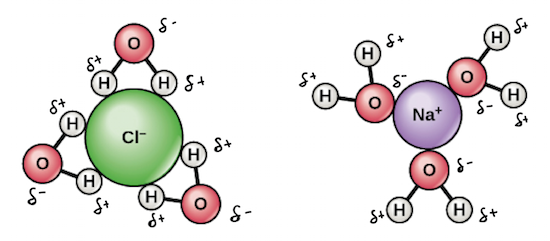
For an ion such as sodium, water molecules surround it. This separates it from other ions and allows it to move in a watery fluid such as blood plasma. Water can similarly dissolve biologically useful molecules such as glucose and amino acids.
However, not everything dissolves well in water. Lipids, or fats, are largely non-polar and insoluble in water. This is why you should not write that water dissolves all nutrients. For this learning outcome, focus on soluble substances: glucose, amino acids, mineral ions, urea, and excess salts.
Water | Cambridge (CIE) IGCSE Biology Revision Notes 2021
Read “Water” from Save My Exams for a concise exam-level overview of water as a biological solvent. It directly connects water’s solvent property to transport, digested food, and urine.
In the subsection “Water as a Solvent,” read all five bullet points, starting with the sentence beginning the definition of water as a solvent and continuing to the final bullet ending with metabolic reactions in cells. As you read, sort each example into one of three headings in your notes: digestion, transport, or excretion.
A useful distinction for precise answers:
- Water as a solvent: water dissolves substances so that they can move in a solution.
- Water in hydrolysis: water can also be used as a reactant to break large food molecules into smaller molecules during digestion.
Both roles matter in digestion, but if a question specifically asks about water as a solvent, lead with dissolving and transport of substances.
Water in digestion: from food to an absorbable solution
Digestion takes place in a watery environment. Food is mixed with saliva and digestive juices, which contain lots of water. Digestive enzymes act on food molecules in this environment.
Large molecules in food are not always able to pass through the intestinal lining. Digestion produces smaller molecules. For example:
- carbohydrates are digested into simple sugars such as glucose;
- proteins are digested into amino acids.
Many of these small products are soluble in water. Once dissolved in the liquid contents of the small intestine, they can be moved to the intestinal surface and absorbed into the body.
This is the key link:
The word absorption means the movement of digested food molecules from the alimentary canal into the blood or lymph. Water does not force every nutrient through the intestinal wall by itself; cells and membranes control absorption. But dissolving nutrients makes them available to move in the intestinal contents and then in body fluids.

The image also shows an important idea for later digestion lessons: a villus is supplied with capillaries. Once a soluble nutrient has crossed the epithelial layer, it can enter the blood and be transported around the body.
A strong digestion explanation might therefore say:
Water acts as a solvent in the small intestine by dissolving small digested food molecules, such as glucose and amino acids. This allows them to be carried in the liquid contents of the gut to the intestinal lining, where they can be absorbed into the blood.
Water in transport: why blood plasma is useful
Blood consists of cells suspended in a liquid called plasma. Plasma is mostly water. This water provides a moving medium in which many substances can be dissolved and transported.
After absorption from the small intestine:
- glucose dissolves in plasma and is transported to cells for respiration;
- amino acids dissolve in plasma and are transported to cells for growth and repair;
- mineral ions and salts can also be carried in solution;
- urea, a waste substance, dissolves in plasma so that it can be taken to the kidneys.
The water does not actively “push” these substances. The circulatory system moves blood around the body, while water keeps many substances dissolved in the plasma so they can travel with it.
Water as Blood Tranport (2016) IB Biology
Watch “Water as Blood Transport (2016) IB Biology” by Alex Lee for a short explanation of solvent vocabulary and why dissolved substances are carried in blood plasma.
Watch the vocabulary to consolidate solvent, solute, and solution. Then watch plasma transport, followed by dissolved nutrients. Focus particularly on the examples of sodium and chloride ions, glucose, and amino acids travelling in plasma. The later mention of insulin and glycogen is useful context, but the central point here is that soluble substances can travel in water-based plasma.
It is worth making one careful comparison. Oxygen is not mainly transported simply dissolved in plasma; most oxygen binds to haemoglobin in red blood cells. Likewise, fats need special transport arrangements because they do not dissolve readily in water. These exceptions actually reinforce the rule: water is an excellent transport medium for soluble substances.
A high-mark transport chain is:
Water is the main component of blood plasma. It dissolves substances such as glucose, amino acids, and mineral ions, so they can be transported in the bloodstream from one part of the body to another.
The same solvent principle occurs in plants: water carries dissolved mineral ions from roots through xylem vessels. In this course, though, the most important human example is transport in blood plasma.
Water in excretion: removing dissolved wastes
Excretion is the removal of waste products made by metabolism and substances present in excess. It is not the same as egestion, which is the removal of undigested food from the digestive system.
Water helps excretion because important wastes can dissolve in it. Two key examples are:
- urea, a nitrogen-containing waste substance;
- excess mineral salts.
These substances dissolve in the watery plasma of the blood. Blood carries them to the kidneys. The kidneys remove urea, excess salts, and some water from the blood to form urine. Urine is therefore mainly water containing dissolved wastes.
The complete pathway is:
Without enough water, less water is available to form urine. The urine becomes more concentrated because there is less water relative to the amount of dissolved urea and salts. The body can conserve water to some extent, but it still needs water as the medium for removing these substances.
An exam-ready explanation is:
Water acts as a solvent by dissolving urea and excess salts. These dissolved substances are transported in the blood to the kidneys and are removed from the body in urine.
Notice how this answer includes the substances, the transport route, and the final outcome. That is much stronger than writing only, “Water helps the kidneys.”
Turning the idea into assessment answers
For a question about water as a solvent, use this four-part structure:
- State the property: water dissolves many substances; it is a solvent.
- Name a relevant solute: glucose, amino acids, urea, or salts.
- Name the water-based medium: intestinal contents, blood plasma, or urine.
- State why it matters: absorption, transport to cells, or removal from the body.
| Context | A weak statement | A stronger biological explanation |
|---|---|---|
| Digestion | “Water helps digest food.” | “Water dissolves small digested molecules such as glucose and amino acids in the small intestine, allowing them to be absorbed.” |
| Transport | “Blood carries nutrients.” | “Water in blood plasma dissolves glucose and amino acids, allowing them to be transported to body cells.” |
| Excretion | “Water removes waste.” | “Water dissolves urea and excess salts so they can be transported to the kidneys and excreted in urine.” |
For a top-band response covering all three contexts, you could write:
Water is a solvent because it dissolves many substances. In digestion, small food molecules such as glucose and amino acids dissolve in the watery contents of the small intestine, allowing them to be absorbed. Water in blood plasma transports these dissolved nutrients to cells. It also dissolves urea and excess salts, which are carried to the kidneys and removed from the body in urine.
Key takeaways
- A solvent dissolves a solute to make a solution.
- Water’s polarity helps it dissolve ions and many polar molecules.
- In digestion, water dissolves small digested molecules so they can move to, and be absorbed through, the intestinal lining.
- Water in blood plasma transports dissolved glucose, amino acids, ions, urea, and other soluble substances.
- Water dissolves urea and excess salts, allowing them to be removed in urine.
- Do not claim that water dissolves every nutrient: fats are largely insoluble in water.
- For strong written answers, explain the whole chain: substance dissolved watery medium destination or outcome.
Next, you will build from water’s importance to learn the principal dietary sources and functions of carbohydrates, fats, proteins, vitamins, minerals, fibre, and water.
Can't find a good explanation? Sign up and we'll make it for you
Sign up