
Good to see you again. In the previous lesson, you learned the procedures and positive results for the five major food tests. This lesson takes the next step: treating those tests as an investigation rather than a colour-matching exercise.
In a written assessment, you may be given results for an unknown food sample and asked what nutrients it contains, whether the test was valid, or which controls should have been used. By the end of this lesson, you should be able to select suitable positive and negative controls, judge whether a set of results is trustworthy, and write precise conclusions about an unknown sample.
Controls: the evidence behind a food-test conclusion
A colour change in an unknown sample is only useful if you know what the test should look like when it works and when the nutrient is absent. That is why scientists use controls.
A positive control is a sample known to contain the nutrient being tested. It should produce the expected positive result.
A negative control is a sample known not to contain the nutrient being tested. For food tests, this is usually distilled or deionised water. It should produce the expected negative result.
For example, if you are using Benedict’s test:
- A glucose solution is the positive control. After heating with Benedict’s solution, it should become green, yellow, orange, or form a brick-red precipitate.
- Distilled water is the negative control. After heating with Benedict’s solution, it should remain blue.
- The unknown sample is tested in exactly the same way.
The controls give you a basis for comparing the unknown result. They also check that the reagent and method have worked correctly.
A Biology Laboratory Exercise Using Macromolecule Assays to Distinguish Four Types of Milk - PMC
Read this short example from a laboratory investigation published on PMC. It shows how known positive samples and distilled water were used before students interpreted coded, unknown “milk” samples.
In the paragraph describing the second half of the investigation, read from “Each group discusses what types of macromolecules are likely to be present in whole milk” to “students interpret their results and identify the four milk samples.” Follow the control logic: every assay includes distilled water as a negative control and a known strong positive sample before the unknowns are identified.
The key idea is:
Controls do not tell you what is in the unknown directly. They show whether the test can be trusted.
Choosing controls for each food test
A strong positive control contains the nutrient you are specifically testing for. It is better than using an ordinary food because ordinary foods often contain several nutrients.
For instance, milk is not a good positive control for protein if you want an unambiguous result, because it also contains lipid and reducing sugar. A gelatine solution is better: it is known to contain protein.
| Food test | Nutrient detected | Suitable positive control | Suitable negative control | What valid controls should show |
|---|---|---|---|---|
| Iodine | Starch | Starch solution | Distilled water | Positive becomes blue-black; negative stays orange-brown |
| Benedict’s + heat | Reducing sugar | Glucose solution | Distilled water | Positive changes through green/yellow/orange or brick-red; negative stays blue |
| Biuret | Protein | Gelatine or albumin solution | Distilled water | Positive becomes lilac/purple; negative stays blue |
| Ethanol-emulsion | Lipid | Vegetable oil | Distilled water | Positive forms a cloudy white emulsion; negative remains clear |
| DCPIP | Vitamin C | Ascorbic acid (vitamin C) solution | Distilled water | Positive decolourises blue DCPIP; negative remains blue |
The supplied Food Tests and Results infographic is useful for refreshing the four main macromolecule tests. It is not a replacement for controls: the controls must be treated with the same reagent and conditions as the unknown sample.
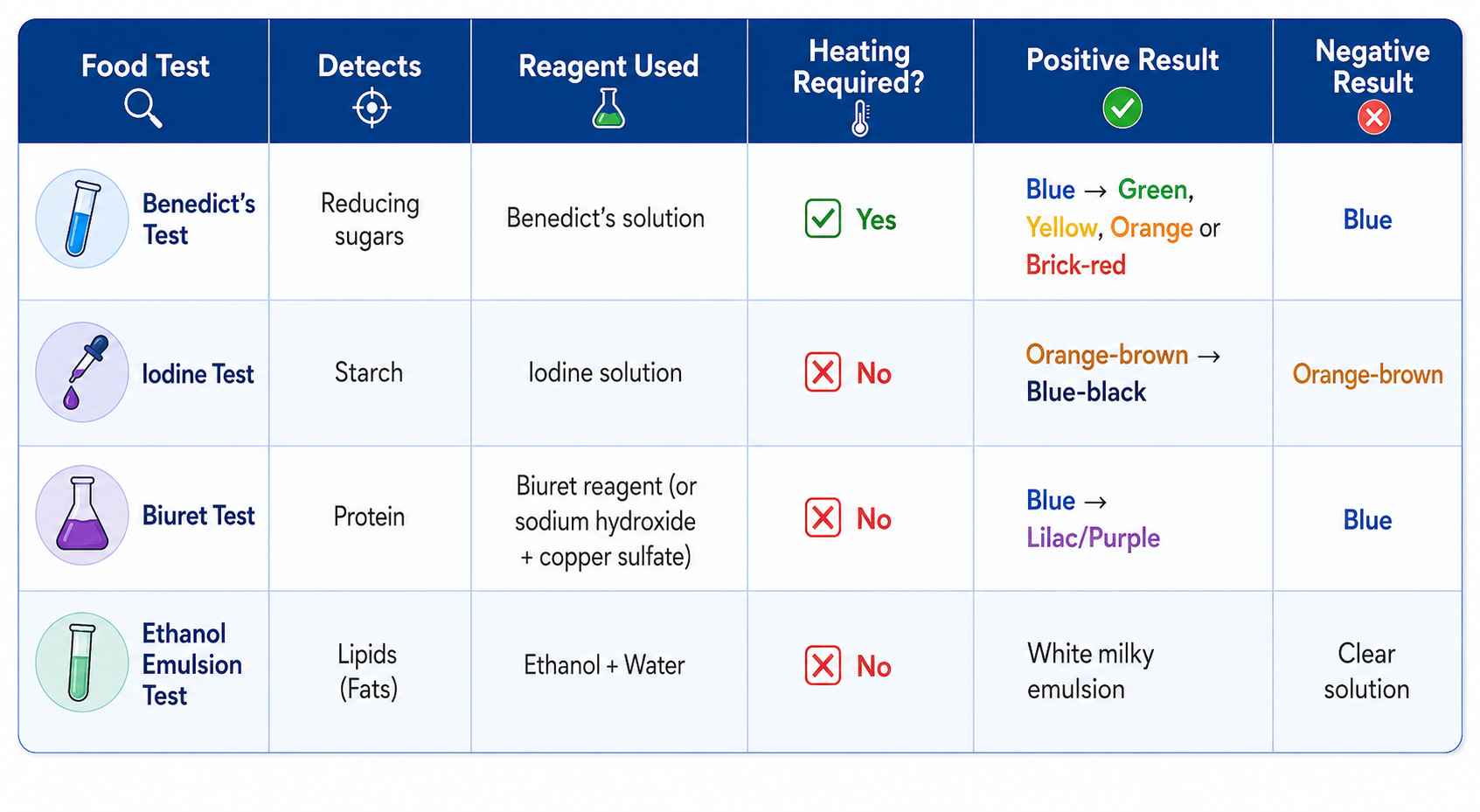
For every set of tubes, keep the following conditions the same:
- volume of sample;
- volume and concentration of reagent;
- temperature and heating time for Benedict’s test;
- order of additions;
- time allowed for a colour change;
- lighting and method of observation, where possible.
If these conditions differ, a different result might be caused by the method rather than by a difference in nutrients.
Seeing controls in practice: iodine and an unknown
The iodine test offers a simple visual example. Water provides the negative comparison: it should stay orange-brown after iodine is added. A starch solution provides the positive comparison: it should become blue-black. You can then compare the unknown directly with both.
Iodine Test for Polysaccharides 2.0
Watch “Iodine Test for Polysaccharides 2.0” by Professor Drew Collop. It demonstrates an unknown sample being tested alongside water and known reference samples, then shows how comparison supports a conclusion.
Watch the setup, focusing on how water and known carbohydrate samples are treated with the same iodine reagent as the unknowns. Then watch the expected colours for the reference samples, followed by the comparison of unknowns against controls. For this course, remember that a blue-black iodine result indicates starch; do not need to memorise the additional glycogen result shown in the video.
A valid iodine-test set might look like this:
| Tube | Sample | Observation after iodine | Interpretation |
|---|---|---|---|
| 1 | Distilled water, negative control | Orange-brown | Correct negative result |
| 2 | Starch solution, positive control | Blue-black | Correct positive result |
| 3 | Unknown food extract | Blue-black | Starch is present in the unknown |
Because both controls behaved as expected, the unknown result is credible.
What if the controls do not behave as expected?
Controls are especially important when the unknown gives a negative result. Consider the following Benedict’s-test results after heating:
| Tube | Sample | Final observation |
|---|---|---|
| 1 | Distilled water, negative control | Blue |
| 2 | Glucose solution, positive control | Blue |
| 3 | Unknown sample | Blue |
The negative control is correct: it stayed blue. But the positive control is wrong: glucose should have produced a positive colour change. Possible reasons include:
- the Benedict’s reagent was old or incorrectly prepared;
- the water bath was not hot enough;
- the tubes were not heated for long enough;
- the glucose control was incorrectly labelled or too dilute;
- an error occurred when the reagent was added.
Because the positive control failed, you cannot conclude that the unknown lacks reducing sugar. The unknown may contain sugar, but the test did not work. The correct conclusion is:
The Benedict’s test was invalid because the glucose positive control remained blue. The test should be repeated before drawing a conclusion about reducing sugar in the unknown.
Now consider the opposite situation in an iodine test:
| Tube | Sample | Observation after iodine |
|---|---|---|
| 1 | Distilled water, negative control | Blue-black |
| 2 | Starch solution, positive control | Blue-black |
| 3 | Unknown food extract | Blue-black |
The positive control looks correct, but the negative control should not turn blue-black. This suggests contamination — perhaps starch was accidentally transferred by a pipette, spotting tile, or unwashed glassware. Again, the results cannot be trusted. The investigation should be repeated using clean equipment and separate droppers.
A practical rule for assessments is:
| Control result | Meaning | Can you trust the unknown result? |
|---|---|---|
| Positive control positive; negative control negative | Test worked as intended | Usually yes |
| Positive control negative | Reagent or method may have failed | No |
| Negative control positive | Contamination or an error is likely | No |
| Both controls unexpected | Major method problem | No; repeat the test |
A reliable layout for testing an unknown
For each nutrient, use at least three labelled tubes or wells:
- Negative control — distilled water.
- Positive control — a known solution containing the nutrient.
- Unknown sample — the food extract you are trying to identify.
For Benedict’s test, for example, all three tubes should receive the same volume of Benedict’s solution and be heated together in the same water bath. For the ethanol-emulsion test, all three should receive ethanol, be shaken, then receive water.
This makes the type of sample the main difference between tubes. In an investigation, that is the comparison you are trying to make.
It is also sensible to repeat tests, especially if the result is faint or unexpected. Repeats are not the same as controls:
- A control checks whether the method works.
- A repeat checks whether a result is consistent.
Interpreting a full unknown-sample result table
When you are given several food-test results, do not jump straight to naming a food. Work methodically:
- Check that the positive and negative controls are valid.
- Record the unknown’s observation, not just a nutrient name.
- Match that observation to the relevant positive or negative result.
- State which nutrients are present or not detected.
- If asked to identify the food, compare its nutrient profile with the possible choices provided.
Here is a worked example.
Results
| Test | Positive control result | Negative control result | Unknown result |
|---|---|---|---|
| Iodine | Blue-black | Orange-brown | Blue-black |
| Benedict’s, heated | Brick-red precipitate | Blue | Orange |
| Biuret | Purple | Blue | Purple |
| Ethanol-emulsion | Milky white emulsion | Clear | Clear |
| DCPIP | Colourless | Blue | Blue |
All controls gave their expected results, so the investigation is valid.
Interpret each unknown result
| Test | Unknown observation | Conclusion |
|---|---|---|
| Iodine | Blue-black | Starch is present |
| Benedict’s | Orange after heating | Reducing sugar is present |
| Biuret | Purple | Protein is present |
| Ethanol-emulsion | Clear | Lipid was not detected |
| DCPIP | Remained blue | Vitamin C was not detected |
A high-quality overall conclusion would be:
The unknown food sample contains starch, reducing sugar, and protein. Lipid and vitamin C were not detected. The results are reliable because the positive and negative controls gave the expected results.
Notice the wording “not detected”. A negative result means that the nutrient was not detected under the conditions of that test. It is more precise than claiming with complete certainty that the nutrient is absent.
Also notice that the food tests identify a nutrient profile, not necessarily one exact food. Many foods contain a mixture of nutrients. You can identify a named food only if the question gives possible samples or other evidence to compare.
Writing conclusions that earn marks
A common weak answer is:
It has sugar.
A stronger answer gives the observation, the nutrient name, and the condition that makes the result valid:
After heating with Benedict’s solution, the unknown changed from blue to orange, indicating that reducing sugar is present. The glucose and water controls gave the expected results, so this conclusion is valid.
Use this structure:
Observation + interpretation + control-based validity statement
For a negative result:
The ethanol-water mixture remained clear, so lipid was not detected in the unknown. The vegetable-oil positive control formed a cloudy white emulsion and the water negative control remained clear, supporting the validity of the result.
This kind of answer shows both factual recall and scientific reasoning — exactly what mixed-format biology tests often assess.
Key takeaways
- A positive control contains a known amount of the nutrient and should give a positive result.
- A negative control, usually distilled water, should give a negative result.
- Controls must receive the same reagent and treatment as the unknown sample.
- If either control behaves unexpectedly, do not make a firm conclusion about the unknown; identify the problem and repeat the test.
- Interpret unknowns by recording the observation first, then linking it to the nutrient tested.
- State that a nutrient was not detected rather than automatically claiming it is completely absent.
- A full conclusion should explain whether the controls make the unknown’s result valid.
Next, you will move away from laboratory identification and look at why water is biologically essential as a solvent in digestion, transport, and excretion.
Can't find a good explanation? Sign up and we'll make it for you
Sign up