
Hello again. Last lesson established that proteins are made from amino acids and that their shape determines their function. This lesson focuses on a practical written-test skill: using chemical tests to identify nutrients in food. A food test does not tell you everything in a sample; it gives evidence for one specific type of nutrient through a characteristic colour or appearance.
By the end, you should be able to describe, in the correct order, the procedure and positive result for tests for starch, reducing sugars, protein, lipids, and vitamin C. These are common short-answer questions, so precise scientific language matters.
The five-test overview
Before memorising details, organise the tests around the substance being looked for.
| Nutrient tested | Test/reagent | Positive result |
|---|---|---|
| Starch | Iodine solution | Blue-black |
| Reducing sugar (such as glucose) | Benedict’s solution + heat | Green/yellow/orange to brick-red precipitate |
| Protein | Biuret reagent | Lilac/purple |
| Lipid (fat/oil) | Ethanol-emulsion test | Cloudy white or milky emulsion |
| Vitamin C | DCPIP | Blue dye becomes colourless |
The biggest source of errors is mixing up the tests that use blue reagents:
- Benedict’s starts blue and is heated; a positive result becomes green, yellow, orange, or brick-red.
- Biuret starts blue and is not heated; a positive result is lilac or purple.
- DCPIP is blue; vitamin C makes it colourless.
The sequence below is worth practising aloud: nutrient → reagent → method → positive observation → conclusion.
Food Tests - Iodine, Biuret, Benedict's, Ethanol, DCPIP
Watch “Food Tests - Iodine, Biuret, Benedict's, Ethanol, DCPIP” by Science Sauce for a visual walkthrough of all five procedures. Focus on what is added, whether heating is needed, and the exact positive result rather than trying to memorise every tube shown.
Watch iodine test for starch, then Biuret test for protein. Continue with Benedict's test, paying special attention to the hot-water-bath step and the range of positive colours. Finish with the lipid test and DCPIP, noting that DCPIP must become completely colourless for a positive vitamin C result.
Starting with a usable food sample
For many solid foods, the nutrient molecules first need to be brought into a liquid form so that the reagent can contact them.
A typical preparation is:
- Crush or grind the food sample using a pestle and mortar.
- Add distilled water and mix.
- Filter the mixture to produce a clearer liquid called the filtrate.
- Put separate portions of the filtrate into labelled test tubes for the different tests.
Use a separate portion of food sample for each test. For example, a sample tested with iodine should not then be used for Biuret: the first reagent may alter the colour or composition of the sample and make the next observation unreliable.
The exception is the ethanol-emulsion test. Lipids do not dissolve in water, so the sample is mixed with ethanol first, rather than prepared as an aqueous filtrate.
Wear eye protection whenever performing food tests. Benedict’s requires a hot water bath, and ethanol is flammable, so it must be kept away from naked flames.
Iodine test: starch
Starch is a carbohydrate made of many glucose units. It is common in foods such as potato, rice, bread, pasta, and cereal.
Procedure
- Place a small amount of the food sample or food filtrate in a test tube, spotting tile, or white tile.
- Add a few drops of iodine solution.
- Observe the colour.
No heating is required.
Results and conclusion
Iodine solution is initially orange-brown or yellow-brown.
- Positive result: the sample turns blue-black — starch is present.
- Negative result: it remains orange-brown — no starch has been detected.
In an assessment, avoid writing simply “it goes black.” Write “the iodine solution changes from orange-brown to blue-black, showing that starch is present.”
Benedict’s test: reducing sugars
Benedict’s test detects reducing sugars, including glucose and fructose. Be specific: a negative Benedict’s test does not prove that there are no carbohydrates or no sugars at all. It means that no reducing sugar was detected under the test conditions.
Procedure
- Place a portion of food filtrate into a test tube.
- Add Benedict’s solution. It is blue at the start.
- Mix gently.
- Place the tube in a hot water bath for several minutes. Do not heat ethanol-containing samples.
- Observe the final colour.
The water bath supplies heat safely and speeds the reaction between reducing sugar and Benedict’s reagent.
Results and conclusion
- Negative result: remains blue.
- Positive result: changes from blue to green, yellow, orange, or brick-red.
- A brick-red precipitate is the classic strong positive result. A precipitate is an insoluble solid that appears in the liquid.
The colour may indicate approximate concentration only if conditions are controlled carefully. For a standard identification question, any change through green, yellow, orange, or brick-red counts as positive.
A precise conclusion would be:
After heating with Benedict’s solution, the sample changed from blue to orange. This shows that reducing sugar is present.
Do not confuse the heated Benedict’s test with the iodine test. Benedict’s detects reducing sugars; iodine detects starch.
Biuret test: protein
The Biuret test detects peptide bonds, so it gives a positive result with proteins because proteins are long chains of amino acids joined by peptide bonds. This connects directly to the protein structure work from the previous lesson.
In some labs, the reagent is supplied as ready-made Biuret reagent. In others, the required alkaline and copper-containing solutions are added separately. Follow your school’s exact lab instructions, but the expected result is the same.
Procedure
- Put a portion of the food filtrate into a test tube.
- Add Biuret reagent.
- Mix gently.
- Observe the colour.
No heating is needed.
Results and conclusion
- Negative result: remains blue.
- Positive result: changes to lilac or purple.
A suitable written answer is:
Add Biuret reagent to the food sample and mix gently. A lilac or purple colour shows that protein is present.
Remember the contrast:
| Test | Start colour | Extra condition | Positive result |
|---|---|---|---|
| Benedict’s | Blue | Heat in water bath | Green to brick-red |
| Biuret | Blue | No heating | Lilac/purple |
Ethanol-emulsion test: lipids
Lipids include fats and oils. Unlike many sugars and proteins, lipids do not dissolve in water. This property explains both the procedure and the milky positive result.
Procedure
- Put a small amount of the food sample into a test tube.
- Add ethanol and shake thoroughly. Any lipid present dissolves in the ethanol.
- Add water, or pour the ethanol mixture into a second tube containing water.
- Observe the mixture.
Results and conclusion
- Positive result: a cloudy white, milky emulsion appears.
- Negative result: the mixture stays clear; no milky cloudiness appears.
The white cloudiness is caused by tiny droplets of lipid dispersed through the water. The lipid was first dissolved in ethanol, but it cannot remain dissolved when water is added.
A strong explanation is:
The sample is shaken with ethanol and then water is added. A cloudy white emulsion indicates that lipids are present.
A frequent error is writing that ethanol “tests for protein” or that water is added first. The correct order is always:
DCPIP test: vitamin C
Vitamin C, also called ascorbic acid, is found in many fruits and vegetables. DCPIP is a blue indicator dye. Vitamin C reduces the dye, making it lose its colour.
Procedure
- Put a fixed amount of blue DCPIP solution into a test tube.
- Add the food extract or fruit juice drop by drop.
- Swirl or mix after each addition.
- Continue until the dye becomes colourless, or until it is clear that it remains blue.
Results and conclusion
- Positive result: blue DCPIP becomes colourless — vitamin C is present.
- Negative result: the DCPIP remains blue.
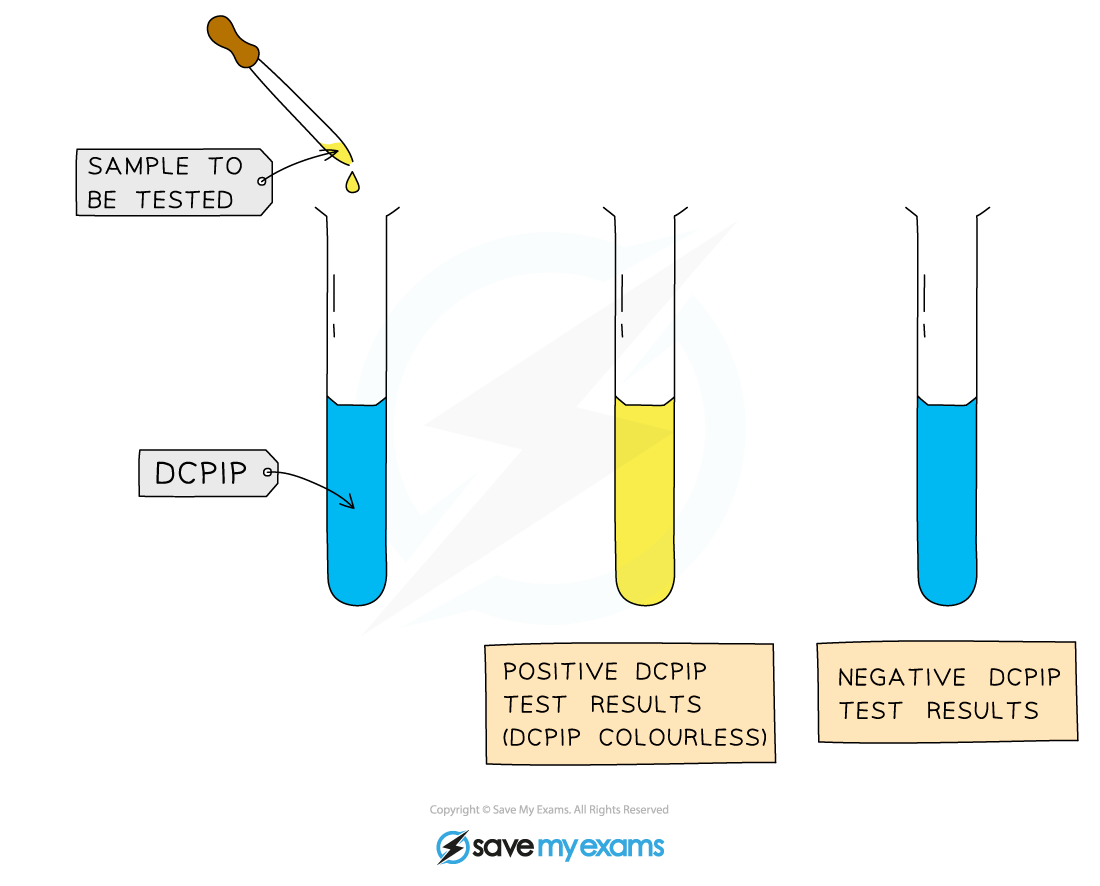
The DCPIP may briefly become pinkish when an acidic sample is added. Do not treat this as a positive result. The positive endpoint is that the dye becomes completely colourless.
For a simple qualitative test, the conclusion is only “vitamin C is present.” Later, if equal volumes and concentrations of DCPIP are used, the volume of juice needed to decolourise it can compare vitamin C concentration:
- less juice needed to make DCPIP colourless = more vitamin C in that juice;
- more juice needed = less vitamin C.
Exam-ready method statements
When a question asks you to describe a food test, include three things:
- What you add — the reagent.
- What you do — especially heating, shaking, or adding water.
- What you observe and conclude — the positive result and nutrient.
Use this checklist:
| If the question says… | Your answer must include… |
|---|---|
| “Test for starch” | Add iodine; blue-black means starch present. |
| “Test for reducing sugar” | Add Benedict’s; heat in a water bath; green/yellow/orange/brick-red means reducing sugar present. |
| “Test for protein” | Add Biuret reagent; lilac/purple means protein present. |
| “Test for lipid” | Add ethanol and shake; add water; cloudy white emulsion means lipid present. |
| “Test for vitamin C” | Add sample to blue DCPIP dropwise; colourless means vitamin C present. |
A useful 5-minute revision activity is to cover the “positive result” column in the first table, then redraw the table from memory. Next, cover the procedures and say each one aloud in full. Being able to recall the colour alone is not enough for a multi-mark practical-method question.
Key takeaways
- Iodine tests for starch: orange-brown to blue-black.
- Benedict’s tests for reducing sugars: add reagent and heat in a water bath; a green, yellow, orange, or brick-red precipitate is positive.
- Biuret tests for protein: blue to lilac/purple.
- The ethanol-emulsion test detects lipids: add ethanol and shake, then add water; a milky white emulsion is positive.
- DCPIP tests for vitamin C: blue dye becomes colourless.
- In written answers, state the reagent, key method step, observation, and conclusion.
Next, you will build on these procedures by selecting suitable positive and negative controls and using a full set of results to identify nutrients in an unknown food sample.
Can't find a good explanation? Sign up and we'll make it for you
Sign up