
Welcome back. Last lesson built the nutrient toolkit: carbohydrates provide glucose for respiration; fats are energy stores and insulators; proteins supply amino acids for growth and repair; vitamins, minerals, fibre, and water support essential processes. This lesson puts those separate facts together.
A balanced diet is not simply “eating healthy food,” and it certainly does not mean eating equal amounts of every nutrient. It is a varied diet that supplies enough energy and all essential nutrients in appropriate proportions for a particular person. You will also learn why the word particular matters: an active adolescent, a sedentary adult, and someone recovering from illness do not have identical dietary needs.
What “balanced” actually means
A balanced diet has four linked features:
- Variety — foods from different groups, because no single food supplies everything needed.
- Nutrient adequacy — sufficient carbohydrate, fat, protein, vitamins, minerals, fibre, and water.
- Appropriate proportions — more of some food types than others; fats and sugary foods should not make up most of the diet.
- Appropriate energy intake — enough food energy for the body’s needs, without a long-term excess or shortage.
The nutrient roles from the previous lesson explain why variety is necessary. For example, a diet based mainly on bread and sugary drinks may supply plenty of carbohydrate energy, but it is unlikely to provide enough iron, vitamin C, calcium, protein, or fibre. In contrast, eating only salad vegetables would provide some vitamins and fibre but may not supply sufficient energy, protein, calcium, or iron.
A useful way to organise a balanced diet is by food groups rather than trying to calculate every nutrient in every meal:
- Vegetables and fruit provide vitamins, minerals, water, and fibre.
- Grain foods, especially wholegrain choices, provide carbohydrate for respiration and fibre.
- Protein foods — legumes, nuts, seeds, fish, eggs, poultry, and meat — provide protein and may provide iron.
- Milk and milk products, or suitable calcium-fortified alternatives, can provide protein and calcium.
- Unsaturated fats from foods such as vegetable oils, nuts, seeds, and oily fish are needed in smaller amounts.
Water should be the usual drink because it supports transport, reactions, excretion, and temperature control without adding dietary energy.
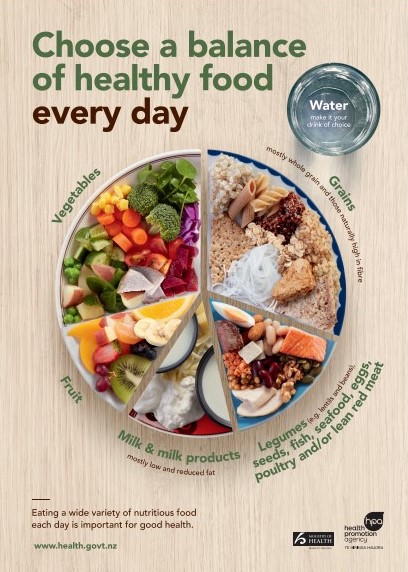
The plate is a guide, not an instruction that every meal must look identical. A balanced diet is assessed across a day or longer: breakfast, lunch, dinner, and snacks can complement one another. It can also be achieved through many cultural food patterns. For example, legumes can provide protein instead of meat, and calcium-fortified plant milks can be used instead of dairy.
Read the New Zealand guidance for a local food-group framework. Its serving numbers are designed for healthy adults, so use them to understand the principle of variety and changing requirements—not as a personal target for a Year 11 student.
Food groups and serving size – adults
Read Healthify NZ’s overview to see how a balanced eating pattern is built from food groups and adapted to different circumstances.
In the opening section, “Key points about food groups and serving size,” read the opening advice. Focus on why variety matters and the four food groups listed below it. Then move to “Food groups and recommended number of daily servings” and read the passage beginning serving needs. Notice that age, body size, activity, and pregnancy can change the amount needed.
Balanced nutrients and balanced energy are related—but not the same
Food contains chemical energy. The body releases this energy in respiration and uses it for movement, active transport, building molecules, keeping warm, and maintaining vital functions such as breathing and heartbeat.
Over a long period, the basic relationship can be represented as:
- If energy intake and energy expenditure are broadly equal over time, body mass is more likely to remain stable.
- If intake is consistently greater than expenditure, the excess energy is stored, mainly as fat, and body mass tends to increase.
- If expenditure is consistently greater than intake, stored energy is used and body mass tends to decrease.
This scale model is useful, but do not oversimplify it in an exam answer. Energy balance alone does not show whether a diet is nutritionally balanced. Someone could consume enough energy from foods high in sugar and fat while still lacking fibre, iron, calcium, or vitamins. Equally, a person’s body mass is influenced by many factors, including growth, activity, illness, body composition, and long-term energy balance.
At this level, make the distinction clear:
- A balanced diet supplies the required nutrients and suitable energy.
- Energy balance compares energy intake with energy expenditure.
Why energy requirements differ between people
Your daily energy expenditure is not just the energy used in sport or exercise. It includes energy needed to keep you alive at rest, plus energy for activity and other demands.
Basal metabolic rate (BMR) is the energy needed for basic life processes when the body is at rest: for example, breathing, heartbeat, nerve activity, maintaining body temperature, and keeping cells functioning. BMR makes up a substantial part of daily energy expenditure.
On top of BMR, the body uses energy for physical activity, growth, digestion, and—in some environments—temperature regulation.
Watch the short summary below. It connects the nutrient list from the previous lesson to the definition of a balanced diet and begins to explain why people need different amounts of food.
Nutrition and Diet - GCSE Biology (9-1)
In “Nutrition and Diet - GCSE Biology (9-1),” Mr Exham Biology explains that a balanced diet contains the nutrient categories in appropriate proportions and relates energy needs to individual circumstances.
Watch balance and needs. Listen especially for the distinction between including all nutrient groups and needing equal quantities of them. Note the examples involving body mass, adolescence, athletic training, pregnancy, and active versus office-based work.
Age and growth
Children and adolescents need energy and protein not only for ordinary body functions but also for growth and development. During adolescence, new tissues are being made, bones grow, and body composition changes. This often means a higher energy requirement than in adulthood, although the exact amount still depends strongly on body size and activity level.
Older people may require less energy if they are less active or have less muscle mass. However, a lower energy requirement does not mean vitamins, minerals, protein, fibre, and water become unimportant. In fact, nutrient-rich food can become especially important when a person needs less total food energy.
Body size and body composition
A larger body generally needs more energy to maintain and move than a smaller body. Muscle tissue uses more energy at rest than fat tissue, so two people of the same mass can have different energy requirements if their body compositions differ.
Sex can affect average energy needs because, on average, adult biological males tend to have more muscle mass than adult biological females of the same age and size. This is an average trend, not a rule for every individual. Activity level, height, mass, growth stage, and muscle mass are usually more useful biological explanations than simply writing “because they are male” or “because they are female.”
Physical activity and occupation
Physical activity is one of the clearest factors affecting energy needs. Contracting muscles require energy released by respiration. Therefore, a person who trains regularly, plays sport, cycles to school, or does physically demanding work uses more energy than someone who spends most of the day sitting.
A strong explanation uses a causal chain:
An athlete needs more energy because frequent muscle contraction increases the rate of respiration in muscle cells. Therefore, they need a greater energy intake to replace the energy used in activity.
This does not mean an active person only needs extra carbohydrate. Their overall diet still needs adequate protein for repair, water for hydration, minerals, vitamins, and fibre.
Pregnancy, breastfeeding, illness, and recovery
Pregnancy increases nutritional demands because the developing fetus needs materials for growth, while the pregnant person’s body is also changing. Breastfeeding requires energy and nutrients for milk production. These are examples where the diet must support a specific physiological process, not merely “eating for two.”
Illness, injury, and recovery may also increase energy and protein requirements because the body is repairing tissues and supporting immune responses. Some illnesses can reduce appetite or affect absorption, so dietary needs must be considered carefully rather than assumed to be the same for everyone.
For a compact exam-focused account of these personal factors, use the BBC resource.
BBC Bitesize summarises BMR and the major personal factors that change daily energy requirements.
Read from the “BMR” subsection through “Specific needs.” Begin at the BMR explanation. Make a two-column note: put each factor in the left column and write the biological reason it can increase or decrease energy demand in the right column. Treat the numerical examples as illustrative rather than universal targets.
Environmental factors: the body’s surroundings and food surroundings
The word environmental can refer to two related ideas. It is worth separating them, because it improves the precision of a written answer.
1. Physical environment can alter physiological requirements
The temperature around a person can affect energy and water needs.
In a cold environment, the body may need to release more energy to maintain a stable internal temperature. Muscles may shiver, and metabolic activity can increase. This can raise energy requirements, especially if a person is outdoors, poorly insulated, or physically exposed to cold conditions.
In a hot environment, more sweating can increase water loss. The body may therefore need more water to maintain blood volume and allow cooling by sweat evaporation. Prolonged sweating can also increase the need to replace salts. Heat does not automatically mean that a person needs dramatically more food energy; its most direct nutritional effect is often on fluid balance.
This is a precise comparison:
Cold conditions can increase energy expenditure for temperature regulation, whereas hot conditions can increase water requirements because more water is lost in sweat.
2. Social and food environments affect what diet is practical
Food availability, food cost, family income, location, cultural food practices, seasonal supply, and access to cooking facilities can all influence what someone eats. These factors do not necessarily change the body’s basic requirement for nutrients, but they can affect whether it is easy to meet those requirements.
For example:
- Limited access to fresh fruit and vegetables can make it harder to obtain vitamin C and fibre.
- A vegetarian or vegan dietary pattern requires thoughtful choices of legumes, fortified foods, nuts, seeds, grains, and other suitable sources to meet protein, iron, calcium, and vitamin needs.
- Cultural foods can absolutely form part of a balanced diet; the biological requirement is for nutrients, not for one particular cuisine.
- Budget and availability may lead a family to choose frozen, canned, dried, or seasonal foods. These can still contribute to a balanced diet.
This distinction avoids a common weak statement such as “culture changes energy needs.” Culture usually influences food choices and food access, while age, body size, activity, growth, health, and temperature more directly influence physiological requirements.
Turning the idea into an exam answer
For an “explain” question, avoid a list with no links. A reliable structure is:
- Define a balanced diet.
- Give examples of food groups or nutrients that must be included.
- Explain a factor that changes requirements using cause and effect.
- State the dietary consequence.
For instance:
A balanced diet contains a variety of foods that provide carbohydrates, fats, proteins, vitamins, minerals, fibre, and water in appropriate proportions. It provides enough carbohydrate and fat for energy, protein for growth and repair, and vitamins and minerals for normal body processes. Requirements vary between people: an active adolescent needs more energy than an inactive adult because exercise and growth increase the rate of respiration and tissue production. Environmental temperature can also affect needs, since cold conditions may increase energy expenditure for keeping warm, while hot conditions increase water loss through sweating.
Notice how this answer does not claim that every person needs the same proportions or the same number of servings. It gives a general biological principle, then applies it to a person and a condition.
A quick revision method for this outcome is to make a three-part grid in your notes:
| Category | Examples | Biological link |
|---|---|---|
| A balanced diet | Variety from food groups; all essential nutrients; suitable energy | Prevents deficiencies and supports normal function |
| Personal factors | Age, growth, size, activity, pregnancy, illness | Alter energy use or material needs |
| Environmental factors | Temperature, food availability, cost, culture | Alter thermoregulation/fluid loss or practical food choices |
Practise saying each biological link aloud in a full sentence. This turns a memorised list into an explanation suitable for written assessment.
Key takeaways
- A balanced diet provides all essential nutrients, enough water, and appropriate energy in suitable proportions; it does not mean equal amounts of each nutrient.
- Variety across vegetables and fruit, grains, protein foods, calcium-rich foods or alternatives, and healthy fats makes it more likely that all nutrient requirements are met.
- Energy balance compares intake and expenditure over time, but having stable body mass does not automatically mean a diet is nutritionally balanced.
- Personal requirements vary with age, growth, body size and composition, activity level, pregnancy or breastfeeding, illness, and recovery.
- Cold conditions may increase energy needed for temperature regulation; hot conditions can increase water needs through sweating.
- Food availability, cost, culture, and access affect how easily someone can achieve a balanced diet, even if they do not fundamentally change the body’s nutrient requirements.
Next, you will apply this nutrition knowledge to explain the causes and effects of conditions including starvation, obesity, constipation, coronary heart disease, scurvy, vitamin D deficiency, iron deficiency, kwashiorkor, and marasmus.
Can't find a good explanation? Sign up and we'll make it for you
Sign up